
https://www.yiddishbookcenter.org/collections/oral-histories/excerpts/woh-ex-0000135/celebrating-christmas-and-hanukkah-1930s

https://www.yiddishbookcenter.org/collections/oral-histories/excerpts/woh-ex-0000135/celebrating-christmas-and-hanukkah-1930s


Sign up for free today and you’ll automatically be registered for all four fall sessions, taking place once a month in September, October, November, and December.
Sarah Brown, The Chronicle’s news editor, and Rick Seltzer, author of the subscriber-only Daily Briefing newsletter, will tackle the most pressing issues in higher-ed policy, helping you stay informed and prepared for what’s ahead.
Session 1: September 25 at 1 p.m. ET / 10 a.m. PT
Session 2: October 28 at 1 p.m. ET / 10 a.m. PT
Session 3: November 20 at 1 p.m. ET / 10 a.m. PT
Session 4: December 15 at 1 p.m. ET / 10 a.m. PT
Don’t worry if you can’t attend live: Registrants will receive reminders before each session and on-demand access to the recordings afterward.
Focused on Health
Lorenzo Cohen, Ph.D., director of MD Anderson’s Integrative Medicine Program, shares what to watch for & how small changes can help protect your health.
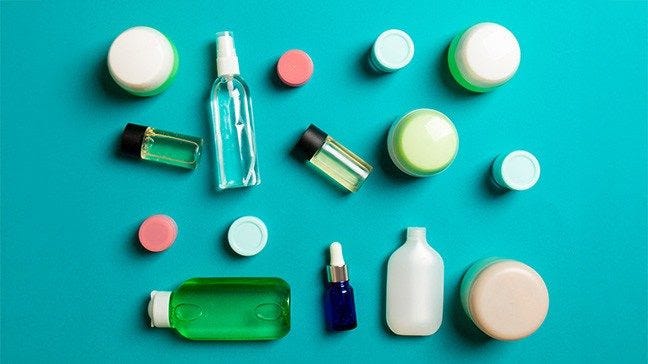
Have you washed your hands, showered, styled your hair or applied makeup today? If so, you’ve used a personal care product.
While these products can help us look and feel our best, you may have questions about their ingredients and how they can impact your health.
You’re not alone. As director of MD Anderson’s Integrative Medicine Program and a melanoma survivor myself, I spend a lot of time considering these questions and carefully selecting the products I use.
Research shows that the more you can clean up your personal environment, the lower your risk of cancer. And we believe that the less your body needs to process toxic chemicals, the healthier you will be. If you’re undergoing cancer treatment, we want your body to be focused on that, not on processing chemical exposures. That’s why I’m sharing tips to help you make informed decisions on personal care products.
Some beauty and personal care products contain endocrine disrupting ingredients that can modify how your hormonal system works.
Some byproducts of beauty services and product manufacturing are carcinogenic, such as formaldehyde gas and 1,4-Dioxane.
Governmental and educational resources can help you vet products and learn more about their ingredients.
A strong scent can be a clue that a product contains endocrine disrupting ingredients.
Personal care and beauty products often contain dozens of ingredients that help a product do its job, extend its shelf life and give it a certain texture, color or smell. But could the products you use to get clean have a dirty side?
Often, products don’t contain large amounts of a single chemical. But, because of how commonly they are found in products, you could be exposed to hundreds of them per day. The Food and Drug Administration (FDA) and the Department of Agriculture (USDA) require studies on some of these chemicals. However, researchers are still learning how these chemicals affect the body over a long period of time and in different combinations. There is limited scientific knowledge and safety data on how the ingredients in personal care products affect our bodies in the combinations in which we use them and over a lifetime.
Here are a few examples of products and processes that may have health risks.
Many hair smoothing or straightening products release a type of carcinogen called formaldehyde gas into the air when they are heated, according to the FDA.
It lists that long-term risks of formaldehyde exposure include:
Headaches
Asthma
Contact dermatitis
Possibly cancer
“The greater the exposure to products that contain formaldehyde in terms of both length of time and concentration, the higher the potential health risks,” the FDA website says.
To see if a hair straightening product contains formaldehyde or will release formaldehyde gas when used, the agency recommends scanning product labels for the following ingredients:
Formaldehyde
Formalin
Methylene glycol
Another potential carcinogen that has been found in some beauty products in “extremely small amounts” is 1,4-Dioxane. It isn’t intentionally added to products, but instead a byproduct of manufacturing some detergents, foaming agents, emulsifiers and solvents, the FDA writes.
The agency writes that the 1,4-Dioxane levels they have detected in cosmetic products have decreased over time. The FDA has proposed changes to manufacturing processes to further decrease these levels. FDA research has also shown that 1,4-Dioxane evaporates, which limits how much the skin absorbs.
To find products that may contain 1,4-Dioxane, the FDA recommends looking for the following phrases on ingredient labels:
PEG
Polyethylene
Polyethylene glycol
Polyoxyethylene
Words that include ‘-eth-’ or ‘-oxynol-’
Other personal care product ingredients are endocrine disruptors, or substances that change how the body’s hormonal system functions. Endocrine disruptors can influence estrogen, progesterone and testosterone levels.
Examples of endocrine-disrupting chemicals found in personal care products include:
Phthalates
Parabens
Benzene
Bisphenol A (BPA)
Bisphenol S (BPS)
Endocrine disruptors are problematic in cancer because many cancers are hormonally driven, including breast, ovarian and prostate cancer. We’re still learning exactly how exposure to endocrine disruptors affects our health and cancer risk.
Your personal care decisions impact more than your grooming routine. They also shape the future of the industry. Your purchases show manufacturers what you’d like to see more of and what you aren’t willing to buy. Use these tips to limit the harmful chemicals in your personal care or beauty routine.
It can be overwhelming to overhaul your personal care routine. If you’re not sure where to start, I recommend following your nose. If a product has a strong scent, that is a warning sign that it may contain an endocrine disruptor.
While scents can come from natural sources, they can also be created by a combination of toxic chemicals. So, how can you tell the difference? Check a product’s label for the word ‘fragrance.’ This single word can be a catch-all for dozens of chemicals. And, because they are often included in tiny amounts compared to the total amount of product, each chemical doesn’t need to be individually listed.
If you prefer scented products, opt for natural fragrance sources such as essential oils rather than products that only list ‘fragrance.’
Sometimes, identifying a chemical in a personal care product is as easy as flipping it over and reading its ingredients label. Look out for the endocrine disruptors listed above and make note of any other ingredients you don’t recognize. When in doubt, choose the product that has ingredients that are all recognizable to you.
Don’t skip this step just because a product is labeled as clean or free of certain ingredients. For example, many beauty products are now being made without phthalates and parabens. But even if a product is labeled as “phthalate-free” or “paraben-free,” it’s still important to read the label and make sure it doesn’t contain anything equally harmful.
Of course, looking up each ingredient in a product can be time-consuming. Instead, I recommend turning to governmental and educational resources for advice.
When you are looking for reputable information online, seek out sites that end in ‘.edu’ or ‘.org’ rather than ‘.com’ sites, which often sell products.
RELATED: How to find trustworthy cancer information online
There are even websites and apps that allow you to scan a product’s barcode to learn more about its ingredients and see how they score compared to other products. You can find these apps by searching “beauty product scanner.”
It can be tempting to think that only being exposed to small amounts of chemicals in beauty and personal care products is no big deal. And while it’s true that dose matters, avoiding harmful chemicals in any amount is ideal.
It’s important to be mindful of your exposure to chemicals at all ages, but especially during adolescence when the body is growing rapidly and cells can grow out of control. So, as we continue researching how environmental exposures affect cancer outcomes, don’t underestimate the importance of small changes to your environment.
It can help to know your ‘why.’ If you have cancer, your ‘why’ might be the desire to have all your biological resources helping to control the cancer: you want your liver to function well to process chemotherapy and targeted therapies, and your kidneys working to filter blood effectively. If your body is also processing toxic chemicals, that makes these jobs harder.
Instead, try to find alternatives. This will look different for everyone. Maybe it means choosing to wear makeup on weekends instead of every day, getting your nails done less frequently or switching to a cleaner product when you need a refill. Ultimately, the less you can expose yourself to harmful chemicals in your products, the better.


By Steve Bien-Aimé • March 20, 2019
When we die, we lose much of our say in how we want our lives, achievements, and identities framed in obituaries—that power is given to editors and journalists, who often follow industry norms.
Even though most U.S. publications have stopped using courtesy titles, exceptions are sometimes made for obituaries, where Mr., Ms., and so on are used to show respect. For example, Philly.com, the website for The Philadelphia Inquirer and Philadelphia Daily News, generally does not use honorifics; however, in a 2018 obit for legendary Philadelphia Eagles player Tommy McDonald, an honorific was used—for him and no one else. Honorifics also hold a precious place in certain cultural contexts, such as racial or regional. Using titles in the South, for example, can be a matter of respect and even racial equality.
Even though most U.S. publications have stopped using courtesy titles, exceptions are sometimes made for obituaries.
Gendered honorifics, however, can have unintended harms. For some, the discomfort arises from the inherent emphasis on one part of a person—gender—when we go through life with many identities. Language shapes how we interpret reality, so placing a gender modifier before a person’s name gives the impression that we should be viewed through gender first and that all other characteristics fall in descending importance. The resulting issue is that some people don’t want to be viewed primarily through their gender. Also, courtesy titles for men and women are unequal: Before the use of Ms., the courtesy titles Miss and Mrs. revealed a woman’s marital status when married and unmarried men shared the status-free Mr.
The courtesy titles with longevity are ones without a gender bias. Because of systemic erasure of women’s achievements, some women with a PhD have added Dr. to their Twitter handles. My Northern Kentucky University colleague Alina Campan, an associate professor in computer science, says that while Mrs. is too general for her, she would want to be called Professor in an obituary because “My career defines a lot of who I am. I act in this role, and it has become an inherent part of my personality.”
Placing a gender modifier before a person’s name gives the impression that we should be viewed through gender first.
Associated Press Stylebook editor Paula Froke noted that AP style generally recommends not to use courtesy titles. However, she said by email that “If the person was a medical doctor, we would use Dr. as the title on first reference in an obituary just as we would in any other kind of story. Same with the Rev., when relevant.” Journalism bellwether The New York Times, which still uses courtesy titles except in certain sections, permits alternate courtesy titles, said the Times’ associate managing editor for standards, Philip B. Corbett, in an email. Mx., for example, has seen increasing acceptance for those failed by gender binaries or don’t believe in gendered honorifics.
Though journalists have begun using Mx., its usage is drawing attention in different ways. After The New York Times used Mx. in 2015, it explained its decision in a column: “People inside and outside the newsroom wondered if ‘Mx.’—an unfamiliar term to many—had suddenly taken its place alongside ‘Mr.’ and ‘Ms.’ in our stylebook’s entry on courtesy titles. The short answer is no. Or not yet. Or perhaps, ask me again in a while. Things are changing fast in this area.”
The courtesy titles with longevity are ones without a gender bias.
Recognizing societal changes, the 2017 Associated Press Stylebook called for editors and journalists to modify their language: “In stories about people who identify as neither male nor female or ask not to be referred to as he/she/him/her: Use the person’s name in place of a pronoun, or otherwise reword the sentence, whenever possible. If they/them/their use is essential, explain in the text that the person prefers a gender-neutral pronoun. Be sure that the phrasing does not imply more than one person.”
Introducing new terms and meanings can be a balancing act. While the visibility of Mx. indicates progress, explaining why Mx. was used for specific people might inadvertently overemphasize an aspect that is not germane to the story, such as the person’s gender. However, providing detailed explanations might be part of necessary growing pains as it takes a conscious effort to normalize new practices. As such, some educators are bringing the knowledge into the classroom: One substitute teacher engages with students about gender diversity by introducing themself with Mx.
Mx., for example, has seen increasing acceptance for those failed by gender binaries or don’t believe in gendered honorifics.
It’s important to differentiate between someone highlighting one of their identities (such as gender) versus an outsider’s description presenting their own bias (such as that gender is the primary identity). Habitual use of gendered honorifics reinforce one identity over and over, which causes other elements of one’s life to be overlooked. Determining the salience of something so personal as identity is hard—for some it’s their job, for others it’s their family roles—especially when the subject isn’t here to clarify. Thus, it’s time to end gendered courtesy titles in obits. As linguistic conventions evolve (as they always do), we must remember our complexity as individuals and to respect one another by not overemphasizing one identity in lieu of others.
Steve Bien-Aimé is an assistant professor of journalism at Northern Kentucky University. Before receiving his doctorate from Penn State’s College of Communications, Steve worked as a copy editor at The News Journal in Delaware and The Baltimore Sun and served in a variety of functions at FOXSports.com, departing as deputy NFL editor. His research interests include race and gender portrayals in news and sports media.
ROLE of the POSITION Reporting to the Director of Special Collections and Archives, the Director provides strategic leadership and direction for the Oral History Research Center (OHRC) within the University Libraries. They are responsible for overseeing the entire program, including collecting oral histories; developing new projects; conducting research; creating question sets; identifying, interviewing, and recording […]
Our 30th year of watching Word, Excel, Outlook and PowerPoint.
20 August 2025 – Vol. 30 No.32
Read the full article • Share this on Facebook – X/Twitter – Threads – BlueSky
Just like Copilot or its parent ChatGPT, the Copilot function in Excel use for analysis but not so much for getting hard facts. Our testing of the new Copilot() feature shows that no-one should trust what AI says is true.
We’ve taken Microsoft’s example and extended them a little to show the real-world pitfalls and tricks for using Copilot() in Excel. It wasn’t hard to find factual errors in Copilot() responses, some big, small or not understandable!
Copilot has a slippery and changing concept of ‘truth’.
Carefully word the prompt and context.
Carefully check results.
Sorting has to be done as part of the Copilot prompt, but isn’t always correct.
Filtering to exclude some results, individual or as a group, can be done in the prompts
Copilot has trouble parsing first and last names with a middle initial.
Headings for Copilot() lists may or may not appear. Better to be specific.
Microsoft’s Copilot() example shows how to get a list of airports.

Source: Microsoft
Like most Microsoft carefully chosen examples, if you do a little digging the problems arise.
We add a filter by population and asked for more details “Airports in cities over half million people, show airport name and code”
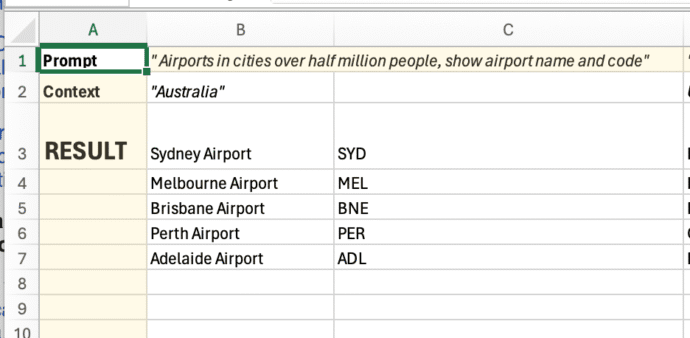
As you can see, Copilot() returns a dynamic (spill) array which can include multiple columns.
However, there are problems:
Gold Coast/Tweed Heads has a population of over 700k and it’s airport should be on the list.
Canberra and Newcastle have populations just over 500k and should have been included.
The proper name is “Sydney Kingsford Smith Airport”. Changing the prompt to ask for “full airport name” gives a more accurate result.
Just one example of how careful wording of AI prompts is important.
Which only confirms what we’ve said about AI for some time:
Always check the facts and be careful about the wording of prompts.
Just another factual error we found in our testing. Asking for ” Airports in cities over half million people, show airport name and code” for the UK might seem correct but it’s not.
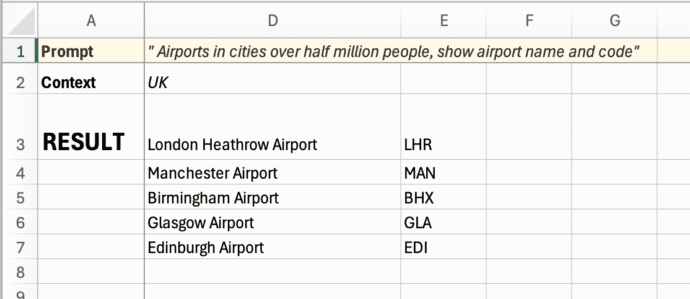
London has 5 or 6 airports (it depends). However, you define “London airports”, it should at least include Gatwick (LGW) and London City (LCY). Luton, Stansted and especially Southend are also called “London airports” with a certain generosity of spirit <g>.
Copilot makes the same mistake with New York, only listing JFK and not La Guardia (LGA).
But change the prompt to ask for distance from a location and suddenly Gatwick airport appears! LCY, which is even closer to Greenwich, is still missing.
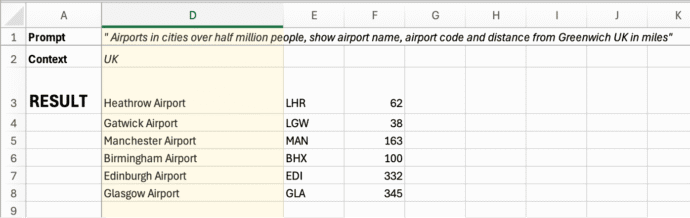
This isn’t pedantic nit-picking, it’s examples of a common problem with the current AI systems. We rarely get a ‘factual’ result from Copilot or ChatGPT that doesn’t need some changes.