
Forwarded this email? Subscribe here for more

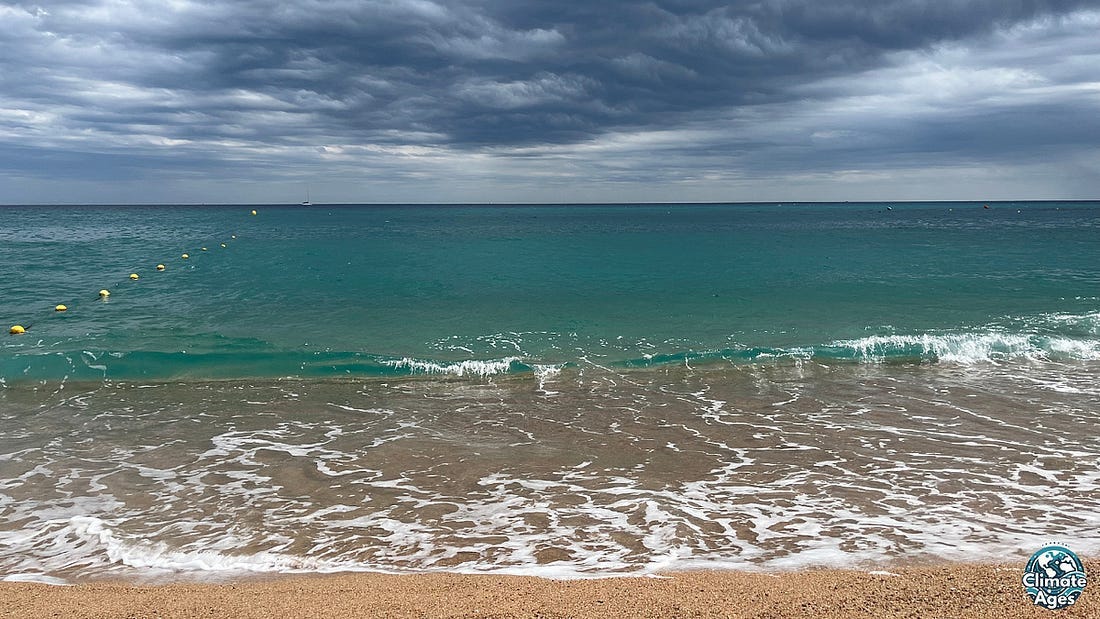
I’m so excited that I’m writing today’s newsletter from my beloved hometown on the Mediterranean coast north of Barcelona.
I truly needed this break, and I’m enjoying every second I spend with my family… even waking up earlier than anyone to still send you these newsletters that are so important to me.
Climate Ages is a reader-supported publication. To receive new posts and support my work, consider becoming a free or paid subscriber.
Here we go, much love from the place that saw me grow up into my nerdy self!
There was a time when I believed research spoke for itself.
If the science was rigorous, if the paper was peer-reviewed, then surely someone outside the academic circles, somewhere, would recognize its value.
It wasn’t until I started framing my work through the lens of why it mattered that everything changed.
That’s when:
More people cared.
Funders listened.
Collaborators reached out.
And I finally felt aligned with the reason I became a scientist in the first place.
Let’s talk about how this works and how you can apply it to your own work.
Why framing matters more than you think
Imagine you’re working on soil microbe interactions. Important stuff. But say your abstract starts with:
“Species-specific microbial consortia mediate nitrogen flux under fluctuating precipitation scenarios.”
Now imagine you reframe it like this:
“Farmers around the world are struggling to grow food in increasingly unpredictable weather. Our team discovered how the right microbes can help soil hold onto nutrients during droughts, boosting resilience for crops and communities.”
The science didn’t change.
The framing did.
You went from “technical niche” to “climate resilience and food security.”
That’s not spin. That’s storytelling rooted in purpose.
The 3-Part Shift: From Research → Relevance → Resonance
Here’s the simple framework I use with Climate Ages stories and with my students:
-
What is the research?
State it clearly, without jargon. -
Why does it matter to someone specific?
Who benefits? What changes? What’s at stake? -
How can you tell that story in human language?
Use real-world comparisons. Ground it in emotions, not just data.
Example:
“We studied fossil reef isotopes to understand abrupt extinction events.”
“Ancient reefs reveal how fast oceans can change. Understanding past collapses can help protect coral reefs today.”
Real talk: This is also how you unlock funding
Funders don’t fund ideas. They fund outcomes.
If your grant proposal sounds like a technical exercise, it may get lost in the pile. But if you can clearly show:
What’s at stake
Who it helps
Why it matters now
…you’re speaking their language.
That’s how you go from “another proposal” to “an urgent opportunity to fund.”
Try this exercise today
Pick a project you’ve worked on recently. Now rewrite it using this template:
-
Problem: What issue does your research help solve?
-
Action: What did you do or discover?
-
Impact: Why does it matter in the real world?
Here’s another example:
Before:
“We assessed groundwater salinization trends in peri-urban aquifers under increased anthropogenic stressors.”
After:
“Millions rely on groundwater to drink, farm, and live. Our study shows how urban sprawl is quietly salting our water, and what can be done to protect it.”
Which one do you think a journalist, funder, or policymaker is more likely to engage with?
Exactly.
Science with purpose isn’t fluff. It’s strategy.
When you frame your research through the lens of purpose:
You clarify your message.
You build trust with non-scientists.
You create ripple effects beyond citations.
This is what we do at Climate Ages’ Outreach Lab every day:
help scientists like you connect the dots between curiosity, credibility, and change.
Because the world doesn’t need more research papers that never get translated to a lay audience.
It needs more scientists brave enough to say:
“This matters. And here’s why.”
Your turn: Today’s exercise
Pick one of your current or past projects.
Rewrite it using the Problem → Action → Impact method.
Then post it on LinkedIn, share it in your newsletter, or pitch it to a journalist.
Or just send it to me: I’d love to see how you reframe your science through purpose.
Bridge your Science with the World
It’s ready to listen.
—
See you next week,
— Sílvia Pienda-Munoz, PhD — Climate Ages’ Outreach Lab
P.S. One last note: I’m opening the first Outreach Lab cohort in mid-September.
It’s a program designed to help you build a profitable and scalable Science Newslettter that attracts collaborations, brings funding, and increases your impact as a scientist.
If that sounds like something you’d like to be part of, you can join the waitlist here.
There will be only 20 spots in the first cohort, and spots will fill quickly.