
The Texas Historical Society posts “Texas Day by Day”, with a short post about something that happened on that particular date, sometime in Texas History. On June 20, they posted:
Texas senator delivers speech against martial law
June 20th, 1870
On this day in 1870, Texas senator Marmion Bowers delivered a speech opposing Governor Edmund Davis’s newly legislated right to declare martial law. Bowers was born in Indiana in 1829 and moved to Texas in 1853. By November 1856, he was practicing law in Austin, where he was at one time in partnership with Alexander Stuart Walker. He served in the Confederate army during the Civil War until he was elected to the Tenth Texas Legislature (1863-64). In 1869 he was elected to the Texas Senate, where he served until his death. There he opposed Republican attempts to restore order to the state through the use of force. Governor Davis’s declarations of martial law and his use of the militia and state police in Madison, Hill, Walker, Limestone, and Freestone counties were some of the most controversial Reconstruction-era measures. Bowers died in Austin in 1872.
YOU GO, MARMION! Right? Especially in 2025, when martial law is on everybody’s mind—this guy stood up to it!
Well, not so fast.
According to the another article by Texas Historical Society:
In 1870 anarchy prevailed across much of Texas despite years of military occupation. The Radical Republican-dominated Twelfth Legislature approved sweeping anticrime measures proposed by Governor Edmund J. Davis.
Crucial components, such as the State Police and state militia, brought criticism to Davis and his supporters. These instruments of order also brought the administration into conflict with localities even as Davis tried to protect key political constituencies and solicit the support of those who viewed him with suspicion.
A major challenge to Davis’s authority followed the murder of Walker County freedman Sam Jenkins in December 1870. Jenkins had testified against several whites in a case of assault, and his corpse appeared along a road outside Huntsville several days later. An investigation by State Police Capt. Leander H. McNelly led to the arrest of four whites: Nathaniel Outlaw, Joseph Wright, Fred Parks, and John McParrish. With tensions high, state district judge J. R. Burnett acquitted Parks, finding the others guilty on January 11, 1871. Before the men could be escorted to jail, gunfire broke out in the courtroom, and both Wright and McParrish escaped with the aid of Huntsville citizens. Outlaw failed to escape and was taken into custody by the State Police.
The East Texas Historical Journal offers another article “Defying Davis: The Walker County Rebellion, 1871 Ricky F. Dobbs.”
He has a startling assessment:
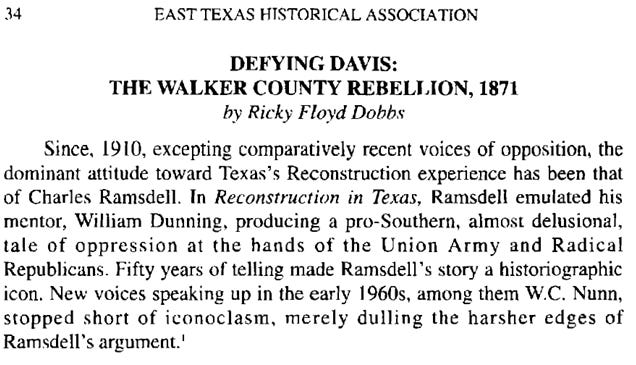
It seems that by compartmentalizing nuggets of history, the Texas Historical Society avoids angering deep red Republican Texas, and presents a pretty skewed perspective on Texas history. Someone famous once said something to the effect that “Those who don’t learn history are doomed to repeat it.” Charles Santayana actually said “Those who cannot remember the past are condemned to repeating it.”
It certainly seems like we repeat history no matter what we know about it. We re-elected Donald Trump. World War I was followed by Word War II a mere 20 years later.
But obscuring history is not just.
Here’s a quote from Wikipedia about William Dunning and his view of the Reconstruction Era in Texas:
Historian Eric Foner, a leading specialist in the Reconstruction Era, said of the Dunning School academics:
The traditional or Dunning School of Reconstruction was not just an interpretation of history. It was part of the edifice of the Jim Crow System. It was an explanation for and justification of taking the right to vote away from black people on the grounds that they completely abused it during Reconstruction. It was a justification for the white South resisting outside efforts in changing race relations because of the worry of having another Reconstruction. All of the alleged horrors of Reconstruction helped to freeze the minds of the white South in resistance to any change whatsoever. And it was only after the Civil Rights revolution swept away the racist underpinnings of that old view—i.e., that black people are incapable of taking part in American democracy—that you could get a new view of Reconstruction widely accepted. For a long time it was an intellectual straitjacket for much of the white South, and historians have a lot to answer for in helping to propagate a racist system in this country.[2]