The Ruhr Pocket campaign of April 1945 ended Germany’s hopes—and established the US Army.
Think of World War II as a tale of two armies. The German Wehrmacht dominated the fighting early, but had gone downhill ever since. By 1945, losses were soaring, replacements weren’t keeping up, and much of the German army consisted of Volkssturm (People’s Assault) units, old men and boys from the Reich with sketchy training and equipment. German weapons—Tiger tanks and ME-262 jet aircraft—might be quite advanced, but the men at the front rarely saw enough of them to make a difference. Field Marshal Albert Kesselring, German supreme commander in the west, once complained that leading German armies this late in the war was like “playing a Beethoven sonata on an old, rickety, out of tune piano.”
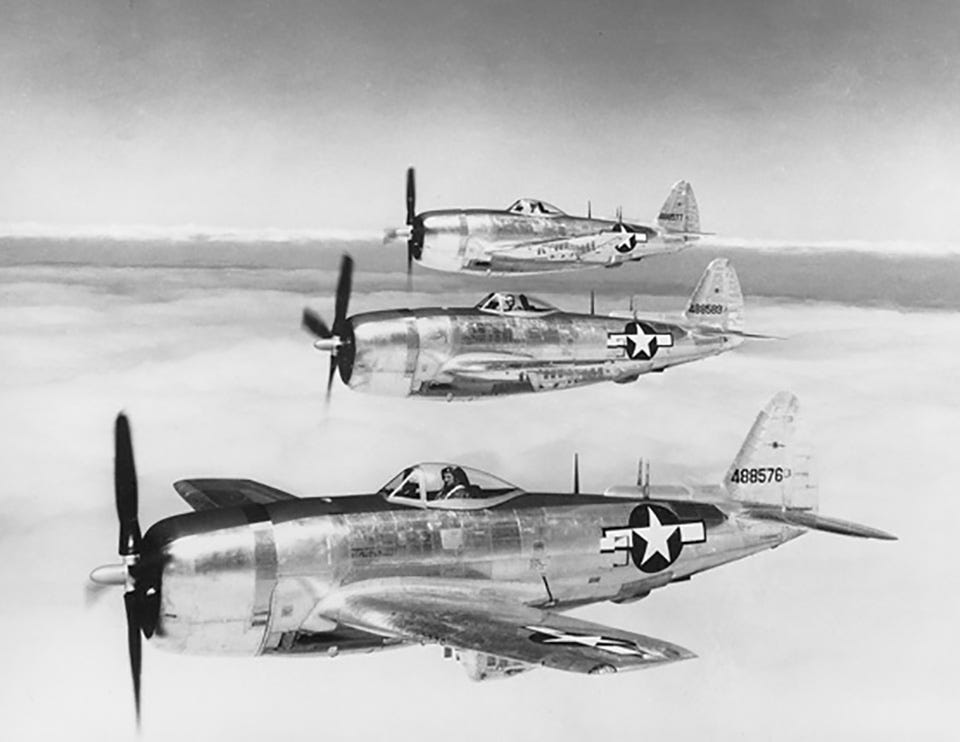
The US Army joined the war late and stumbled in its debuts in North Africa and Italy. By 1945, however, the Americans were as seasoned and professional as anyone in the field. Their material support—weapons, fuel, ammunition, food—was lavish. US officials liked to brag that the G.I. was “the best-paid and best-fed soldier” of all time. Bristling with modern equipment and vehicles—tanks, halftracks, self-propelled artillery—the US Army was both mobile and lethal. If an American unit found a seam in enemy defenses, it could slash through like lightning, and once in contact, could hurl more brute firepower than any force in history. The amount of artillery the Americans rained down on their enemies never ceased to shock the Germans, whose own artillery had to be more selective about what they obliterated. Finally, US commanders had waves of fighters and fighter-bombers like the P-47 Thunderbolt or P-51 Mustang that made it nearly impossible for the Germans to move in daylight. By 1945, the US Army may have been the most effective ground force in history.
The Sturdy Republic P-47 Thunderbolt. Courtesy of the United States Air Force.
In 1945, all these advantages came together in the greatest American victory of World War II. The battle of the Ruhr Pocket has never won the attention it deserves, but it was something rare in military history. World War II was messy and unpredictable, and plans rarely worked out the way the generals conceived them. In the Ruhr, however, the US Army lived the dream: establishing full-spectrum dominance to win decisive victory at minimal cost.
The western allies were a bit slow off the mark in 1945. The supreme commander, General Dwight D. Eisenhower, had a huge force under his command, five million men in three army groups: 21st in the north, consisting of British, Canadian, and US forces under Field Marshal Bernard Law Montgomery; the all-American 12th in the center under General Omar Bradley; and the 6th in the south, consisting of US and French forces under General Jacob L. Devers.
January saw the Allies still trying to shake off the aftereffects of the great German offensive in the Ardennes Forest, the battle of the Bulge. Even after they righted themselves and resumed the advance, the going was slow, with a month of gritty fighting needed to clear the densely populated Rhineland and close up to the great river itself. Allied armies were still 300 miles from Berlin, however, and final victory seemed a long way off.
The Rhine was a serious obstacle. River-crossing operations are highly complex by nature, requiring careful planning, tight cooperation between infantry, engineers, and artillery, and time to prepare. But in one of the war’s most dramatic moments, the looming barrier suddenly vanished. As General John W. Leonard’s 9th Armored Division (part of General Courtney Hodges’s 1st Army) approached the Rhine at Remagen on March 7, the Americans were astonished to see that the Ludendorff Bridge over the river was still standing. American tanks rushed it just as the Germans set off explosives. The bridge lifted off its foundations, then settled back down again—intact. Suddenly and incredibly, the Allies were over the Rhine. “Hot dog, Courtney!” Bradley responded when Hodges told him the news “This will bust him wide open.” Within the hour, Hodges was pushing every man and vehicle he could across the bridge, forming a powerful bridgehead on the eastern bank of the Rhine.
General Courtney Hodges commanded the US First Army during World War II. Courtesy of the US Army Center for Military History.
Despite the lucky break at Remagen, getting over the Rhine was only a means to an end. With Germany on the ropes and many Allied soldiers counting the days till they went home, the key now was to smash the Wehrmacht and bring this dread conflict to a close as soon as possible. It was easier said than done. Blocking the American path was a pair of German armies comprising Army Group B, 400,000 men, with 5th Panzer Army on the right and 15th Army on the left. The 5th Panzer was defending the Ruhr, one of the Reich’s last remaining heavy industrial centers, home to the massive Krupp Steel Works at Essen, while 15th Army stood watch against the US bridgehead at Remagen. Army Group B’s commander, Field Marshal Walter Model, was one of the most determined fighters left in Adolf Hitler’s stable, a bitter-ender and a defensive specialist of great skill. The “Führer’s fireman,” his men called him, always thrown in where the fighting was hottest and the situation most dire.
German Field Marshal Walter Model. Courtesy of the National Digital Archives in Poland.
If the Americans wanted to go home, they had no choice but to go through Army Group B. For all the troubles the Germans had by this point in the war, those two armies were still strong enough to cause trouble—and mass casualties—to any attacker foolish enough to launch a frontal assault. Seizing the Ruhr and striking a blow at German heavy industry had been part of the Allied operational plan even before D-Day. But fighting through the Ruhr, with all its cities, factories, and millions of civilians, had real bloodbath potential, and could easily turn into a super-Stalingrad, an urban battle on an unimaginable scale.
For that very reason, Eisenhower’s plan had always been to encircle German forces in the Ruhr, not blast through them frontally. Often maligned as a dull “broad front” strategist—keeping all his armies moving forward in lockstep—Ike could spot a battlefield opening as well as any general in the war. And with the lucky break at Remagen, he saw a big one.
His operational plan called for a classic pincer maneuver by two armies. Hodges’s 1st Army would break out of the Remagen bridgehead and drive east. Meanwhile, 90 miles to the north, US 9th Army under General Walter H. Simpson would cross the Rhine at Wesel as part of Montgomery’s multi-army crossing operation named Operation Plunder. Once over the river, the 9th, too, would motor east. Boiled down to essentials, the Americans would have one army on the Ruhr’s northern flank, and another on its southern. At this point, both armies would wheel inward, turn towards one another, and link up behind Army Group B, encircling and destroying it. The plan was risky, since the two US armies would be out of contact with one another as they came forward. It relied on surprise, speed, and the immobility of German forces due to fuel shortages and Allied air attack. Speed was essential. If Model recognized the threat and could deploy reserves to meet it—the very technique he had mastered in Russia in 1943-44—he could make a great deal of trouble for Hodges and Simpson.
The plan was a risk, but a calculated one. Allied intelligence had drawn a detailed and accurate portrait of the German defenders. In the south, Hodges would target German LXVII Corps, holding the left (southern) flank of the 15th Army. Having been through hard fighting in the Rhineland, the corps was understrength, undersupplied, and had largely ceased reconnaissance patrolling, a sure sign that German élan was ebbing. In the north, however, 9th Army was certain to move more slowly. Simpson’s forces were not yet over the Rhine, crossing the river required care, and Montgomery was a cautious commander who liked to line things up and take his time. Moreover, the terrain east of Wesel was marshy and wooded, and reconnaissance flights had just identified a German Panzer division, the 116th, in reserve in this sector. Indeed, Montgomery had already decided to expand his crossing operation to include a two-division airborne drop, Operation Varsity, to disrupt the defenses and keep German reserves from getting to the front.
Montgomery launched Operation Plunder (now Plunder-Varsity) on March 23, kicking things off with a massive four-hour, 4,000-gun artillery barrage and followed by airborne drops by British 6th and US 17th Airborne Divisions. Although the parachute troops took heavy casualties, the crossing forces got over the Rhine against weak resistance and formed a bridgehead on the far bank. Simpson’s US 9th Army now prepared for a breakout offensive to the east, with 8th Armored and 2nd Armored Divisions probing for weak spots in the German line. As predicted, the going was slow, and 9th Army took a full week to chew through the Germans and the terrain, aided every step of the way by heavy US artillery fire and non-stop attacks by tactical air power. Not until March 29th did Simpson break through into the clear, heading east.
American Glider Troops during Operation Varsity . Courtesy of Bibliomation.
While 9th Army slogged forward, 1st Army at Remagen put on one of the greatest American shows of the war. Hodges had three heavy corps arrayed abreast, from north to south the VII under General J. Lawton (“Lightning Joe”) Collins, the III (General James Van Fleet), and V (General Clarence R. Huebner), all crowded into a 35-mile strip on the east bank of the Rhine. All three corps bulged with manpower and equipment and, as always, firepower support was extravagant. The attack opened before dawn on March 25th and simply vaporized the German defenders. Even the weather cooperated, offering a crystal clear day that allowed XIX Tactical Air Command to roam the skies and swoop down at will on the hapless Germans below.
By noon, all three US corps had made a clean breakthrough out of the Remagen bridgehead, advancing twelve miles the first day and twenty on the second. The pace was frenetic and US infantry often hitched a ride on the nearest Sherman tank to keep up, rather than wait for their trucks. Already, US columns were taking the surrender of thousands of Germans, 17,000 by III Corps on March 26th alone. A few German units attempted to launch counterattacks, but US momentum smothered them before they got started, and most G.I.s probably never even noticed them.
Onward came the Americans, reaching Giessen and Marburg on day four, March 28th. With 1st Army already 80 miles from the start line, the time had come to make its great wheel to the north, cutting across the rear of Army Group B, linking up with 9th Army, and encircling the entire German force in the Ruhr. The commander of 3rd Armored Division, General Maurice Rose, assembled a task force under LTC Walter B. Richardson and gave a simple order, “Just go like hell.” Richardson’s objective was Paderborn, 60 miles due north.
The ride of Task Force Richardson was an epic in miniature. Slashing north, firing on the run, and cutting across columns of German stragglers, Richardson rode his column hard. He eluded roadblocks when he could and blasted through others, making 45 miles in one day. But when the task force reached Brilon, 15 miles south of Paderborn, the column halted while Richardson’s exhausted force did a thorough reconnaissance of a champagne warehouse.
Next morning, his groggy tank crews finally met actual German resistance, an ad hoc battalion thrown together by cadets from an SS Training Center, supported by sixty Tiger and Panther tanks. A tough scrap ensued over the next two days, and, when General Rose came up to supervise the fight on March 30th, he was killed when his personal reconnaissance column—two jeeps, a motorcycle, and an armored car—had the bad luck to bump into German Tiger tanks from the 507th Battalion. Nevertheless, US forces kept coming up, sidestepping SS defenses at Paderborn and heading west toward Lippstadt. As always by this point of the war, the Germans could not keep up with American speed.
At Lippstadt, the lead elements of the two US armies—the 9th coming over from Wesel and the 1st coming up from Remagen—made contact. It was April 1, Easter Sunday, just after noon. The pincers snapped shut, and the US Army had its greatest encirclement of the war. Model’s Army Group B—5th Panzer and 15th Armies, seven corps, and 19 divisions, with all their support troops and headquarters—was surrounded, trapped in an egg-shaped pocket 30 by 75 miles in diameter. Enclosed in the ring were no fewer than 26 generals and even an admiral, Werner Scheer, commander of Defense District I in Essen.
While the Americans maneuvered, Model and the Germans barely moved. Since 1945, historians have drawn up a litany of reasons why. Half-strength divisions, low fuel, Allied command of the air, morale collapse among the rank and file, and of course, the refusal of the Führer, Adolf Hitler, to countenance even the smallest tactical retreat: Model was caught in a perfect storm of military disaster.
But one other fact deserves mention: the blistering tempo of the American rush had forced German headquarters on all levels to flee their posts or dive for cover. By the second day, Model had lost contact with the commander of his 15th Army, General Gustav-Adolf von Zangen, whom he presumed captured or killed. Zangen was neither, but was equally unable to raise Model by radio. Model appointed another commander and ordered him to launch a counterattack with units from 15th Army, at the precise moment that Zangen was trying to form his stragglers into a new defensive position to the east. No wonder so many German soldiers were confused. Inside the pocket, Model himself first wanted to fight on, then gradually came to see the hopelessness of the situation. From outside, the High Command in Berlin demanded that Model stay put and defend “Fortress Ruhr.” Hitler promised to send a newly formed army, the 12th, to relieve the Ruhr, and hinted that new “wonder weapons” were on the way that would turn the tide of battle—but it was soon clear to Model that neither 12th Army nor miracle weapons were going to show up anytime soon.
During Easter Week, the Americans solidified the ring around Army Group B, placing four corps around the perimeter. All four immediately launched concentric drives against the outmanned and unsupplied enemy, herding the Germans into a smaller and smaller space, packing them together, and making them an even more lucrative target for US firepower. By April 11th, the pocket was half as large as it had been on the 1st; by the 14th, US attacks toward the town of Hagen had sliced the pocket in half. Here and there, German troops were already surrendering, often under the urging of the local civilian population.
The locals soon learned that any sign of resistance—German sniper fire, an infantry skirmish, or a random mortar round—seemed to madden the “Amis.” The result was almost always the same: a hailstorm of US fire that flattened the town and killed German soldiers and civilians alike. Artillery units attached to US XVI Corps on the northwestern edge of the pocket, for example, fired no fewer than 259,000 rounds in fourteen days. Assuming that the other three corps kept pace, American guns may well have fired one million shells during the two-week battle.
To the people of the Ruhr, the Americans seemed to arrive out of the blue. The good burghers of Gesseln, near Paderborn, were attending a delayed Easter Mass on Tuesday, April 3 when they heard the clanking and roaring of engines in the streets of their little village. “Herr Vicar, they are here,” a woman whispered to the priest, at the very moment that a 76 mm. cannon from an American Sherman tank poked through the church door, trained directly at the altar. US soldiers defused the situation by entering the church, kneeling, and praying the Mass with the parishioners.
Things didn’t always end so happily. The battle wrought enormous physical destruction. Factories closed and production ceased, as did the distribution of food and goods to the region’s cities and suburbs. Electricity, water, and sewage all broke down in this densely populated area—a recipe for disease if the battle dragged on. The Ruhr’s prosperous middle classes rushed to their local banks to pull out their Reichmarks, a currency that would soon be all but worthless. Meanwhile, bands of Russian and Polish forced laborers from the Nazi slave empire roamed the countryside, pillaging what they could.
When to run up the white flag and surrender to the Americans became a crucial question for German civilians. Doing so too early meant falling afoul of the Nazi authorities who were demanding a fight to the finish; doing so too late could mean a violent introduction to the American way of war. All too often, the local Nazi bigwig called upon his townsmen to fight to the death, then fled just before the Americans attacked.
On April 14, with the pocket torn in two and German units running out of ammunition and food, mass surrenders began. The 116th Panzer Division, for example, had neither a single serviceable tank nor an artillery round left to its name. Thousands and then tens of thousands of German soldiers responded to US loudspeaker calls to surrender, or simply made for the nearest US unit, white flag or handkerchief in hand. The men of the Wehrmacht could see no reason to carry on the unequal struggle. “What’s the point in this?” one asked. “I have a wife and children.” The number of prisoners exceeded all expectations, amounting to 317,000 men, twice the US intelligence estimate. The human herd rolled in, held in POW cages that were little more than open fields. “Rhine meadow camps,” the Germans called them, stretching as far as the eye could see.
A Soldier of the 12th Armored Division Stands Guard Over German POWs in April 1945. Courtesy of NARA.
One man didn’t surrender, however. Field Marshal Model, crushed by the totality of the defeat, as well as the news that the Soviet government had listed him as a war criminal, was growing more despondent by the hour. “What is left for a defeated general?” he asked his chief of staff General Carl Wagener on April 17. When Wagener did not respond, Model answered his own question: “In ancient times they took poison.” Like Hitler, Model had often complained about the “cowardice” of Field Marshal Friedrich Paulus in letting himself be taken prisoner by the Soviets at Stalingrad. “A field marshal does not become a prisoner,” Model had muttered. “Such a thing is just not possible.” On April 21, on the run from the Americans and having just heard a propaganda broadcast from Josef Goebbels in Berlin condemning the surrender of Model’s “traitorous Ruhr army,” the Field Marshal took leave of his aides in a wood outside of Duisburg, and shot himself with his 6.35 mm service pistol.
A US Soldier Stands Atop a Captured German Tiger Tank. Courtesy of Idaho Military History Museum.
Timing is everything, they say, and the Ruhr took place so close to the final surrender of Germany that the victory has all but vanished from our historical consciousness. But of course, this is reading history backwards. The surrender came so quickly precisely because of the all-encompassing nature of the achievement, which tore the heart out of the German army in the West in two weeks.
Consider once again our “tale of two armies.” In the Ruhr, the Wehrmacht proved unable to keep up with the Americans in a contest of maneuver, or to stand up to them in a pounding firefight. The Ruhr was the moment when the German army died, when German dreams of world conquest evaporated, and when Germany became what it was destined to be all along: an important regional power rather than a global one. The German commander in the Ruhr shot himself rather than live in such a world, and nine days later, so did his Führer in Berlin. Their life’s work—to win world dominance for Germany—had come to naught in the course of two bloody and fruitless world wars.
The US Army, by contrast, came of age in the Ruhr. US troops fought the battle of maneuver to perfection, deftly synchronizing fire and movement and proving, once and for all, that soldiers of a democracy will fight like lions when the nation’s interests are threatened. Moreover, they did all these things at the end of a 4,000-mile logistical pipeline, and at a cost of just 10,000 casualties, remarkably light by late war standards. Like the Germans, the winning side also had a dead general, not a despondent suicide, but a hero: General Rose of 3rd Armored Division, who rode forward boldly to be in the thick of the action with his men.
A year before the battle of the Ruhr, the US Army had been trapped in a grinding, seemingly endless campaign in Italy, and nine short months ago, its lead assault waves had barely gotten ashore at Omaha Beach. Since then, the forge of battle had transformed the army into a lethal and dangerous weapon, the swift sword of a new American superpower.