Whether you are a seasoned history buff or a curious mind eager to uncover the less popular wartime events, we recommend you explore The National World War II Museum’s website. This article is about a Operation Clipper, an offensive to reduce the Geilenkirchen salient in Germany, highlighted the value of specialized tanks in a combined US-British operation.
In October 1944, the Allied advance on Germany stalled in the face of stiffening enemy resistance. Allied leaders believed this was a result of the serious logistics shortfalls that had plagued the Allies since the breakout from Normandy. They did not know, however, that the Wehrmacht had achieved a remarkable resurgence, known today as the “miracle of the West.”
Unbeknownst to the Allies, German war production increased each year of World War II, finally reaching its peak in the fall of 1944. With the resulting influx of new tanks, machine guns, and other weapons, and with a large pool of new military recruits, the Wehrmacht refit 50 burned-out divisions as new Volksgrenadier formations, while secretly mobilizing another 30 divisions in preparation for the Ardennes Counteroffensive.[1] While not the caliber of the originals, these newly formed divisions significantly bolstered the strength of the German defense, especially given the added benefit of the Siegfried Line’s fortifications. Thus, the Allies faced the dual threat of a resurgent Wehrmacht and an anemic logistics system.
This led General Dwight D. Eisenhower, Supreme Allied Commander, to pause operations from October 25 to early November, when the offensive would resume. During this pause, General Omar N. Bradley, commander of the 12th US Army Group, reorganized his front lines. He had only recently incorporated Lieutenant General William H. Simpson’s Ninth US Army headquarters into his army group, assigning Simpson to a sector opposite the Ardennes Forest. Bradley soon reconsidered this assignment.
Eisenhower seemed increasingly likely to place a US field army under British Field Marshal Bernard L. Montgomery’s 21st Army Group, to bolster his combat power for the next phase of the campaign. Bradley wanted to ensure that if he lost a field army, it would be his newest army, the Ninth, rather than the more experienced First or Third Army. Therefore, he ordered Simpson to move his headquarters to a narrow sector next to the 21st Army Group, north of the First US Army and south of the British Second Army. As General Bradley wrote after the war, “Because Simpson’s army was still our greenest, I reasoned that it could be the most easily spared. Thus rather than leave First Army within Monty’s reach, I inserted the Ninth Army between them.”[2]
With fuel, ammunition, and transportation assets stretched thin across the broad Allied front, Bradley minimized the logistical burden of this move by shifting headquarters and boundaries, rather than corps and divisions. Thus, when the Ninth Army headquarters moved north, Simpson assumed command of the XIX Corps in its current location, leaving the VIII Corps and its divisions behind under First Army command. The narrow Ninth Army sector reflected the limited combat power available to Simpson.
The Ninth Army was the newest of Bradley’s field armies, and Simpson did not yet have his full complement of subordinate units. US Army ground force strength in western Europe grew quickly in the fall of 1944. As new divisions arrived from the beachhead in Normandy, the 12th Army Group assigned them to its field armies. This gradually increased each field army’s strength to three corps headquarters with four divisions each, for a total of 12 divisions per field army. However, these troop movements took time and competed for scarce transportation assets.
As planning began for the November offensive, Simpson had just one corps: the XIX Corps, with the 29th and 30th Infantry Divisions, the 2nd Armored Division, and the 113th Cavalry Group available for combat operations. Bradley had recently assigned Major General Alvin C. Gillem’s XIII Corps to Ninth Army, but Gillem did not yet have any troops assigned. Simpson also had the 7th Armored Division and the 102nd and 104th Infantry Divisions nominally under his command, and he would soon receive the 84th Infantry Division, but of these units, only part of the 102nd Division was available to him on November 1.
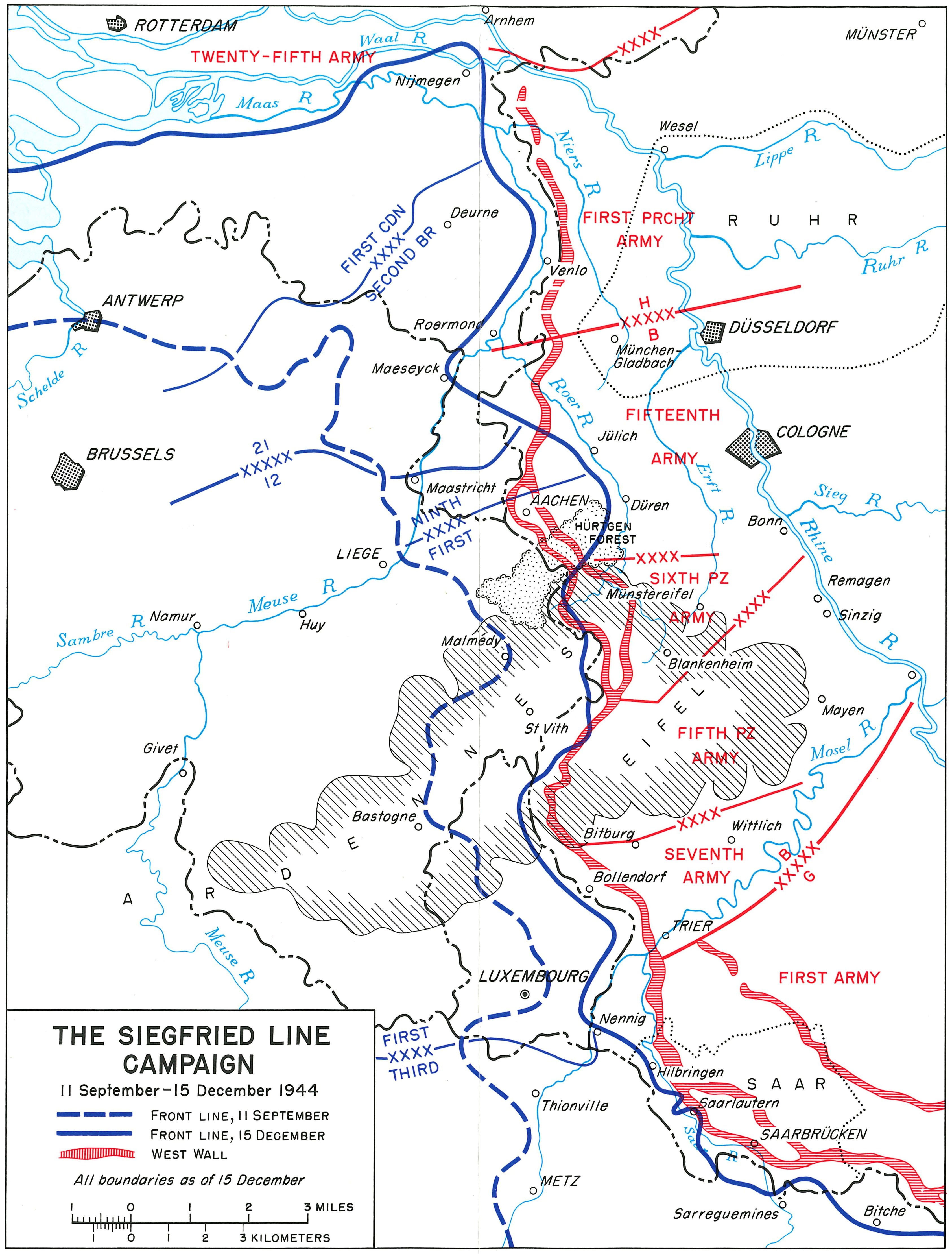
The Siegfried Line Campaign, 11 September – 15 December 1944. U.S. Army Center of Military History.
With this limited force, Simpson faced a significant challenge. The next stage in the Allied advance in the north involved advancing to the Roer River. This would put the 12th and 21st Army Groups in position for the next major offensive: Operation Grenade, the drive to the Rhine River. In bitter fighting north of Aachen, Germany, the XIX Corps, under First US Army command, had broken through the Siegfried Line on October 16. This costly operation proved invaluable in developing techniques to penetrate the German defensive belt. It also gave the XIX Corps valuable combat experience. However, German preparations for the Ardennes Counteroffensive in early November involved key troop movements, concealed from the Allies through elaborate deception operations, which enhanced the German defenses.
Major General Raymond S. McLain, XIX Corps Commander. ibiblio.org
Other factors complicated Simpson’s mission as well. Along the northern boundary of the Ninth Army sector, the Germans occupied the village of Geilenkirchen with a sizable force, creating a salient in the Allied line. This village, situated in one of the most heavily fortified parts of the Siegfried Line, gave the enemy a powerful strongpoint from which to launch counterattacks into the XIX Corps flank. Therefore, Simpson knew he would have to clear Geilenkirchen if his push to the Roer were to succeed, but with only one operational corps, he lacked the combat power to do so.
The Geilenkirchen salient sat astride the boundary between the 21st and 12th Army Groups, with the British XXX Corps to the north and the US XIX Corps to the south. This made a combined operation the obvious approach, but Commonwealth troops would be heavily engaged in operations to clear the Peel Marshes in Holland through mid-November, limiting their available combat power. Fortunately, after holding a series of conferences with Montgomery and his field army commanders, Bradley postponed the coming operation until November 11. This gave time for the British to complete their operations in the Peel Marshes and for more American divisions to augment the 12th Army Group’s combat power.
Major General Alvan C. Gillem Jr., XIII Corps Commander, U.S. Army Center of Military History,
With this change, the situation developed quickly. The 84th Infantry Division arrived in the Ninth Army sector on November 3, and the next day, Simpson assigned it plus the 113th Cavalry Group and the 102nd Infantry Division (now full-strength) to the XIII Corps, with the mission of defending Ninth Army’s northern flank. The 7th Armored Division returned from its temporary assignment to the British Second Army on November 8, rounding out the XIII Corps’ combat power.
The arrival of so many new units in the narrow Ninth Army sector clogged roads and complicated preparations, but further delays gave Simpson time to get his sector organized. The delays resulted primarily from Bradley’s decision to use air power to support the offensive. At a conference on November 7, air and ground planners developed the blueprint for Operation Queen, a preliminary aerial bombardment of unprecedented size that would employ both American and British heavies, mediums, and fighter-bombers.
Bradley was optimistic that Operation Queen would significantly lessen enemy resistance to the ground assault, but he realized it would require clear weather that might be days away. To ensure participation by the maximum possible number of bombers, he agreed to a potential delay. Although the target date for the operation remained November 11, Bradley would approve a 24-hour delay each day the weather kept the bombers grounded. Bradley chose November 16 as the deadline; if the weather did not clear by the 16th, the offensive would begin without air support.
With two corps now available, Simpson found himself in the unusual situation of having more troops than he could employ simultaneously along his limited 10-mile front. Simpson’s mission required him to clear the Roer plain in sector and seize crossing sites over the Roer River. After jumping the Roer, the XIII and XIX Corps would drive northeast to the Rhine at Düsseldorf. Simpson decided to deal with this limited frontage by first committing the XIX Corps as the main effort to clear the Roer plain and drive on Jülich. Once the XIX Corps made sufficient progress, temporary boundary shifts would allow for the commitment of the XIII Corps, which would attack to the Roer along the northern flank and seize crossing sites at Linnich. To deal with the threat posed by the Geilenkirchen salient, Simpson found a solution in Allied cooperation.
Lieutenant General Sir Brian Gwynne Horrocks, British XXX Corps Commander. Imperial War Museum, Catalog Number B 9302
The British XXX Corps, commanded by Lieutenant General Brian Horrocks, assumed responsibility for protecting the Ninth Army’s northern flank on November 12. In discussions over the coming operation, Simpson and Horrocks developed a plan for dealing with Geilenkirchen called “Operation Clipper.” Another temporary boundary change would give the XXX Corps responsibility for the salient, and the temporary assignment of the 84th Infantry Division to his corps would give Horrocks the combat power needed to clear the town and reduce its fortifications.[3]
This arrangement had the benefit of keeping the XIII Corps focused on its mission in the Roer plain, while enabling Simpson to get the 84th Division into the fight from the start. Once the 102nd Infantry Division captured Gereonsweiler and the British XXX Corps cleared Geilenkirchen, bringing Operation Clipper to a successful end, the 84th Division would return to the XIII Corps command in an extended sector. This would give Gillem the space and combat power needed to advance to the Roer River, seize crossing sites in the vicinity of Linnich, and release the 7th Armored Division to exploit the river crossing operation.
November Offensive: The Drive to the Roer, 16 November – 9 December 1944. U.S. Army Center of Military History.
The battle would take place in the Roer plain, a 200-square-mile triangle of low, flat terrain featuring many enemy obstacles and fortifications. A network of improved secondary roads connected more than a hundred small towns and villages, each of which served as an enemy strongpoint. Adding to the challenge presented by these fortified positions, the region experienced an especially rainy November in 1944, with some amount of precipitation during all but two days of the month.[4] This turned the ground into a slick mess that made mobility a serious challenge.
Operation Clipper would take place in the northern part of the Ninth Army sector, in an area defended by General Günther Blumentritt’s XII SS Panzerkorps. With only two divisions, the 176th Infantry and the 183rd Volksgrenadier, Blumentritt had to defend a 22-mile front. Still, these divisions had recently refit and reorganized, and they had relatively high morale. The two divisions that made up the theater reserve in this sector, the 9th Panzer and the 15th Panzergrenadier, were also well-trained and equipped, and located near Linnich where they could intervene quickly in the XIII Corps zone.
Blumentritt paid particular attention to the defense of Geilenkirchen. He positioned his antitank defenses near the town, consisting of 20 assault guns and the full complement of both divisions’ 75-mm and 88-mm antitank guns. He positioned his two-battalion reserve near Geilenkirchen and ordered all his artillery batteries to prepare to mass fire there on order. Finally, he kept in reserve the 301st Tank Battalion with 31 Tiger tanks and the 559th Assault Gun Battalion with 21 guns.
As D-Day approached, low clouds and poor visibility led Bradley to order 24-hour delays until November 15. Up against Bradley’s deadline, McLain knew the mission would begin the next morning, with or without air support. Morale in the XIX Corps was high on the eve of the attack. As recorded in the official history, “In approving a policy of rest before the jump-off, the XIX Corps Commander, General McLain, told one of his division commanders he would need plenty of rest, because ‘when you go again it will be a long drive. Right into Berlin.’” Simpson was confident but measured, noting that even second-rate troops “can fight well from fortified areas like the towns of the Roer Valley.” As he told his staff, “I anticipate one hell of a fight.”[5] Still, Simpson and McLain believed it would take just five days for the XIX Corps to reach the Roer.
While the XIX Corps attack would begin on D-Day, Operation Clipper would start two days later, on November 18. This would hopefully lead some German reserves to reposition to the south in response to the attack in the Roer plain. The successful conclusion of both the XIX Corps offensive and Operation Clipper would give the Ninth Army five more miles of frontage, where Gillem’s XIII Corps would assault across the Roer northwest of Linnich.
Major General Alexander R. Bolling (right) with Major General Gillem of XIII Corps at a farewell party. The 84th Infantry Division In The Battle Of Germany
The 84th Infantry Division, commanded by Major General Alexander R. Bolling, arrived in the Ninth Army area on November 10. Most units newly arrived from the Normandy beachhead gained combat experience in the defense of a relatively quiet sector, giving them a chance to experience enemy fire before commitment to an offensive. Bolling soon learned that his division would not have this opportunity. With only six days’ preparation time, his staff had much work to do to prepare for Operation Clipper. While planning for the offensive, Bolling had to coordinate with the British XXX Corps, which would exercise operational control of the 84th Division, while the XIII Corps remained responsible for administration, evacuation, and supply.
Intelligence revealed that Geilenkirchen, a rail and road center on the Siegfried Line, bristled with defensive fortifications and obstacles. This included nine pillboxes, 14 concrete shelters, and a three-and-a-half-foot-high antitank wall made of five-inch square steel posts mounted in a concrete base. The 2,000-meter-long antitank wall ran parallel to the Wurm River and the Palenberg-Geilenkirchen railroad, creating a significant countermobility obstacle.
Two divisions would execute Operation Clipper. Two regiments of the 84th Infantry Division, the 333rd and 334th, would attack from the south, while the British 43rd Wessex Division would attack on their left flank, striking the salient from the west. The attack would take place in four phases, beginning on November 18, or D+2 (two days after the launch of the XIX Corps main effort in the Roer plain). In the first phase, the 334th Infantry would attack to capture Prummern and the adjacent high ground southeast of the town. The second phase would begin at noon on the 18th, with the 43rd Division’s attack east toward Geilenkirchen to capture the villages of Tripsrath and Bauchem. This would squeeze the enemy defense, protecting the flanks of the 333rd Infantry during phase three, when it attacked on the morning of November 19 to clear Geilenkirchen and the surrounding fortifications up to Süggerath in the Wurm River valley. Finally, in the fourth phase, the 43rd Wessex Division would continue its advance up the west bank of the Wurm to Hoven, while the 84th Division pushed past Süggerath and Prummern to seize the villages of Müllendorf, Würm, and Beeck.
Dragons Teeth of the Siegfried Line, near Geilenkirchen. The 84th Infantry Division In The Battle Of Germany
Given its delayed start, Operation Clipper would not benefit directly from the Operation Queen preliminary bombardment. Horrocks could count on fighter-bomber support, however, from the Second British Tactical Air Force and the XXIX Tactical Air Command. This support began on November 8 with napalm strikes to soften the enemy defense. The 84th Infantry Division would also enjoy the support of British armor. This included Sherman tanks of the Sherwood Rangers Yeomanry Regiment, and specialized tanks of a unit named Drewforce. The British used a wide variety of specialized tanks, collectively known as “Hobart’s Funnies” after the 79th Armoured Division commander, Major General Percy Hobart.
In the pre-dawn hours of November 18, two battalions of the 334th Infantry, supported by two troops of specialized “Flail” tanks, approached enemy lines south of Prummern. The operation took place under artificial moonlight, generated by bouncing giant searchlights, also operated by Drewforce, off the clouds. This cast a dim glow over the area, helping the infantry advance without undue exposure to enemy observation. The 84th was the first US division to employ this British method, which other units adopted as the campaign continued.[6]
Patrols had detected a 25-yard-wide mine belt that the armor and accompanying infantry would have to cross to begin the attack. The Flail tanks began to beat two wide paths through the minefield under sporadic German small-arms fire, clearing the way for the tanks and infantry to attack. The Flails made some progress but gradually became stuck, ultimately forcing the Sherwood Rangers to bypass them and force their way through, losing one tank in the process and delaying the advance.
A Teller mine explodes as British Flail tanks conduct mine clearance on a road near Geilenkirchen, 19 November 1944. National World War II Museum ACCESSION NUMBER: 2013.495.1263 Gift of Mr. Thomas J. Hanlon.
Still, the attack pressed on, gaining the high ground east of Geilenkirchen by midmorning. German resistance gradually intensified, reaching its peak as the infantry approached a group of pillboxes between the minefield and Prummern. Supporting armor proved essential in reducing these fortifications, as did the fire of two artillery battalions, directed by forward observers riding in the Sherwood Rangers’ tanks. As troops had learned in earlier engagements along the Siegfried Line, they first had to force the enemy infantry out of their trenches and into the pillboxes with small arms, mortar, and artillery fire. Once the enemy infantry “buttoned up” in the pillboxes, it was relatively easy to reduce each one in turn.[7]
Leading elements of 1st Battalion, 334th Infantry captured the pillboxes by 9 a.m., but it took another three hours for the troops to consolidate and prepare for the assault on Prummern. A 10-minute artillery barrage preceded the attack, which progressed over flat ground with no cover or concealment. Fortunately, enemy opposition was light. Once the infantry reached the town, opposition ceased quickly, and Volksgrenadiers spilled out of the buildings to surrender.
Meanwhile, the 2nd Battalion drove a wedge into the Geilenkirchen salient just west of Prummern, cutting the road to Immendorf and seizing high ground southeast of Süggerath. Northwest of the salient, the 43rd Wessex Division began its attack at noon on the 18th. The thick mud made off-road travel extremely difficult, and many vehicles bogged down. Nevertheless, by the end of the day the division had advanced two miles, seizing Tripsrath and most of Bauchem and taking 800 German prisoners. With the Allies occupying high ground on three sides of Geilenkirchen, conditions were set for the continuation of the assault.
Forward Artillery Observers Supporting the 84th Infantry Division. The 84th Infantry Division In The Battle Of Germany
On the afternoon of November 18, Horrocks, pleased with the progress made to that point, directed an increase in the speed of the attack. Hoping to take advantage of the attack’s momentum, he directed his divisions to execute the third and fourth phases of the operation on the 19th. This led Bolling on the evening of the 18th to order a final push to seize Hill 101 overlooking Süggerath, and Mahogany Hill overlooking Beeck. Hill 101 fell with relative ease, but a reconnaissance patrol to Mahogany Hill spotted six German tanks headed toward Prummern.
This was the vanguard of a counterattack force composed of two companies of the 10th Panzergrenadier Regiment, reinforced by six tanks. Troops of the 2nd Battalion, 334th Infantry repulsed the attack, but it delayed their move on Mahogany Hill until midday on the 19th. Only then did the regimental commander commit his reserve battalion to the task. Stiff resistance from pillboxes north and east of Prummern repulsed this attack as the rest of the regiment continued to deal with pockets of enemy resistance in Prummern. Finally, late on November 20, support from flame-throwing British “Crocodile” tanks enabled the 334th to reduce the pillboxes. This opened the way to Mahogany Hill, which finally fell on the 22nd.
A Churchill tank fitted with a Crocodile flamethrower in action. This flamethrower could produce a jet of flame exceeding 150 yards in length. Imperial War Museum. TR 2313
The 333rd Infantry’s assault began on November 19. The GIs were surprised to find Geilenkirchen only lightly defended. The Germans in the town, surrounded on three sides by US and British troops, fought a delaying action before melting away. Leaving one battalion behind to clear the town, the rest of the regiment continued toward Süggerath. They encountered two pillboxes guarding the road into town, but a few squirts from the Crocodiles quickly flushed out the occupants. Strongpoints in Süggerath put up tougher resistance, but they finally fell before midnight, when the attack ended with the 333rd still a mile from Würm, its final objective.
British Infantry in Action in the Streets of Geilenkirchen, Germany, December 1944. Imperial War Museums BU 1335
Bolling, concerned about rear security and the possibility of further counterattacks, directed his troops on November 20 to clear the last enemy resistance from Prummern and Süggerath, after which they would continue the attack to Müllendorf, Würm, and Beeck. However, a deluge of rain on the morning of November 21 turned the muddy ground into a quagmire that made armored operations nearly impossible. An attack planned for the 22nd started late because of delays clearing debris from a demolished underpass in Süggerath. The infantry began the attack without armored support but soon went to ground in the face of stiff resistance from enemy pillboxes. Finally, in midafternoon the British armor rejoined the infantry. Once again, as soon as the Crocodile tanks’ flamethrowers went to work, the Germans emerged from their pillboxes, hands in the air.
Still, the attack was 500 yards short of Müllendorf. Further attempts by the 84th Infantry Division to renew the attack were similarly frustrated, while the 43rd Wessex Division also encountered both the deluge of mud and stiffening enemy resistance. The Allied commanders evaluated the situation. With the majority of the Geilenkirchen salient cleared and Gereonsweiler captured by the XIX Corps, Operation Clipper had achieved its main objectives. Ninth Army troops had met the two conditions needed to give the XIII Corps its own zone as well. Finally, on November 23, the 84th Infantry Division and its attachments returned to the XIII Corps command and began preparations to continue the drive to the Roer River after an operational pause.
The two regiments of the 84th Division involved in Operation Clipper incurred 2,000 battle casualties. This included 169 killed and 752 missing. Nonbattle injuries added another 500 to the roster of casualties.[8] The Sherwood Rangers suffered 63 casualties, including 16 killed and another 3 who later died of wounds. They also lost 10 tanks, with 15 damaged but recoverable and another 12 so deeply mired in mud that they were unrecoverable.[9] As stalemate once again took hold along the Allied lines, commanders and troops alike pondered the future, painfully aware that the road to Berlin would be long, and fraught with danger.