Registration is now open for the 2024 OHA Annual Meeting to be held October 30 – November 2 at the Hilton Cincinnati Netherland Plaza. To learn more about this year’s annual meeting, please click here.

Registration is now open for the 2024 OHA Annual Meeting to be held October 30 – November 2 at the Hilton Cincinnati Netherland Plaza. To learn more about this year’s annual meeting, please click here.
Deadline: July 31, 2024 The Arline Custer Memorial Award is presented by the MARAC Arline Custer Memorial Award Committee. This award honors the memory of Arline Custer (1909-1975), MARAC member and editor of the National Union Catalog of Manuscript Collections. Eligibility The Arline Custer Memorial Award recognizes the best books and articles written or compiled […]
Monday, July 1, 2024 at 2pm Central Time Join us on July 1st for a free pre-symposium webinar when AI in OH program committee members Steven Sielaff and James Fowler will provide definitions, examples, and oral history tie-ins for the world of artificial intelligence. Whether you are completely new to the world of AI or […]
Deadline: July 1, 2024 Who is that great instructor that inspired or encouraged you to do oral history? The Oral History Association is accepting nominations for the Cliff Kuhn Postsecondary Teaching Award. If you have a teacher, past or present, who has integrated oral history into their teaching, now is the time to shine a […]
We research words and content for our transcripts. Words that we aren’t sure of, we look up to verify spelling and validity. We got this article from https://www.pewresearch.org/?p=167501. If you’re intrigued, sign up for the Pew Research Newsletter.
Our object is to capture the spoken word, and people make vague references, sometimes to places that no longer exist. Some of the oral histories we transcribe reference events that happened a long time ago—World War II, for example. So we spend a lot of time researching. AI doesn’t verify terms, but we do—we try to verify everything we can.
How they did the study:
How we did this
Pew Research Center conducted the analysis to examine how often online content that once existed becomes inaccessible. One part of the study looks at a representative sample of webpages that existed over the past decade to see how many are still accessible today. For this analysis, we collected a sample of pages from the Common Crawl web repository for each year from 2013 to 2023. We then tried to access those pages to see how many still exist.
A second part of the study looks at the links on existing webpages to see how many of those links are still functional. We did this by collecting a large sample of pages from government websites, news websites and the online encyclopedia Wikipedia.
We identified relevant news domains using data from the audience metrics company comScore and relevant government domains (at multiple levels of government) using data from get.gov, the official administrator for the .gov domain. We collected the news and government pages via Common Crawl and the Wikipedia pages from an archive maintained by the Wikimedia Foundation. For each collection, we identified the links on those pages and followed them to their destination to see what share of those links point to sites that are no longer accessible.
A third part of the study looks at how often individual posts on social media sites are deleted or otherwise removed from public view. We did this by collecting a large sample of public tweets on the social media platform X (then known as Twitter) in real time using the Twitter Streaming API. We then tracked the status of those tweets for a period of three months using the Twitter Search API to monitor how many were still publicly available. Refer to the report methodology for more details.
The internet is an unimaginably vast repository of modern life, with hundreds of billions of indexed webpages. But even as users across the world rely on the web to access books, images, news articles and other resources, this content sometimes disappears from view.
A new Pew Research Center analysis shows just how fleeting online content actually is:
A quarter of all webpages that existed at one point between 2013 and 2023 are no longer accessible, as of October 2023. In most cases, this is because an individual page was deleted or removed on an otherwise functional website.
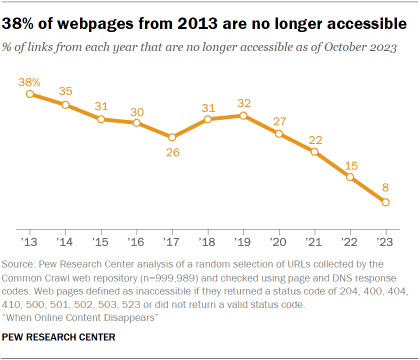
For older content, this trend is even starker. Some 38% of webpages that existed in 2013 are not available today, compared with 8% of pages that existed in 2023.
This “digital decay” occurs in many different online spaces. We examined the links that appear on government and news websites, as well as in the “References” section of Wikipedia pages as of spring 2023. This analysis found that:
23% of news webpages contain at least one broken link, as do 21% of webpages from government sites. News sites with a high level of site traffic and those with less are about equally likely to contain broken links. Local-level government webpages (those belonging to city governments) are especially likely to have broken links.
54% of Wikipedia pages contain at least one link in their “References” section that points to a page that no longer exists.
To see how digital decay plays out on social media, we also collected a real-time sample of tweets during spring 2023 on the social media platform X (then known as Twitter) and followed them for three months. We found that:
Nearly one-in-five tweets are no longer publicly visible on the site just months after being posted. In 60% of these cases, the account that originally posted the tweet was made private, suspended or deleted entirely. In the other 40%, the account holder deleted the individual tweet, but the account itself still existed.
Certain types of tweets tend to go away more often than others. More than 40% of tweets written in Turkish or Arabic are no longer visible on the site within three months of being posted. And tweets from accounts with the default profile settings are especially likely to disappear from public view.
There are many ways of defining whether something on the internet that used to exist is now inaccessible to people trying to reach it today. For instance, “inaccessible” could mean that:
The page no longer exists on its host server, or the host server itself no longer exists. Someone visiting this type of page would typically receive a variation on the “404 Not Found” server error instead of the content they were looking for.
The page address exists but its content has been changed – sometimes dramatically – from what it was originally.
The page exists but certain users – such as those with blindness or other visual impairments – might find it difficult or impossible to read.
For this report, we focused on the first of these: pages that no longer exist. The other definitions of accessibility are beyond the scope of this research.
Our approach is a straightforward way of measuring whether something online is accessible or not. But even so, there is some ambiguity.
First, there are dozens of status codes indicating a problem that a user might encounter when they try to access a page. Not all of them definitively indicate whether the page is permanently defunct or just temporarily unavailable. Second, for security reasons, many sites actively try to prevent the sort of automated data collection that we used to test our full list of links.
For these reasons, we used the most conservative estimate possible for deciding whether a site was actually accessible or not. We counted pages as inaccessible only if they returned one of nine error codes that definitively indicate that the page and/or its host server no longer exist or have become nonfunctional – regardless of how they are being accessed, and by whom. The full list of error codes that we included in our definition are in the methodology.
Here are some of the findings from our analysis of digital decay in various online spaces.
To conduct this part of our analysis, we collected a random sample of just under 1 million webpages from the archives of Common Crawl, an internet archive service that periodically collects snapshots of the internet as it exists at different points in time. We sampled pages collected by Common Crawl each year from 2013 through 2023 (approximately 90,000 pages per year) and checked to see if those pages still exist today.
We found that 25% of all the pages we collected from 2013 through 2023 were no longer accessible as of October 2023. This figure is the sum of two different types of broken pages: 16% of pages are individually inaccessible but come from an otherwise functional root-level domain; the other 9% are inaccessible because their entire root domain is no longer functional.
Not surprisingly, the older snapshots in our collection had the largest share of inaccessible links. Of the pages collected from the 2013 snapshot, 38% were no longer accessible in 2023. But even for pages collected in the 2021 snapshot, about one-in-five were no longer accessible just two years later.
We sampled around 500,000 pages from government websites using the Common Crawl March/April 2023 snapshot of the internet, including a mix of different levels of government (federal, state, local and others). We found every link on each page and followed a random selection of those links to their destination to see if the pages they refer to still exist.
The vast majority go to secure HTTP pages (and have a URL starting with “https://”).
6% go to a static file, like a PDF document.
16% now redirect to a different URL than the one they originally pointed to.
When we followed these links, we found that 6% point to pages that are no longer accessible. Similar shares of internal and external links are no longer functional.
For this analysis, we sampled 500,000 pages from 2,063 websites classified as “News/Information” by the audience metrics firm comScore. The pages were collected from the Common Crawl March/April 2023 snapshot of the internet.
For this analysis, we collected a random sample of 50,000 English-language Wikipedia pages and examined the links in their “References” section. The vast majority of these pages (82%) contain at least one reference link – that is, one that directs the reader to a webpage other than Wikipedia itself.
For this analysis, we collected nearly 5 million tweets posted from March 8 to April 27, 2023, on the social media platform X, which at the time was known as Twitter. We did this using Twitter’s Streaming API, collecting 3,000 public tweets every 30 minutes in real time. This provided us with a representative sample of all tweets posted on the platform during that period. We monitored those tweets until June 15, 2023, and checked each day to see if they were still available on the site or not.
Tweets were especially likely to be deleted or removed over the course of our collection period if they were:
Written in certain languages. Nearly half of all the Turkish-language tweets we collected – and a slightly smaller share of those written in Arabic – were no longer available at the end of the tracking period.
Posted by accounts using the site’s default profile settings. More than half of tweets from accounts using the default profile image were no longer available at the end of the tracking period, as were more than a third from accounts with a default bio field. Tweets from these accounts tend to disappear because the entire account has been deleted or made private, as opposed to the individual tweet being deleted.
Posted by unverified accounts.
We also found that removed or deleted tweets tended to come from newer accounts with relatively few followers and modest activityon the site. On average, tweets that were no longer visible on the site were posted by accounts around eight months younger than those whose tweets stayed on the site.
1% of tweets are removed within one hour
3% within a day
10% within a week
15% within a month
Put another way: Half of tweets that are eventually removed from the platform are unavailable within the first six days of being posted. And 90% of these tweets are unavailable within 46 days.
We research words and content for our transcripts. Words that we aren’t sure of, we look up to verify spelling and validity. We got this article from https://www.pewresearch.org/?p=167501. If you’re intrigued, sign up for the Pew Research Newsletter.
Our object is to capture the spoken word, and people make vague references, sometimes to places that no longer exist. Some of the oral histories we transcribe reference events that happened a long time ago—World War II, for example. So we spend a lot of time researching. AI doesn’t verify terms, but we do—we try to verify everything we can.
How they did the study:
How we did this
Pew Research Center conducted the analysis to examine how often online content that once existed becomes inaccessible. One part of the study looks at a representative sample of webpages that existed over the past decade to see how many are still accessible today. For this analysis, we collected a sample of pages from the Common Crawl web repository for each year from 2013 to 2023. We then tried to access those pages to see how many still exist.
A second part of the study looks at the links on existing webpages to see how many of those links are still functional. We did this by collecting a large sample of pages from government websites, news websites and the online encyclopedia Wikipedia.
We identified relevant news domains using data from the audience metrics company comScore and relevant government domains (at multiple levels of government) using data from get.gov, the official administrator for the .gov domain. We collected the news and government pages via Common Crawl and the Wikipedia pages from an archive maintained by the Wikimedia Foundation. For each collection, we identified the links on those pages and followed them to their destination to see what share of those links point to sites that are no longer accessible.
A third part of the study looks at how often individual posts on social media sites are deleted or otherwise removed from public view. We did this by collecting a large sample of public tweets on the social media platform X (then known as Twitter) in real time using the Twitter Streaming API. We then tracked the status of those tweets for a period of three months using the Twitter Search API to monitor how many were still publicly available. Refer to the report methodology for more details.
The internet is an unimaginably vast repository of modern life, with hundreds of billions of indexed webpages. But even as users across the world rely on the web to access books, images, news articles and other resources, this content sometimes disappears from view.
A new Pew Research Center analysis shows just how fleeting online content actually is:
A quarter of all webpages that existed at one point between 2013 and 2023 are no longer accessible, as of October 2023. In most cases, this is because an individual page was deleted or removed on an otherwise functional website.
For older content, this trend is even starker. Some 38% of webpages that existed in 2013 are not available today, compared with 8% of pages that existed in 2023.
This “digital decay” occurs in many different online spaces. We examined the links that appear on government and news websites, as well as in the “References” section of Wikipedia pages as of spring 2023. This analysis found that:
23% of news webpages contain at least one broken link, as do 21% of webpages from government sites. News sites with a high level of site traffic and those with less are about equally likely to contain broken links. Local-level government webpages (those belonging to city governments) are especially likely to have broken links.
54% of Wikipedia pages contain at least one link in their “References” section that points to a page that no longer exists.
To see how digital decay plays out on social media, we also collected a real-time sample of tweets during spring 2023 on the social media platform X (then known as Twitter) and followed them for three months. We found that:
Nearly one-in-five tweets are no longer publicly visible on the site just months after being posted. In 60% of these cases, the account that originally posted the tweet was made private, suspended or deleted entirely. In the other 40%, the account holder deleted the individual tweet, but the account itself still existed.
Certain types of tweets tend to go away more often than others. More than 40% of tweets written in Turkish or Arabic are no longer visible on the site within three months of being posted. And tweets from accounts with the default profile settings are especially likely to disappear from public view.
There are many ways of defining whether something on the internet that used to exist is now inaccessible to people trying to reach it today. For instance, “inaccessible” could mean that:
The page no longer exists on its host server, or the host server itself no longer exists. Someone visiting this type of page would typically receive a variation on the “404 Not Found” server error instead of the content they were looking for.
The page address exists but its content has been changed – sometimes dramatically – from what it was originally.
The page exists but certain users – such as those with blindness or other visual impairments – might find it difficult or impossible to read.
For this report, we focused on the first of these: pages that no longer exist. The other definitions of accessibility are beyond the scope of this research.
Our approach is a straightforward way of measuring whether something online is accessible or not. But even so, there is some ambiguity.
First, there are dozens of status codes indicating a problem that a user might encounter when they try to access a page. Not all of them definitively indicate whether the page is permanently defunct or just temporarily unavailable. Second, for security reasons, many sites actively try to prevent the sort of automated data collection that we used to test our full list of links.
For these reasons, we used the most conservative estimate possible for deciding whether a site was actually accessible or not. We counted pages as inaccessible only if they returned one of nine error codes that definitively indicate that the page and/or its host server no longer exist or have become nonfunctional – regardless of how they are being accessed, and by whom. The full list of error codes that we included in our definition are in the methodology.
Here are some of the findings from our analysis of digital decay in various online spaces.
To conduct this part of our analysis, we collected a random sample of just under 1 million webpages from the archives of Common Crawl, an internet archive service that periodically collects snapshots of the internet as it exists at different points in time. We sampled pages collected by Common Crawl each year from 2013 through 2023 (approximately 90,000 pages per year) and checked to see if those pages still exist today.
We found that 25% of all the pages we collected from 2013 through 2023 were no longer accessible as of October 2023. This figure is the sum of two different types of broken pages: 16% of pages are individually inaccessible but come from an otherwise functional root-level domain; the other 9% are inaccessible because their entire root domain is no longer functional.
Not surprisingly, the older snapshots in our collection had the largest share of inaccessible links. Of the pages collected from the 2013 snapshot, 38% were no longer accessible in 2023. But even for pages collected in the 2021 snapshot, about one-in-five were no longer accessible just two years later.
We sampled around 500,000 pages from government websites using the Common Crawl March/April 2023 snapshot of the internet, including a mix of different levels of government (federal, state, local and others). We found every link on each page and followed a random selection of those links to their destination to see if the pages they refer to still exist.
The vast majority go to secure HTTP pages (and have a URL starting with “https://”).
6% go to a static file, like a PDF document.
16% now redirect to a different URL than the one they originally pointed to.
When we followed these links, we found that 6% point to pages that are no longer accessible. Similar shares of internal and external links are no longer functional.
For this analysis, we sampled 500,000 pages from 2,063 websites classified as “News/Information” by the audience metrics firm comScore. The pages were collected from the Common Crawl March/April 2023 snapshot of the internet.
For this analysis, we collected a random sample of 50,000 English-language Wikipedia pages and examined the links in their “References” section. The vast majority of these pages (82%) contain at least one reference link – that is, one that directs the reader to a webpage other than Wikipedia itself.
For this analysis, we collected nearly 5 million tweets posted from March 8 to April 27, 2023, on the social media platform X, which at the time was known as Twitter. We did this using Twitter’s Streaming API, collecting 3,000 public tweets every 30 minutes in real time. This provided us with a representative sample of all tweets posted on the platform during that period. We monitored those tweets until June 15, 2023, and checked each day to see if they were still available on the site or not.
Tweets were especially likely to be deleted or removed over the course of our collection period if they were:
Written in certain languages. Nearly half of all the Turkish-language tweets we collected – and a slightly smaller share of those written in Arabic – were no longer available at the end of the tracking period.
Posted by accounts using the site’s default profile settings. More than half of tweets from accounts using the default profile image were no longer available at the end of the tracking period, as were more than a third from accounts with a default bio field. Tweets from these accounts tend to disappear because the entire account has been deleted or made private, as opposed to the individual tweet being deleted.
Posted by unverified accounts.
We also found that removed or deleted tweets tended to come from newer accounts with relatively few followers and modest activityon the site. On average, tweets that were no longer visible on the site were posted by accounts around eight months younger than those whose tweets stayed on the site.
1% of tweets are removed within one hour
3% within a day
10% within a week
15% within a month
Put another way: Half of tweets that are eventually removed from the platform are unavailable within the first six days of being posted. And 90% of these tweets are unavailable within 46 days.