PRESIDENT’S LETTER
By Troy Reeves
Within minutes of Kelly Elaine handing me the presidential gavel (and tote bag), people started asking me questions or offering comments about OHA’s present and future. While I have and will continue to give them all thought and, when needed, action, I want to spend my first president’s message looking backwards, not forward.
As an homage to our Keynoter, Mi’Jan Celie Tho-Biaz—this message serves as a love letter to all those involved in making OHA 2024 in Cincinnati so successful. First and foremost, sometime during the Spring of 2023, I asked Ellen Brooks if she would chair this year’s meeting. Note: for this year, we convened one committee, the conference committee, to oversee both the program and local efforts. Ellen and I then reached out to over a dozen folks to see if they would join us. Almost all agreed to help. They, Ellen and the committee, then spent countless hours on, among the many things, reviewing proposals, working on workshops and tours and overseeing the keynotes and plenaries. So, thanks Ellen and the 2024 OHA Conference Committee for your time, goodwill and sense of humor. All were much appreciated and are needed to plan and implement our annual meeting.
Next, to the Executive Office—the Stev(ph)ens, Hailey and the grad students—did just about everything Ellen and I asked of you (and actually I’m not sure they said no to any of our questions/ideas, no matter how hairbrained). These things included making the annual business meeting virtual and moving it to a few weeks before the conference, creating 60-minute sessions (as well as the traditional 90-minute ones), adding an app (Sched) to help us plan the conference and help attendees navigate it, and uncoupling the keynote address from a formal, hotel lunch. Having these people run our day-to-day operations, including running our annual meeting, has been transformative for our organization. So, thank you all.
Thanks to those, over the past year, who served on committees and task forces or who have joined a caucus. Your work throughout the year, as well as those committees who sponsored events and held an in-person meeting at the annual meeting, was invaluable to its success. Special shout out here to the Membership Committee, because as their council liaison I saw them work through issues and tasks—including the sponsoring and implementation of Friday’s Newcomer’s Breakfast–efficiently, effectively and successfully.
Last, to all of the members who participated in any way in Cincinnati. Whether you presented, chaired, or attended, your participation did not go unnoticed. You are the backbone of the OHA, helping us continue to be an organization, as the front page of our website says, “committed to the value of oral history.” I appreciate all of you and look forward to serving as your president this year.
DIRECTOR’S COLUMN
Associate Director’s Report
By Steven Sielaff
Just days before the 2024 Annual Meeting, OHA launched an initiative on the official OHA website from members of the new Oral History Review (OHR) editorial team. OHR Extra! is an open-access online publication that complements the journal by extending the conversations editors are having in the Review and aims to support the oral history community at large by inviting coverage of topics, news, projects and events important to the field.
OHR Extra! will be updated regularly throughout the year, but to kick off this initiative five pieces of content initially were shared with the membership: an author interview, a project interview, a news release, an announcement concerning OHR’s presence at the Annual Meeting, and the first installment of “5 Questions about a Book.” All OHR Extra! content can be found in the newly-expanded OHR directory on the OHA website HERE.
The integration of this new service within the OHA website is key in providing an engaging presence among the rest of OHA’s offerings and news services. The workflow design of editors providing new content to the home office to post will also allow us to create social media and news blast features to be included in our bi-monthly emails.
Of course, long-standing members of the OHA will recognize elements of OHR Extra! in the former online publication space created by past OHR editorial team members: the OHR Blog. The good news here is that the content created for this blog from 2018-2024 will be preserved by OHA in the coming months.
Blog manager Janneken Smucker and OHA website consultant Rachael Gilg will coordinate to migrate not only the site, but also the blog’s domain to OHA’s hosted instance, assuring that all posts and links remain intact. The blog’s history and context will be further developed and represented within the OHR’s directory on the OHA website, and I have plans in 2025 to explore other ways to increase the discoverability of this older blog content.
My thanks to both the old and new OHR editorial teams for expanding their offerings beyond the pages of the journal and working with the home office to assure the OHA membership has ample opportunities to engage with this material. To contact the OHR team with a notice or idea for OHR Extra!, please email OHR Media Review Editor Bud Kliment at OHRMedia@outlook.com.
Brooklyn College Panelists Discuss:
‘Election 2024: What now?’
Read books, advised Paul Ortiz, an Oral History Association past president and Cornell University labor history professor.
Teach civics, because people don’t know how government works, said Melissa Murray, New York University law professor and MSNBC legal analyst.
Figure out how to talk to people and work with people who are not our mirror images, added Barbara Smith, independent scholar and groundbreaking author on Black feminism.
Smith, Ortiz and Murray are, respectively, the 2023, 2024 and 2025 distinguished Hess Scholars-in-Residence at Brooklyn College. They were invited to participate in the virtual online discussion before the Nov. 5 election, Ortiz noted, adding: “We were going to have a struggle one way or the other.”
Brooklyn College political science professor Gaston Alonso, who moderated the program, asked the panelists to boil down their advice for moving forward, which elicited their recommendations about reading books, teaching civics and learning how to engage with people who don’t look like you.
But the panelists also expressed wide-ranging concerns about how to understand the results of the 2024 elections, which resulted in the Republicans winning the White House and majorities in both houses of Congress.
“I don’t think anyone knows completely what happened,” Smith said. “We’re grasping at straws” to understand the election results. But racism and sexism were “heavily implicated” in the outcome, she added, noting that the racism and misogyny exhibited by the president-elect and his running mate appeal to significant numbers of people.
Ortiz urged listeners to avoid the tendency to blame people—individuals or groups—for Democrats’ election losses. “We cannot afford to play the blame game,” he said. “We need everyone to rebuild democracy.”
But he singled out corporate media for playing what he called a “shameful role in stoking fears” about the U.S. southern border being overrun by undocumented immigrants and in failing to cover the issue forthrightly. He recalled listening to radio call-in shows in which people from Vermont and other states far removed from the southern border would rail about the country being overrun by immigrants.
Blaming immigrant workers for all the problems facing the country is a long American tradition, but it’s really the economic system that’s at fault, he said, adding: “We’ve got to be willing to change the system.” He praised students for taking the initiative to organize unions, which historically have represented powerful voices for the working class.
Murray noted the impact on the election of social media, which had the effect of stoking a sense of grievance and malaise in ways not seen before, likely affecting how people voted.
But she also said Democrats this year already were facing headwinds, given an international trend in some 80 elections worldwide in the past two years. Results in almost all of them reflected an anti-incumbent fervor, she said, adding that it’s ironic President-elect Trump was able to present himself as a fresh face.
To the extent that economic issues were key vote drivers, there is a clear disjunction between what economic indicators say about the economy and the way people actually feel, Murray said. “There’s a feeling that government isn’t working, and we ought to throw the bums out.”
“If we want progressive governance,” she said, “we have to show it’s worthwhile and makes people’s lives better.”
The panelists identified several issues that particularly concern them about the election results.
Smith said she is especially concerned about the Trump promises to eliminate the Department of Education, which would mean the elimination of Head Start and Title I funding for schools in impoverished neighborhoods, among others. She also expressed concern about scapegoating people in the trans and LGBT communities and her fears for an increase in hate crimes, noting that the “take our country back” slogan, which Trump supporters popularized, is a “racialized attack.”
Murray said she feared the incoming administration represents a “grave situation” for reproductive rights and called it “mindboggling” that a majority of women voted for Trump.
Despite their concerns, the panelists clearly are not packing their bags to decamp to a desert island for the next four years.
“We just have to keep organizing and reaching out to others,” Ortiz said.
Volunteer Spotlight
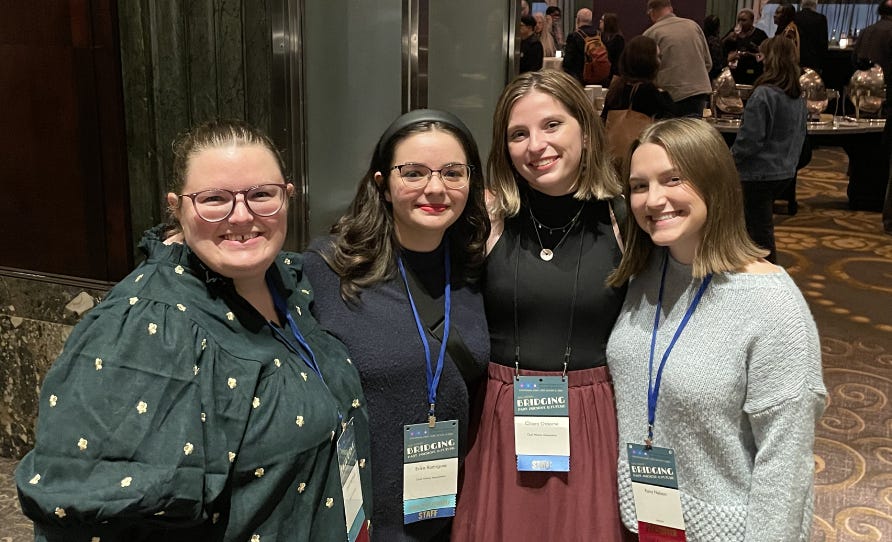
The OHA Annual Meeting Graduate Assistants (from left to right): Laura McNeice, Erika Rodriguez, Chiara Osborne, Kara Nelson.
This month, the OHA Newsletter thanks the volunteers who took on a role in one of the nearly 100 OHA conference sessions in Cincinnati, enriching the week for everyone.
While conference presenters might not think of their participation as a form of volunteering, few get paid to polish a presentation, travel to a conference site, describe their work in a panel or poster session or chair one of those events. So in a real sense, it is volunteers who make conference sessions possible, from groups of students who shared their initial forays into oral history to seasoned professionals who work as independent oral historians, senior faculty members, museum volunteers and others.
While the logistics of planning and executing the conference itself relies on conference committee volunteers and OHA staff, the conference content emerges from the energy of individuals who volunteer to describe their work, their ideas and their questions with fellow oral historians. Thank you!
And for OHA members who were inspired by those volunteers in Cincinnati, consider submitting a proposal for next year’s conference in Atlanta, Oct. 15-18, 2025. The conference call for proposals can be found in the 2024 conference program, summarized later in this Newsletter, and is available at www.oralhistory.org. Proposals are due February 21, 2025.
Cincinnati Conference Overview
A wide array of panel presentations, posters, exhibitors, workshops, plenary sessions, tours, receptions with tasty food and exuberant conversation plus the elegant art deco surroundings of the Hilton Netherland Plaza Hotel greeted more than 500 people at the 58th annual meeting of the Oral History Association Oct. 30-Nov. 2.
The Cincinnati conference theme, Bridging Past, Present and Future, was carried out in sessions that highlighted the breadth of oral history practice and challenges that lie ahead.
This issue of the OHA Newsletter highlights annual awards, the annual business meeting (held virtually in October), conference plenaries and selected panel presentations, as well as other news of interest to oral historians. More stories from the conference will be included in upcoming newsletters.
OHA annual business meeting goes online
In a break from a traditional early morning, sparsely attended annual business meeting during the conference, Oral History Association members registered for the 2024 conference Zoomed in to a virtual business meeting on Oct. 1 for a review of the year’s work, plans for the future, a financial report and votes to approve bylaws changes. Here are some highlights:
+ OHA Council has created a Law and Ethics Task Force to address legal and ethical aspects of oral history, including consideration of evolving matters of federal law and Indigenous sovereignty. It also is tasked with developing a comprehensive resource guide for managing legacy oral history collections and establishing criteria for archival relationships and custodial agreements. The seven-member task force is to complete its work next year.
+ AI Symposium co-chairs Sarah Milligan and Steven Sielaff presented a final report summarizing the virtual symposium held in July. More than 250 people registered, and attendance at the 10 online sessions and pre-session introduction to AI ranged from about 50 to more than 100 participants, with additional views of session recordings available on YouTube. A follow-up survey yielded numerous suggestions for further symposia, and the committee suggested OHA maintain a schedule of hosting a virtual summer symposium every other year. Registration fees for the symposium, which ranged from free for student, retired and life members to $250 for non-partner member institutions, generated $9,700 for OHA.
+ Finance Committee Co-chair Mary Larson reported the 2023 year-end financial statement showed OHA assets of $907,810 and liabilities of $80,072.
+ Executive Director Stephen Sloan reported a record 1,227 OHA members and 43 partner members. The cost of life memberships will gradually increase from the current $1,000 fee to $1,250 in 2025 and $1,500 in 2026. Life memberships go to the OHA Endowment Fund.
+ Meeting attendees voted online to approve two bylaws changes. One establishes an anniversary membership renewal cycle, in which a member’s 12-month membership renews on the anniversary of their joining or past renewal date, rather than a calendar year-end membership renewal. The change is effective Jan. 1, 2025. A second bylaws change clarifies that committee assignments are finalized in the fall of each year and that terms of service begin and end at the beginning of the annual meeting.
+ Council member Francine D. Spang-Willis announced the establishment of an OHA Indigenous Award beginning in 2025.
+ Future annual meetings are scheduled for Atlanta in 2025 and Portland, Oregon, in 2026. A joint meeting with the American Folklore Society is under consideration for Chicago in 2027.
OHA presents awards for exemplary work
OHA awards for exemplary oral history work were presented at the Oct. 31 Presidential Reception, with a wide variety of themes represented in the award-winning work. The winners and comments from judges are:
Two Article Awards—Estelle Freedman for “ ‘Not a Word Was Said Ever Again’: Silence and Speech in Women’s Oral History Accounts of Sexual Harassment.” Freedman used digital humanities tools to analyze a massive body of oral history transcripts over a long period of time to find out how American women made sense of their treatment in the workplace through speech and silence.
Jamey Jesperson and Saylesh Wesley, “ ‘Waking to Dream’: The Life Story of Saylesh Wesley, Trans Stó:lō Elder-to-Be.” This co-created article combines Western and Indigenous oral history methods to explore one individual’s multiple intersecting identities over time.
Book Award—Joseph Plaster, Kids on the Street: Queer Kinship and Religion in San Francisco’s Tenderloin. Equal parts ethnography and oral history, Plaster’s book illustrates how queer, unhoused youth—self-described “kids on the street”—in San Francisco’s Tenderloin district created a community that roots itself in reciprocity, mutual aid and the making of “street (or chosen) families.”
Cliff Kuhn Secondary Teaching Award—Mary Marshall Clark, Columbia University. The inaugural recipient of the award, Clark has made deep and lasting contributions to oral history education. She has led Columbia’s Summer Institute for Oral History, taught an annual graduate seminar, envisioned and co-founded the Oral History Master of Arts program at Columbia and continues to teach in it. The OHMA program, the first of its kind in the U.S. and one of only a few internationally, has more than 200 alumni who are expanding the impact of Clark’s teaching as they train new generations of oral historians.
Three Mason Multimedia Awards—Roger Eardley-Pryor, Shanna Farrell and Amanda Tewes, “Japanese American Intergenerational Narratives Oral History Project.” This project explores how intergenerational trauma and healing occurred after the U.S. incarceration of Japanese Americans during World War II. The interviews are available online through the University of California, Berkeley library and through podcasts and graphic narrative illustrations.
Judith Raiskin, “Outliers and Outlaws: The Eugene Lesbian History Project.” This oral history project tells the story of the lesbian community in Eugene, Oregon, where, in the 1960s, hundreds of young lesbian-identifying women moved to Eugene to build a unique, vibrant and formidable community. The project includes a digital exhibition, a museum exhibit and a film.
Rachel Seidman, “To Live and Breathe: Women and Environmental Justice in Washington, D.C.” This exhibit and accompanying film uses oral histories of environmental activists to explore the long history of environmental justice activism in the nation’s capital.
Two Stetson Kennedy Vox Populi Awards—Peggy Douglas, University of Tennessee at Chattanooga, is a longtime social justice activist, playwright, performer and teacher. While not formally trained in oral history, she has used interviews as the basis of public performances that have explored the lives of various communities in and around Chattanooga.
Voice of Witness, a public history organization founded in 2005 in Northern California, has a global reach that focuses on human rights and education. VOW has conducted or facilitated hundreds of interviews and has published more than 20 books based on its oral history projects. Topics have focused on incarcerated people, undocumented immigrants, farm workers, Indigenous people and many others. Additionally, VOW has created lesson plans and training opportunities for secondary school teachers who want to bring interviews into the classroom.
Keynote speaker and plenary sessions inspire, challenge oral historians
OHA conference keynote speaker Mi’Jan Celie Tho-Biaz is all about engaging with the world and its people through her unquenchable curiosity, a characteristic she urged the audience to embrace by grounding themselves through all their senses–hearing, sight, touch, smell and taste—to gather details about the world around them.
The multi-faceted Kennedy Center Citizen Artist has fashioned a career that blends oral history, art, media and ritual to develop cultural projects that incorporate disparate themes, from food to music to folk narratives.
In a question-and-answer presentation format with Amy Starecheski, director of Columbia University’s Oral History Master of Arts program, Tho-Biaz said she comes from a family of cultural workers, who shaped her approach to a career.
“I was raised by a bunch of story pushers in Chicago,” she said. Her parents both are mainstream media story producers and one of her grandmothers was a librarian on the South Side of Chicago who would bring home tattered and out-of-circulation books for her granddaughter.
That’s how she first encountered The Souls of Black Folk by W. E. B. Du Bois, first published in 1903. With that book, Tho-Biaz said, her grandmother “showed me that Black stories matter and have mattered for years.” And her dad taught her that telling stories is worth fighting for.
Tho-Biaz described her career as one of “following gingerbread crumbs,” which has led to work that has included academia and independent consulting.
“Oral historians at our root are deeply curious people,” she said. “Oral history at its core is an intimacy, trust-based practice.”
The academic world, on the other hand, is a rigid one that emphasizes rigorous research, but in doing so, she said, “It kills curiosity.”
*****
Moderated by Elena Foulis of Texas A&M University-San Antonio, two oral historians from other Texas universities explored in a Friday plenary session the challenges and rewards of using oral history to engage students and communities in documenting their pasts, which otherwise might be lost.
Maria E. Cotera, a professor of Mexican American and Latina/o Studies at the University of Texas at Austin, described her roots in oral history growing from her mother’s activity in the social justice movement in the 1970s. “Those women’s stories had been left out of history of those years,” she said, noting that the narrators all had extensive private collections of archival documents and other artifacts that added to their oral narratives and that have enriched the university’s Chicana Digital Memory Collective, which Cotera co-founded. Cotera said she was motivated by a desire to make that information visible and available to students in her classrooms.
“We have to preserve these stories before they’re gone,” she said, adding that “sharing stories of disempowered youth of the 1970s gives today’s students their power back.”
Jesse Jesús Esparza, a history professor at Texas Southern University in Houston, said he started using oral history in the classroom because “I got bored just giving students exams.” He decided to challenge students to use oral history interviews as a way to create treasured records that would last forever. Getting out of a classroom to uncover, preserve and promote Chicano history creates life-long memories for his students, he said, and it’s critically important to make sure the interviews are placed in archives to fill gaps in the archival record.
Esparza said that because his university is an HBCU, it’s important to teach through a lens of Brown and Black experiences for students whose history has been whitewashed. “Oral history is how we undo the damage that has been created,” he said.
Cotera and Esparza emphasized the importance of giving interviews back to the communities from which they came and to maintain relationships with those communities. Cotera said she has partnered on exhibit design projects related to the collections and collaborated with an arts group in northern New Mexico to create plays and other arts outreach.
Esparza said his interviews generally are given back to community partners because it’s easier for them to make the materials available to those within the community.
He also reminded oral historians that while oral historians in higher education settings are making use of oral history, they need to understand its connection to long-ago practices. “This is an ancient form that pre-dates academia,” he noted.
*****
A panel of Cincinnatians described the rich history of the city’s lost West End African American neighborhood that has been reclaimed through interviews, maps, photos and the passions of former residents who refused to let its stories fade away.
In a Saturday plenary session, chaired by Toilynn O’Neal Turner, CEO and founder of the Robert O’Neal Multicultural Arts Center in Cincinnati, panelists recounted the history of the West End and its lasting legacy.
Anne Steinhart, history professor at the University of Cincinnati, reviewed the neighborhood’s history as a lively Black community in the 1950s, created through red-lining practices of the era. “It was a place that was a village whose people took care of each other,” she said, showing photographs taken in the 1950s related to urban renewal efforts in which the city declared the neighborhood to be blighted and planned to demolish houses, churches and businesses, offset by promises of new housing, which were unfulfilled.
People in the West End dispersed and had to rebuild their community connections, she said.
Keloni Parks, manager of the West End branch of the Cincinnati and Hamilton County Public Library, founded and co-produced a podcast series and accompanying blog titled “West End Stories Project,” drawing on interviews with people who remembered the neighborhood. The podcasts, available online help reconnect people, she said.
Elissa Yancey, whose nonprofit A Picture’s Worth uses photos to spark community conversations, said her work engaging people to share photos leads to sharing conversations across differences
LaVerne Summerlin, who has taught in the English Department at the University of Cincinnati for more than 50 years, grew up in the West End. She interviewed 100 African American alumni of the nine West End Catholic schools for her book Gems of Cincinnati’s West End: Black Children and Catholic Missionaries 1940-1970, published in 2020.
Summerlin said the parents, teachers and people who worked around the Catholic parishes “created an environment to let us know they believed in us.” Shrinking numbers of priests and nuns to run the schools over the years contributed to their gradual decline along with neighborhood changes, but one of them, St. Ann’s School, founded in 1867, lasted until 1967, she said.
Ultimately, Steinart said, two Black churches were demolished to make way for a soccer stadium and only one Catholic school survived. Displacement of the Black communities like the West End due to construction of a freeway was a national phenomenon, Turner noted.
Nonetheless Summerlin suggested that many former West Enders won’t forget the accompanying destruction of Holy Trinity Elementary School, which used to stand where the I-75 south exit ramp is now.
“I see advantages of I-75,” she said, but added that she’s grateful it didn’t come until after she’d graduated from Holy Trinity.
Panelists consider how oral historians might benefit from IRB reviews
Until 2019, oral historians engaged in a decades-long struggle with federal officials over a rule requiring institutional review boards (IRBs) to pass judgment on oral history projects that were reviewed under rules relating to research involving human subjects. Led by OHA leaders and others, historians objected to IRB insistence that specific questions be spelled out and approved in advance, that narrators remain anonymous and that recordings be destroyed after interviews, for example, all of which contradict oral history best practices but which IRBs often required.
Oral historians argued that their narrators were not, in fact research subjects, but were co-creators of their personal history narratives, a position federal officials eventually agreed with, issuing a rule change in 2019 providing an IRB exemption for “scholarly and journalistic activities (e.g., oral history, journalism, biography, literary criticism, legal research, and historical scholarship), including the collection and use of information, that focus directly on the specific individuals about whom the information is collected.”
“I absolutely loathe and despise the concept of IRB,” the University of Kentucky’s Douglas Boyd told an OHA conference session, indicating he was relieved when the federal rule was changed.
But he said he’s been rethinking.
There’s a value, he suggested, in balancing the need for ethical autonomy in oral history work with the reality that a lot of oral history projects are being undertaken by people who aren’t paying attention to the ethical implications of their work, especially when it comes to considerations of access to oral history materials.
Boyd, director of the Louie B. Nunn Center for Oral History at the University of Kentucky Libraries and a past OHA president, cited an example of a freshman student who wanted to donate a book of poetry he’d written based on interviews with undocumented immigrants. The student, he said, “didn’t get good advice” on his project.
The matter of informed consent “is where we are most failing as a practice,” particularly regarding extreme online access to oral histories and the explosion of artificial intelligence, he said. “We’re not doing a great job because we don’t know what we don’t know,” especially regarding access via large language learning models, he said, suggesting that IRB review could play a role in helping oral historians think through ethical issues, particularly related to informed consent.
Given advances in technology, Boyd said he has lost confidence in believing that oral history archives can promise narrators anonymity. Even if a narrator’s name is anonymized, other clues in an archived interview could make the narrator’s name traceable online.
Jay-Marie Bravent, a University of Kentucky archivist and vice chair of the university’s non-medical IRB, suggested that oral historians should think of IRB review as a type of peer review of their projects, including consideration of informed consent for participants and issues related to data privacy and future use. The IRB’s role, Bravent said, is to help make a project’s possible risks manageable.
Every IRB is different, Bravent said, but unlike the early days, most IRB members now understand the difference between oral history work and protecting people subject to medical research, which was origin of IRBs. She also noted that institutions other than colleges and universities also have IRBs that review research proposals.
Brandon T. Pieczko, digital and special collections librarian at the Indiana University School of Medicine, described an ethically challenging oral history project to document the impact of opioid abuse in Indiana for which he had to submit a protocol for review by a local hospital’s IRB.
Because the project deals with sensitive subjects, including substance abuse, child abuse and family relationships, among other topics, narrators in the Indiana project retain their rights to the interviews and have the option to make it accessible only in house, Pieczko said. He noted that of the narrators interviewed so far, all have been peer counselors and all have been OK with public access to their interviews.
Kirsten Dilger, local history programmer for the Kenton County (Kentucky) Public Library, said most of her work is community-based, including helping patrons search their genealogy. She described one somewhat informal project in which she worked with junior high students from a local Catholic school who were interviewing residents of a Catholic retirement home. In that project, she decided not to use informed consent documents with residents who had Alzheimer’s disease.
And in another situation, she recalled an interview with a prominent local narrator “who said something outrageous.” Dilger said she questioned him on whether he wanted to restrict access to anything in the interview, but the narrator readily signed a deed of gift apparently without qualms.
Interviewing deaf narrators requires attention to visual, not vocal, content, panelists say
Two professors from the Rochester Institute of Technology’s National Technical Institute for the Deaf, challenged oral historians to consider ways American Sign Language users can enjoy greater access to oral history.
In a session that included sign language interpreters as well as interpreters who voiced the signed presentations, historian Corinna Hill and Kierstin Muroski, who teaches sign language interpretation at RIT, identified some of the challenges associated with collecting and sharing oral history interviews conducted in ASL.
For starters, Hill said, while the advent of covid opened oral history to remote interviewing, the technology leaves something to be desired when deaf narrators and interviewers are involved. A key problem, she noted, is that Zoom’s transcription option, which some oral historians take for granted, is based on audio input, not visual input.
Even with in-person interviews, a deaf interviewer may face challenges in working with a hearing narrator who doesn’t understand the requirements of recording an interview with a deaf oral historian. She cited as an example an interview she conducted with Tom Wheeler, who chaired the Federal Communications Commission, about the FCC’s text-to-911 initiative.
Hill said she couldn’t meet the interpreter in advance, had no choice of location, had no equipment except pen and paper and no control over the furniture arrangement. As a result, she didn’t have good eye contact with Wheeler and had to write and look at the interpreter at the same time, which created a power imbalance in the interview, settings where people too often link “power” with speech and sound.
“Deaf people often aren’t part of the conversation,” she said, noting that hearing people tend to focus on the interpreter rather than on the deaf person who is signing their part of the conversation.
She also cited a case of a deaf Holocaust survivor whose video-recorded interview focused on the narrator’s face, mistakenly cutting off the image of her hands as she signed. “This was incredibly sad,” Hill said.
She called for the development of new technologies that might address some issues but also said oral historians should consider issues of accessibility for deaf narrators and deaf audiences from the beginning of a project, not the end.
Hill’s colleague Muroski, a nationally certified ASL-English interpreter, teaches students who also aim to qualify as certified interpreters, a field that emerged as a profession in 1964. Muroski described some of her concerns about planning an oral history project focusing on deaf senior citizens who can describe what their experiences were like before sign language interpreters were commonplace.
Muroski emphasized that she wants to value narrator-centeredness in the project and said she wonders whether a hearing person can even collect such narratives. She also asked:
–can a bilingual hearing person understand cultural differences?
–if the interviewer does not know ASL and requires an interpreter, will the lag between the questions and answers raise concerns about accuracy and completeness of the exchange?
–what about a signed video consent?
–how should an interpreter be placed relative to other participants in the interview and how much preparation should the interpreter have?
Muroski also noted that video oral histories conducted in ASL require enough cameras to focus on every participant in the interview, including interviewer, narrator and interpreter, which inevitably adds to the cost of such oral histories.
Despite the apparent challenges associated with Muroski’s planned project, audience members urged her not to get bogged down and instead identify practical solutions in working with her deaf narrators to document important information about the history of the deaf experience in the United States.
Environmental oral histories focus on environment, culture
Oral histories can tell the stories of a Florida hurricane’s aftermath, an island slowly sinking into Chesapeake Bay, the scientists who study such phenomena, and a recent spate of off-the-grid dwellers in the rural Missouri Ozarks. And OHA conference attendees got a taste of all of them from a panel focusing on environment and culture.
Florida Gulf Coast University history professor Frances Davey and cognitive psychologist Joanna Salapska-Gelleri teamed up to have their students interview survivors of the 2022 Hurricane Ian that damaged Florida’s barrier islands and coastal communities, leaving 100 people dead and damage totaling $115 billion.
People used social media in real time to document their own stories, Davey said, and many are still grappling with the fallout from Ian.
The interviews highlighted the social and economic factors that differentiated the hurricane’s impact, with one narrator noting the relationship between a family’s rent and its relative safety and raising questions about how to prepare underserved communities for natural disasters, she said.
Davey suggested that artificial intelligence can help in analyzing oral history interviews, finding common themes and enabling translation into multiple languages to improve interview access.
Water and its potential to damage a landscape also figures into the graduate work of Lincoln Lewis of the University of Virginia. An architect and community planner, Lewis is embedded in research on Tangier Island in Chesapeake Bay.
Accessible only by ferry from Virginia and Maryland, or by private boat, the low-lying island is home to about 300 people. And it faces unique environmental changes, with sea levels rising, the island sinking, seawater infiltrating groundwater and the roots of marsh grasses being eaten away by tides, Lewis said.
Island residents don’t like the phrase “climate change” but they readily describe erosion that threatens their home, Lewis said. One narrator noted that in the 11 years he’s lived there, he’s noticed the bird species changing, with marsh birds being replaced by open-water birds, for example.
Historic photos document some of the community’s changes, and Lewis used them as memory aids in his interviews. Architectural drawings also augment his work. Lewis said that planners need to take into account a community’s past as they try to help people make planning decisions for the future.
By some estimates, Tangier Island has lost two-thirds of its land mass to sea level rise since 1850 and may become uninhabitable in another 50 years, as sea level rise continues.
Just as Tangier Island residents’ interviews reflect the meaning of a changing home place, so also do some of the interviews in the National Oceanic and Atmospheric Administration’s Voices Oral History Archives.
Archives project manager Molly Graham said the NOAA collection includes some 2,500 interviews related to the changing environment, climate, oceans and coasts, including interviews with witnesses to and survivors of floods, hurricanes, tsunamis and the like, interviews with scientists who study weather and climate phenomena and interviews with people whose lives and work revolve around fishing and related water-dependent activity.
Oral history interviews “allow us to ground truth empirical data,” Graham said, and add voices to the public record that don’t appear in other sources.
About half of the collection, she said, is contributed by outside partners. The archives website,
https://voices.nmfs.noaa.gov/
, offers a detailed oral history tutorial for people interested in contributing interviews to the collection, including references to standard oral history publications and Oral History Association resources.
Missouri oral historian Alexander Primm brought a land-locked perspective to the environmental oral history focus with an account of his research related to a growing phenomenon of micro-land sales in the Ozarks that is changing housing patterns in southeast Missouri’s rural Shannon County.
Online real estate companies that sell tracts of land of up to about 5 acres, often with no credit check required, have attracted buyers who want to get away and live off the grid, Primm said.
Primm also studies the impact on land use in counties with confinement animal feeding operations, which generate significant animal waste. While Iowa is the center of such operations in the United States because of its hog confinement facilities, Missouri is a leader in chicken and turkey processing operations that also create significant waste disposal issues, he said.
Revisiting Studs Terkel’s Division Street
When legendary oral historian Studs Terkel’s book Division Street was published in 1967, he likely couldn’t have imagined that more than 50 years later, the book would be reissued and some of his original narrators’ descendants would have a chance to tell their own stories.
Two former Chicago Tribune journalists teamed up to do just that, and their work, funded largely by the National Endowment for the Humanities, is set to share some of those stories in a series of seven podcasts set for release Jan. 27, 2025.
Terkel interviewed more than 70 everyday Chicagoans for his book, asking them about their lives, hopes, fears and dreams for themselves, their families and their country, during a time of dramatic social change.
Pulitzer Prize-winning journalist Mary Schmich and podcast executive producer Melissa Harris tracked down some of Terkel’s narrators’ descendants to create the podcasts, which feature their stories, along with some of Terkel’s original interviews, which were digitized late last year by the Library of Congress.
The project, “Division Street Revisited,” will be available on major podcast platforms, distributed by public media organization PRX, which also will make the episodes available to public radio stations nationwide.
Schmich wrote the foreword to the new edition of Division Street, published this month by The New Press.
You can find more information on the project website, which will be live Dec. 3: mharris.com/