
Thank you for reading Capturing Voices. This post is public so feel free to share it.
Thanks for reading Capturing Voices! Subscribe for free to receive new posts and support my work.

You’ve probably heard about Grammarly – the Word-integrated tool that allows you to check for spelling and grammar mistakes. However, you might not be familiar with their blog yet. That’s where this article came from.
There are a few “rules” of grammar that aren’t actually rules or, at any rate, rules that people like grammarians and linguists can agree on. These scenarios show that the standards and norms around language can be inconsistent and often confusing.
One classic example of these non-rule rules is the common advice that infinitives shouldn’t be split—meaning no words should come between the to preceding an infinitive verb and the verb itself. In fact, it’s now widely acknowledged that there’s nothing grammatically incorrect about a split infinitive. Let’s not be afraid to boldly go where many have been told not to go before.
An infinitive is the root form of a verb, which is the way it appears without any of the changes that it can make to show properties (such as voice, mood, tense, person, and number). It’s also the form of a verb that can appear after the word to: to be, to have.
When we refer to an infinitive as being “split,” we mean that an adverb or adverb phrase is placed between the to and the principal verb in a sentence, as in these examples:
She seems to often be up and about early in the morning.
Wen decided to gradually decrease the amount of time they spent on their phone every day.
The short answer to the question of whether it’s OK to use split infinitives is yes. Most usage experts today agree that there is no grammatical objection to the split infinitive and that there are quite a few circumstances in which splitting an infinitive can be preferable to leaving it intact.
It’s generally preferable to place an adverb as close as possible to the verb it is modifying, and sometimes misplacing it can really change the meaning of a sentence. Compare the following two examples—the first has the infinitive split by the adverb always, and the second is rewritten in a way that doesn’t split the infinitive:
I was taught to always clean up after myself.
I was taught always to clean up after myself.
In the second sentence, the infinitive to clean up is not split. However, the placement of always after the verb phrase was taught makes the meaning ambiguous—the sentence could be read as saying that the teaching always happened rather than that the lesson was to always clean up.
There are certain constructions whose meanings are absolutely reliant on an infinitive being split. Consider this sentence:
The company had intended to more than double its output that quarter.
It couldn’t be rewritten as “The company had intended more than to double its output” or as “The company had intended to double more than its output”—neither of those versions makes any sense.
Sometimes, even when a sentence could be rewritten to avoid splitting an infinitive without its meaning being obscured, the result sounds awkward, unnatural, or like the emphasis is in the wrong place. In those cases, it generally makes sense to split the infinitive rather than sacrifice the gracefulness of your language. Here are some examples of sentences that would lose some naturalness or emphasis without their split infinitives. Try to reorganize them with the infinitive unsplit and see if you agree.
I want to really emphasize the importance of the workshop tomorrow.
Paz likes to gradually come to consciousness in the morning rather than being abruptly woken up.
We choose to not mow the lawn in order to attract pollinators.
Because so many readers, educators, and others still object to split infinitives and find them annoying, it may make sense to avoid them in cases where you don’t have to sacrifice any clarity or elegance to do so. Here are some examples of sentences that can be painlessly rewritten to avoid the split infinitive, with examples of how to do that:
Split: The women proceeded to briefly describe what they’d seen in the city.
Not split: The women proceeded to describe what they’d seen in the city.
Split: I’d love to completely go over the text with you tomorrow.
Not split: I’d love to go over the text with you completely tomorrow.
Just keep in mind that you don’t have to spoil a natural rhythm or muddy your meaning just to appease the anti-splitters.
These are the voyages of the Starship Enterprise. Its five-year mission: to explore strange new worlds, to seek out new life and new civilizations, to boldly go where no man has gone before. —Star Trek
For me I’m sworn to never trust a man— / At least with letters. —Elizabeth Barrett Browning, Aurora Leigh
But still, the policy of the army at that time was not to send—was specifically to not send—women into combat roles —NPR
Nor can I blame thee, though it be my lot / To strongly, wrongly, vainly love thee still. —Lord Byron, “Love and Death”
I knocked gently and rang as quietly as possible, for I feared to disturb Lucy or her mother, and hoped to only bring a servant to the door. —Bram Stoker, Dracula
An infinitive is the most basic form of a verb, which is the way it appears without any of the changes that it can make to show properties. It’s also the form of a verb that can appear after the word to.
A split infinitive is an infinitive that has an adverb or adverb phrase appearing between the to and the principal verb.
Though many people have been taught that using a split infinitive is grammatically incorrect, that idea has little basis in historical usage guides, and most usage experts today agree that there is no grammatical objection to the practice. Often, splitting an infinitive is clearer or more graceful than not splitting it.
Do you ever feel confused? Most people are familiar with this common adjective; they could answer the question with ease. The adjective disoriented is somewhat less common in everyday speech. Disoriented and confused carry similar meanings, but disoriented may be less familiar for some folks. A brief study of prefixes and suffixes, known collectively as affixes, can often help you decode just about any challenging word. Let’s start with the prefix in the word disoriented!

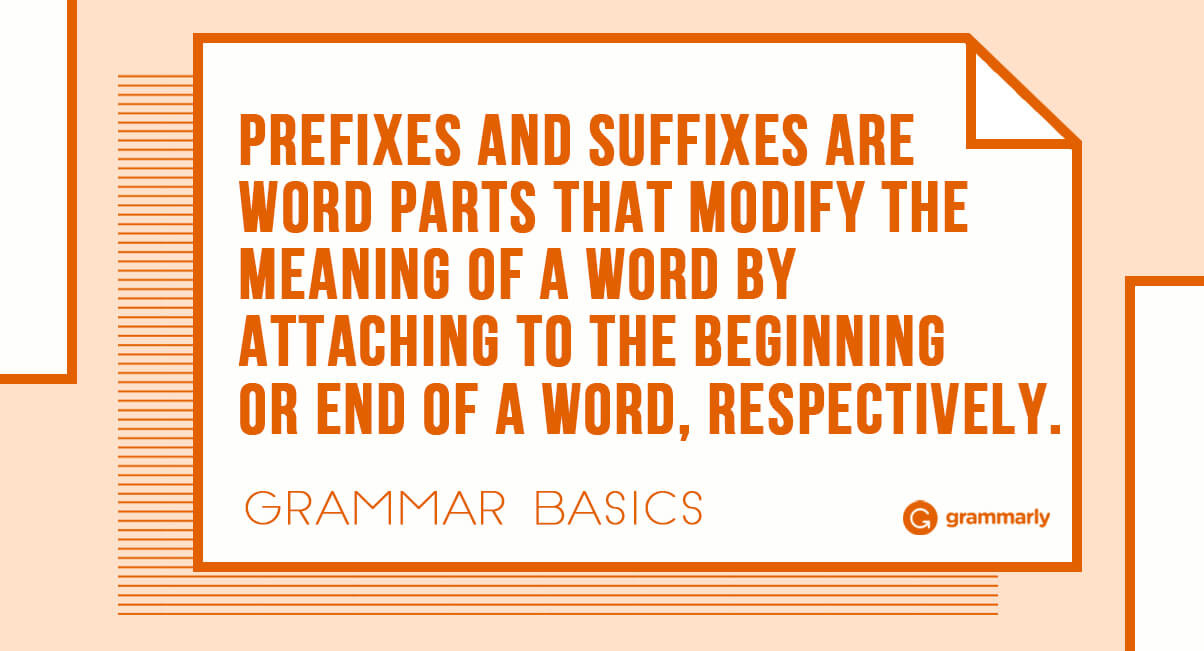
Prefixes come at the beginning of a word. They are usually one to three letters long, and attaching them to a word will affect the word’s meaning. Some prefixes even combine with other prefixes to create words such as unpremeditated (un+ pre+ meditated).
Dis- means not, absence of, apart, away, or having a reversing force. Since dis- means not, what does disoriented mean? It’s pretty simple when you know the prefix.
Mis- and mal- mean wrong or bad and are sometimes used for negation. Besides the common mistake, these prefixes also introduce the words misaligned, misfit, malformed, and malfunction.
Im- and its variant in- mean not. Think impossible, impregnable, incapable, inconceivable.
Un- also means not. It is a very common prefix seen in words such as unstoppable, unconquered, and unrestrained. In fact, there are quite a few prefixes that mean not. Don’t forget il- as in illogical and ir- as in irreversible.
Extra- is not just a brand of gum. As a prefix, it means beyond. Extraterrestrials live beyond the boundaries of our earth. Extrasensory perception refers to receiving information beyond what your senses would normally detect.
Superman illustrates the prefix super- to a tee. Didn’t he go above and beyond to save lives?
Lots of prefixes clue us in on size. Especially large things are described with prefixes like mega- and macro- while small things are micro- or mini-. That information can help you to buy electronics: Would you prefer a minicomputer or one with more megabytes?
Equi- means equal, as in equidistant. The semi- of semigloss paint lets you know that it is only partially glossy.
Other prefixes indicate quantity like over- (excess) and under- (insufficiency).
Prefixes can tell you how much of something there is. Mono- and uni- mean one. How many wheels does a unicycle have? How many people speak during a monologue? Bi- and di- refer to two. For a comprehensive list of numerical prefixes, visit Factmonster.com.
If you like to know where things are, you will appreciate the following group of prefixes. They designate locations. You can remember them by associating them with common examples. Submarines go under the water. Transporters carry goods across distances from one place to another. The infrastructure is the basic framework underlying an organization. Peripheral vision helps you to see around yourself.
These prefixes involve time and order. Difficult words like antecedent and precedent are simpler to decode if you remember that ante- and pre- mean before.
Post- means after. Retro- signifies backward. Prim(e)- denotes first.
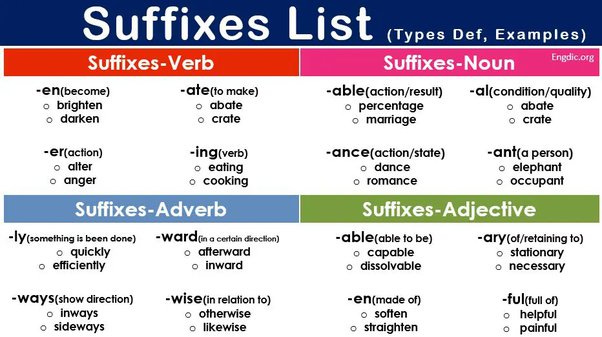
You find suffixes at the ends of words. Like prefixes, they are a rich source of information about a word. Have you ever seen blue or pink balloons at a baby shower? Some parents use colors to indicate the sex of their new baby. In the same way, some suffixes announce what part of speech a word is. Here are some examples.
The following suffixes are usually found at the end of nouns: -ance, -ation, -ness, -ism, -ment, -ship.
Beyond giving clues to the part of speech, suffixes also carry meaning. The endings -er, -or, -ist, or -yst are commonly added to words for people who perform certain tasks or activities. Examples include programmer, calculator, analyst, and abolitionist.
There are several suffixes associated with the meaning to make. By combining the baseactive with the suffix -ate, you create the word activate, which means to make active.
Other suffixes with this meaning are -ize, -ise, -ify, and -en. What verbs do you know that end with these suffixes?
In the majority of cases, adverbs are formed by adding -ly to an adjective. For instance, beautiful becomes beautifully. If the adjective already ends with a y as in easy, you would replace the y with -ily to form the adverb easily. There is a special rule for adjectives ending in -able, -ible, or -le: replace the -e with -y. For most words ending in -ic (with the exception of public) add -ally.
Brownish is a color strongly reminiscent of brown, but not quite brown. People have a lot of fun with -ish because it means similar. You may even hear someone use this suffix alone in response to a question. Sally and Peter are dating, aren’t they? …Ish! The slang use of the suffix means “something like that.”
-Al, -ar, -ed, -ic, -ical, and -ive signify having the quality of. Magnetic objects, for example, have qualities of magnets.
The -ous of dangerous means full of or like, while -less means without.
Do you ever feel disoriented, unhinged, or disarranged? If you used hints from the prefixes and suffixes in these words, you realized that they are synonyms of disoriented. Next time you encounter a tough word, don’t panic. Use those little building blocks to guess the meaning of the term.
Oral histories are invaluable resources, capturing the raw, unfiltered essence of human experience. These spoken narratives preserve the voices of individuals in a way that written records or secondhand accounts never could. However, one question often arises when transcribing oral histories: Should profanity be included in the transcript?
At Adept Word Management, we firmly believe that, unless specifically instructed otherwise, profanity has a rightful place in oral history transcripts. Here’s why:
Oral histories aim to preserve not just the content of what was said but also how it was said. The tone, choice of words, and expressions—all contribute to the authenticity of the narrative. Profanity, when used, is often a deliberate part of the speaker’s vocabulary. It reflects their personality, cultural background, and the emotions of the moment. To sanitize such language risks losing the speaker’s true voice and, with it, the integrity of their story.
Profanity is often used to emphasize strong emotions—joy, frustration, anger, or disbelief. Imagine a speaker recounting a harrowing or deeply personal experience, punctuated by expletives that underscore the intensity of their feelings. Removing those words dilutes the power of the moment. Including profanity in the transcript ensures the reader feels the full emotional weight of the speaker’s account, as they intended to express it.
As transcriptionists, our role is not to judge, censor, or reinterpret. Our job is to provide an accurate and faithful record of what was said. Censorship, even with the best intentions, undermines the purpose of oral histories—to preserve history as it was experienced and conveyed by the speaker.
Oral histories are often used by historians, sociologists, and other researchers to understand the past. Omitting or altering profanity can lead to misinterpretations. Researchers depend on transcripts to provide a transparent record of the speaker’s thoughts and experiences. Inaccuracies, no matter how small, compromise the transcript’s usefulness as a historical document.
When someone shares their story, they’re trusting us to document it accurately. Changing or omitting their words without consent is a breach of that trust. If the speaker chose to use profanity, it’s our responsibility to honor that choice.
We understand that including profanity in transcripts might not sit well with all audiences. However, context is key. The researchers or institutions who comission the transcripts can take different paths to deal with profanity if they decide to make the oral histories public in any way. For instance, if the transcript will be shared widely, it can include a note at the beginning indicating that the content reflects the speaker’s authentic language, including profanity. This ensures transparency while maintaining the integrity of the record.
Preserving oral histories is about capturing humanity in all its complexity—the good, the bad, and yes, even the profane. Words matter. They’re windows into the speaker’s mind, culture, and emotions. By including profanity, we ensure that we’re not just transcribing words but preserving stories as they were truly told.
AI mistakes that our brilliant transcriptionist caught!

AI: Well, I’m not the only one of Hills resident.
What he REALLY said: Well, I’m not the only one that heals fast then.
AI: The chairman didn’t put up much of a fight.
What he REALLY said: The Germans didn’t put up much of a fight.
AI: We got other companies taking you guys please.
What he REALLY said: We got other companies taking you guys’ place.
AI: So they sent me back to sing with.
What he REALLY said: So they sent me back to St. Vith.
AI: I think the gentleman going to give up.
What he REALLY said: I think the Germans are going to give up.
AI: We didn’t know it was a personal compound.
What he REALLY said: We didn’t know it was a prisoner compound.
AI: I said hi, Swastika.
What he REALLY said: I said, Heiss wasser.
AI: Oh, please call Miramar.
What he REALLY said: Oh, that place is called Miramar.
AI: Okay, Holocaust Louis, Missouri.
What he REALLY said: Okay, I’ll go to St. Louis, Missouri.
AI: Still more like Guangzhou.
=What he REALLY said:
Still more like ground troops.
Show: The Tonight Show Starring Jimmy Fallon
Date: July 15, 2023
Caption Error: “I love to eat large flies.” instead of “I love to eat large fries”
Show: Good Morning America
Date: August 3, 2023
Caption Error: “Breaking news: Giant band escapes zoo.” instead of “Breaking news: Giant panda escapes zoo”
Show: The Ellen DeGeneres Show
Date: June 22, 2023
Caption Error: “Let’s give a warm round of applesauce” instead of “Let’s give a warm round of applause.”
Show: Jeopardy!
Date: May 10, 2023
Caption Error: “This famous artist painted the Mona Pizza.” instead of “This famous artist painted the Mona Lisa”
Show: The Late Show with Stephen Colbert
Date: July 30, 2023
Caption Error: “The president undressed the nation.” instead of “The president addressed the nation”
Show: Saturday Night Live
Date: April 1, 2023
Caption Error: “Live from New York, it’s Saturday fight!” instead of “Live from New York, it’s Saturday night!”
Show: The View
Date: August 12, 2023
Caption Error: “We need to undress this serious issue.” instead of “We need to address this serious issue”
Show: The Big Bang Theory
Date: March 25, 2023
Caption Error: “Sheldon loves his pot on the couch.” instead of “Sheldon loves his spot on the couch”
Show: Friends
Date: May 5, 2023 (rerun)
Caption Error: “We were on a brake!” instead of “We were on a break!”
Show: The Simpsons
Date: June 18, 2023
Caption Error: “Dough!” instead of “D’oh!”
Show: Wheel of Fortune
Date: July 7, 2023
Caption Error: “I’d like to buy a towel.” instead of “I’d like to buy a vowel”
Show: The Bachelor
Date: February 14, 2023
Caption Error: “Will you accept this nose?” instead of “Will you accept this rose?”
Show: America’s Got Talent
Date: August 20, 2023
Caption Error: “That was an amazing perfume.” instead of “That was an amazing performance”
Show: The Office
Date: April 10, 2023 (rerun)
Caption Error: “That’s what cheese said.” instead of “That’s what she said”
Show: Grey’s Anatomy
Date: March 15, 2023
Caption Error: “We need to cooperate immediately.” instead of “We need to operate immediately”
Show: Stranger Things
Date: July 4, 2023
Caption Error: “The Demogorgon is humming.” instead of “The Demogorgon is coming”