AI ‘brain decoder’ can read a person’s thoughts with just a quick brain scan and almost no training

AI ‘brain decoder’ can read a person’s thoughts with just a quick brain scan and almost no training

Scientists have made new improvements to a “brain decoder” that uses artificial intelligence (AI) to convert thoughts into text.

Their new converter algorithm can quickly train an existing decoder on another person’s brain, the team reported in a new study. The findings could one day support people with aphasia, a brain disorder that affects a person’s ability to communicate, the scientists said.

Thanks for reading Capturing Voices! Subscribe for free to receive new posts and support my work.

A brain decoder uses machine learning to translate a person’s thoughts into text, based on their brain’s responses to stories they’ve listened to. However, past iterations of the decoder required participants to listen to stories inside an MRI machine for many hours, and these decoders worked only for the individuals they were trained on.

“People with aphasia oftentimes have some trouble understanding language as well as producing language,” said study co-author Alexander Huth, a computational neuroscientist at the University of Texas at Austin (UT Austin). “So if that’s the case, then we might not be able to build models for their brain at all by watching how their brain responds to stories they listen to.”

In the new research, published Feb. 6 in the journal Current Biology, Huth and co-author Jerry Tang, a graduate student at UT Austin investigated how they might overcome this limitation. “In this study, we were asking, can we do things differently?” he said. “Can we essentially transfer a decoder that we built for one person’s brain to another person’s brain?”

The researchers first trained the brain decoder on a few reference participants the long way — by collecting functional MRI data while the participants listened to 10 hours of radio stories.

Then, they trained two converter algorithms on the reference participants and on a different set of “goal” participants: one using data collected while the participants spent 70 minutes listening to radio stories, and the other while they spent 70 minutes watching silent Pixar short films unrelated to the radio stories.

Using a technique called functional alignment, the team mapped out how the reference and goal participants’ brains responded to the same audio or film stories. They used that information to train the decoder to work with the goal participants’ brains, without needing to collect multiple hours of training data.

Next, the team tested the decoders using a short story that none of the participants had heard before. Although the decoder’s predictions were slightly more accurate for the original reference participants than for the ones who used the converters, the words it predicted from each participant’s brain scans were still semantically related to those used in the test story.

For example, a section of the test story included someone discussing a job they didn’t enjoy, saying “I’m a waitress at an ice cream parlor. So, um, that’s not … I don’t know where I want to be but I know it’s not that.” The decoder using the converter algorithm trained on film data predicted: “I was at a job I thought was boring. I had to take orders and I did not like them so I worked on them every day.” Not an exact match — the decoder doesn’t read out the exact sounds people heard, Huth said — but the ideas are related.

“The really surprising and cool thing was that we can do this even not using language data,” Huth told Live Science. “So we can have data that we collect just while somebody’s watching silent videos, and then we can use that to build this language decoder for their brain.”

Using the video-based converters to transfer existing decoders to people with aphasia may help them express their thoughts, the researchers said. It also reveals some overlap between the ways humans represent ideas from language and from visual narratives in the brain.

“This study suggests that there’s some semantic representation which does not care from which modality it comes,” Yukiyasu Kamitani, a computational neuroscientist at Kyoto University who was not involved in the study, told Live Science. In other words, it helps reveal how the brain represents certain concepts in the same way, even when they’re presented in different formats.

The team’s next steps are to test the converter on participants with aphasia and “build an interface that would help them generate language that they want to generate,” Huth said.


Thanks for reading Capturing Voices! Subscribe for free to receive new posts and support my work.

AI ‘brain decoder’ can read a person’s thoughts with just a quick brain scan and almost no training

AI ‘brain decoder’ can read a person’s thoughts with just a quick brain scan and almost no training

Scientists have made new improvements to a “brain decoder” that uses artificial intelligence (AI) to convert thoughts into text.

Their new converter algorithm can quickly train an existing decoder on another person’s brain, the team reported in a new study. The findings could one day support people with aphasia, a brain disorder that affects a person’s ability to communicate, the scientists said.

Thanks for reading Capturing Voices! Subscribe for free to receive new posts and support my work.

A brain decoder uses machine learning to translate a person’s thoughts into text, based on their brain’s responses to stories they’ve listened to. However, past iterations of the decoder required participants to listen to stories inside an MRI machine for many hours, and these decoders worked only for the individuals they were trained on.

“People with aphasia oftentimes have some trouble understanding language as well as producing language,” said study co-author Alexander Huth, a computational neuroscientist at the University of Texas at Austin (UT Austin). “So if that’s the case, then we might not be able to build models for their brain at all by watching how their brain responds to stories they listen to.”

In the new research, published Feb. 6 in the journal Current Biology, Huth and co-author Jerry Tang, a graduate student at UT Austin investigated how they might overcome this limitation. “In this study, we were asking, can we do things differently?” he said. “Can we essentially transfer a decoder that we built for one person’s brain to another person’s brain?”

The researchers first trained the brain decoder on a few reference participants the long way — by collecting functional MRI data while the participants listened to 10 hours of radio stories.

Then, they trained two converter algorithms on the reference participants and on a different set of “goal” participants: one using data collected while the participants spent 70 minutes listening to radio stories, and the other while they spent 70 minutes watching silent Pixar short films unrelated to the radio stories.

Using a technique called functional alignment, the team mapped out how the reference and goal participants’ brains responded to the same audio or film stories. They used that information to train the decoder to work with the goal participants’ brains, without needing to collect multiple hours of training data.

Next, the team tested the decoders using a short story that none of the participants had heard before. Although the decoder’s predictions were slightly more accurate for the original reference participants than for the ones who used the converters, the words it predicted from each participant’s brain scans were still semantically related to those used in the test story.

For example, a section of the test story included someone discussing a job they didn’t enjoy, saying “I’m a waitress at an ice cream parlor. So, um, that’s not … I don’t know where I want to be but I know it’s not that.” The decoder using the converter algorithm trained on film data predicted: “I was at a job I thought was boring. I had to take orders and I did not like them so I worked on them every day.” Not an exact match — the decoder doesn’t read out the exact sounds people heard, Huth said — but the ideas are related.

“The really surprising and cool thing was that we can do this even not using language data,” Huth told Live Science. “So we can have data that we collect just while somebody’s watching silent videos, and then we can use that to build this language decoder for their brain.”

Using the video-based converters to transfer existing decoders to people with aphasia may help them express their thoughts, the researchers said. It also reveals some overlap between the ways humans represent ideas from language and from visual narratives in the brain.

“This study suggests that there’s some semantic representation which does not care from which modality it comes,” Yukiyasu Kamitani, a computational neuroscientist at Kyoto University who was not involved in the study, told Live Science. In other words, it helps reveal how the brain represents certain concepts in the same way, even when they’re presented in different formats.

The team’s next steps are to test the converter on participants with aphasia and “build an interface that would help them generate language that they want to generate,” Huth said.

Thanks for reading Capturing Voices! Subscribe for free to receive new posts and support my work.

Don’t Miss Out – Celebrate the First OHA Day!

Don’t Miss Out – Celebrate the First OHA Day!

Join us in supporting the Oral History Association by giving to the general endowment and sharing what OHA means to you! Your gift today will be DOUBLED! Thanks to a generous pledge from OHA Past Presidents and the History Task Force, every dollar you donate—up to $7,000—will be matched. Plus, OHA Council members have shown […]

This Is a List of Keywords in Grant Applications that Trump’s Henchmen Are Looking For

This Is a List of Keywords in Grant Applications that Trump’s Henchmen Are Looking For

According to The Washington Post, “At the National Science Foundation, staff have been combing through thousands of active science research projects, alongside a list of keywords, to determine if they include activities that violate executive orders President Donald Trump issued in his first week in office. Those include orders to recognize only two genders and roll back diversity, equity and inclusion initiatives. The search is driven by dozens of flagged words, according to an internal document reviewed by The Washington Post and two NSF employees with knowledge of the review process who spoke on the condition of anonymity because they were not authorized to speak.”

Thanks for reading Capturing Voices! Subscribe for free to receive new posts and support my work.

The words triggering NSF reviews provide a picture of the sievelike net being cast over the typically politically independent scientific enterprise, including words like “trauma,” “barriers,” “equity” and “excluded.”

Here is a sampling of keywords drawing scrutiny to science:

activism

activists

advocacy

advocate

advocates

barrier

barriers

biased

biased toward

biases

biases towards

bipoc

black and latinx

community diversity

community equity

cultural differences

cultural heritage

culturally responsive

disabilities

disability

discriminated

discrimination

discriminatory

diverse backgrounds

diverse communities

diverse community

diverse group

diverse groups

diversified diversify

diversifying

diversity and inclusion

diversity equity

enhance the diversity

enhancing diversity

equal opportunity

equality

equitable

equity

ethnicity

excluded

female

females

fostering inclusivity

gender

gender diversity

genders

hate speech

hispanic minority

historically

implicit bias

implicit biases

inclusion

inclusive

inclusiveness

inclusivity

increase diversity

increase the diversity

indigenous community

inequalities

inequality

inequitable

inequities

institutional

Igbt

marginalize

marginalized

minorities

minority

multicultural

polarization

political

prejudice

privileges

promoting diversity

race and ethnicity

racial

racial diversity

This list is not a complete list, although it is quite extensive.

The Washington Post adds that “According to an internal document, NSF grants that are flagged for “further action” because they don’t comply with the executive orders could be subject to a range of additional steps, including modification to be in compliance or being terminated in part or whole.”

Thanks for reading Capturing Voices! Subscribe for free to receive new posts and support my work.

Got jobs to finish up quickly? We can help! We’re FAST and good! We’ll finish those last minute jobs up for you in no time.

Got jobs to finish up quickly? We can help! We’re FAST and good! We’ll finish those last minute jobs up for you in no time.

NASA pauses work by key space science groups amid Trump executive orders

By Tariq Malik

The space agency’s planetary science analysis groups must pause while NASA checks if they comply with Trump’s orders.

NASA has ordered key planetary science committees for Mars, moon and other exploration to pause all work due to Trump administration executive orders. (Image credit: NASA)

NASA has ordered a pause on all work by key planetary and astrophysics science committees due to recent executive orders by President Donald Trump.

In a series of memos sent from NASA headquarters late Friday (Jan. 31), the space agency directed the leaders of at least 10 planetary science assessment and analysis groups that cover a wide range of topics, from the exploration of the moon and solar system planets to “ocean worlds” like the icy moons of Saturn and Jupiter. According to SpaceNews, NASA’s astrophysics assessment groups received similar memos, all of which cited a need to ensure the groups were in compliance with recent executive orders by Trump.

“As NASA continues to review and ensure compliance with presidential actions, we are requesting that you please pause all meetings and activities of Planetary Science Analysis/Assessment Groups,” read one NASA memo to the Mercury Exploration Assessment Group, which was obtained by Space.com and was nearly identical to memos sent to other planetary science committees.

The memos cited six Trump executive actions, three of them aimed at ending diversity, equity and inclusion (DEI) programs in the federal government. Two others targeting so-called “gender ideology extremism,” while another referred to “Unleashing American Energy” that roll back climate change-related executive orders by the Biden administration.

You may like

The pause order from NASA headquarters has already led to the cancellation of at least one planetary science meeting. The Mercury exploration group, known by the acronym MExAG was scheduled to hold its first in-person meeting this week from Feb. 4 to Feb. 6, but will no longer meet.

“We are forced, therefore, to cancel MExAG 2025,” the Mercury committee’s chair Carolyn Ernst, a planetary scientist with Johns Hopkins University Applied Physics Laboratory, wrote in a memo obtained by Space.com. “This turn of events is shocking and concerning, and is extra painful given the order comes four days before our first in-person meeting.” Some committee members had already begun travel for the meeting, Ernst added.

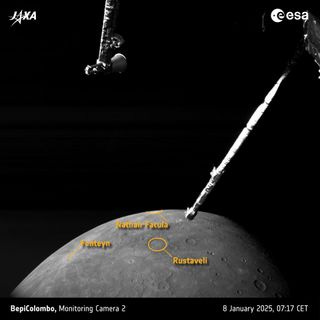
The nearly three-day hybrid meeting was expected to include at up 200 scientists attending either in person of virtually, one scientist Ed Rivera-Valentin shared on the social media site Bluesky. It was expected to include a number of researchers connected to the BepiColombo Mercury mission run by the Japan Aerospace Exploration Agency and the European Space Agency. The probe just made its sixth flyby of Mercury on Jan. 8.

Lava and debris on Mercury's surface as seen by the ESA/JAXA BepiColombo mission on 8 January 2025 during its sixth flyby

Lava and debris on Mercury’s surface as seen by the ESA/JAXA BepiColombo mission on 8 January 2025 during its sixth flyby (Image credit: ESA/BepiColombo/MTM)

“The MExAG steering committee is heartbroken that our first in-person meeting was cancelled due to this,” scientist Mallory Kinczyk wrote on Bluesky.

Vicky Hamilton, a planetary geologist with the Southwest Research Institute who chairs NASA’s Mars Exploration Program Analysis Group, said in a memo to her committee that the group has stopped planning work for its own meeting scheduled for April.

“We will let everyone know as soon as we are able to resume work,” she wrote in a memo obtained by Space.com.

NASA’s assessment and analysis groups meet regularly to assess the latest discoveries and missions in their specific fields and report them back to the space agency’s internal planetary science and astrophysics divisions. While they provide key insight into space science, the groups are not formal advisory committees overseen by the Federal Advisory Committee Act, according to SpaceNews. Many of the planetary science committees are overseen by the Lunar and Planetary Institute, which itself is managed by the Universities Space Research Association.

Related Stories:

Trump wants the US to land astronauts on Mars soon. Could it happen?

Trump says he’d create a Space National Guard if elected

—  Trump’s space policy won’t catch Europe off guard, ESA chief says

NASA’s pause order to its analysis groups is one of several agency changes that have followed executive orders from the Trump administration.

The agency has begun restricting funding to programs related to diversity, equity and inequality, including to a Here to Observer program that connected students from underrepresented groups with NASA planetary science missions, according to SpaceNews.

SpaceNews also reported that the agency has removed a 2023 article about the NASA astronaut class of 1978, a team that included the agency’s first Black, Asian-American and female astronauts, written by NASA’s own history office. It appears to have been removed by Jan. 29, after being accessible as late as Jan. 25, SpaceNews added. You can still find the article on the Internet Archive.

Space.com has reached out to NASA headquarters for comment and will update this story if one is received.

Thanks for reading Capturing Voices! Subscribe for free to receive new posts and support my work.

Got jobs to finish up quickly? We can help! We’re FAST and good! We’ll finish those last minute jobs up for you in no time.

Got jobs to finish up quickly? We can help! We’re FAST and good! We’ll finish those last minute jobs up for you in no time.

NASA pauses work by key space science groups amid Trump executive orders

By Tariq Malik

The space agency’s planetary science analysis groups must pause while NASA checks if they comply with Trump’s orders.

NASA has ordered key planetary science committees for Mars, moon and other exploration to pause all work due to Trump administration executive orders. (Image credit: NASA)

NASA has ordered a pause on all work by key planetary and astrophysics science committees due to recent executive orders by President Donald Trump.

In a series of memos sent from NASA headquarters late Friday (Jan. 31), the space agency directed the leaders of at least 10 planetary science assessment and analysis groups that cover a wide range of topics, from the exploration of the moon and solar system planets to “ocean worlds” like the icy moons of Saturn and Jupiter. According to SpaceNews, NASA’s astrophysics assessment groups received similar memos, all of which cited a need to ensure the groups were in compliance with recent executive orders by Trump.

“As NASA continues to review and ensure compliance with presidential actions, we are requesting that you please pause all meetings and activities of Planetary Science Analysis/Assessment Groups,” read one NASA memo to the Mercury Exploration Assessment Group, which was obtained by Space.com and was nearly identical to memos sent to other planetary science committees.

The memos cited six Trump executive actions, three of them aimed at ending diversity, equity and inclusion (DEI) programs in the federal government. Two others targeting so-called “gender ideology extremism,” while another referred to “Unleashing American Energy” that roll back climate change-related executive orders by the Biden administration.

You may like

The pause order from NASA headquarters has already led to the cancellation of at least one planetary science meeting. The Mercury exploration group, known by the acronym MExAG was scheduled to hold its first in-person meeting this week from Feb. 4 to Feb. 6, but will no longer meet.

“We are forced, therefore, to cancel MExAG 2025,” the Mercury committee’s chair Carolyn Ernst, a planetary scientist with Johns Hopkins University Applied Physics Laboratory, wrote in a memo obtained by Space.com. “This turn of events is shocking and concerning, and is extra painful given the order comes four days before our first in-person meeting.” Some committee members had already begun travel for the meeting, Ernst added.

The nearly three-day hybrid meeting was expected to include at up 200 scientists attending either in person of virtually, one scientist Ed Rivera-Valentin shared on the social media site Bluesky. It was expected to include a number of researchers connected to the BepiColombo Mercury mission run by the Japan Aerospace Exploration Agency and the European Space Agency. The probe just made its sixth flyby of Mercury on Jan. 8.

Lava and debris on Mercury's surface as seen by the ESA/JAXA BepiColombo mission on 8 January 2025 during its sixth flyby

Lava and debris on Mercury’s surface as seen by the ESA/JAXA BepiColombo mission on 8 January 2025 during its sixth flyby (Image credit: ESA/BepiColombo/MTM)

“The MExAG steering committee is heartbroken that our first in-person meeting was cancelled due to this,” scientist Mallory Kinczyk wrote on Bluesky.

Vicky Hamilton, a planetary geologist with the Southwest Research Institute who chairs NASA’s Mars Exploration Program Analysis Group, said in a memo to her committee that the group has stopped planning work for its own meeting scheduled for April.

“We will let everyone know as soon as we are able to resume work,” she wrote in a memo obtained by Space.com.

NASA’s assessment and analysis groups meet regularly to assess the latest discoveries and missions in their specific fields and report them back to the space agency’s internal planetary science and astrophysics divisions. While they provide key insight into space science, the groups are not formal advisory committees overseen by the Federal Advisory Committee Act, according to SpaceNews. Many of the planetary science committees are overseen by the Lunar and Planetary Institute, which itself is managed by the Universities Space Research Association.

Related Stories:

Trump wants the US to land astronauts on Mars soon. Could it happen?

Trump says he’d create a Space National Guard if elected

—  Trump’s space policy won’t catch Europe off guard, ESA chief says

NASA’s pause order to its analysis groups is one of several agency changes that have followed executive orders from the Trump administration.

The agency has begun restricting funding to programs related to diversity, equity and inequality, including to a Here to Observer program that connected students from underrepresented groups with NASA planetary science missions, according to SpaceNews.

SpaceNews also reported that the agency has removed a 2023 article about the NASA astronaut class of 1978, a team that included the agency’s first Black, Asian-American and female astronauts, written by NASA’s own history office. It appears to have been removed by Jan. 29, after being accessible as late as Jan. 25, SpaceNews added. You can still find the article on the Internet Archive.

Space.com has reached out to NASA headquarters for comment and will update this story if one is received.

Thanks for reading Capturing Voices! Subscribe for free to receive new posts and support my work.