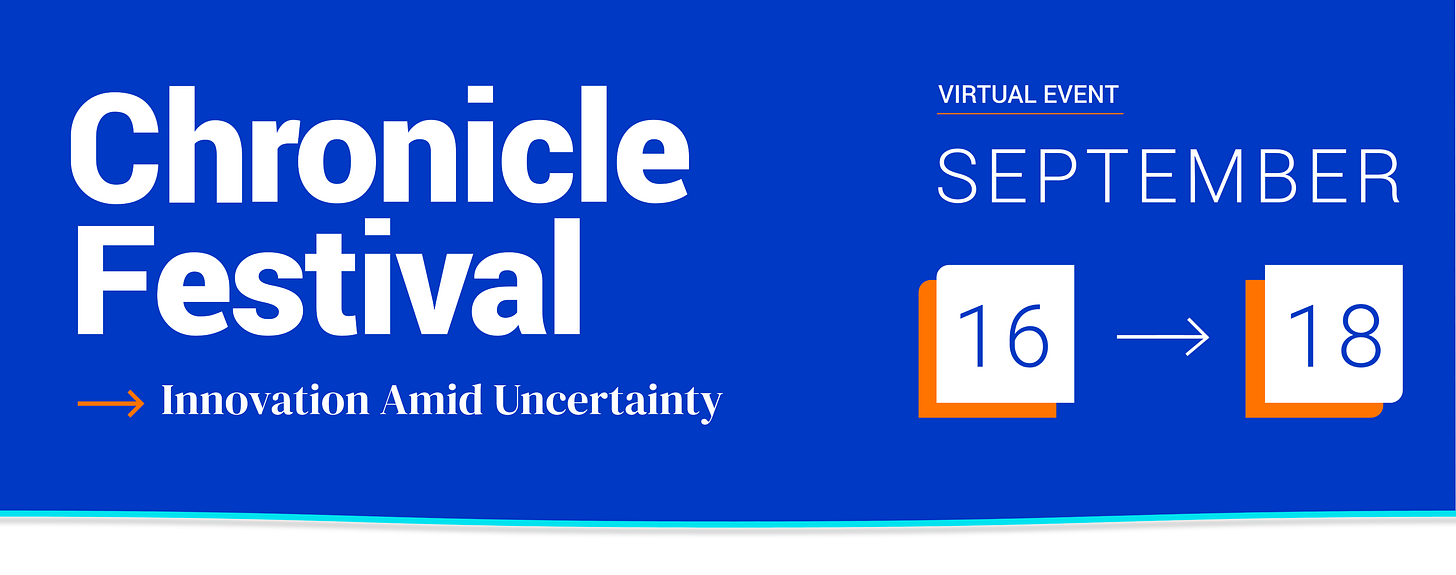
CHRONICLE FOR HIGHER EDUCATION

——>Innovation Amid Uncertainty

Real Conversations. Smart Solutions. Big-Picture Thinking.

How should colleges respond to rising political pressure? What’s next for the bachelor’s degree? Where does AI fit into the curriculum?

Chronicle Festival 2025 brings answers—and bold new questions—directly to your screen. This free virtual event (Sept. 16–18) features thought leaders and campus executives on what’s working and what’s ahead.

You’ll hear from…

And takeaway:

Day 1 | The Gen Z Puzzle

How changing demographics and attitudes are reshaping campus culture

Day 2 | Innovating Leadership

Approaches to uphold honesty while integrating emergent technology

Day 3 | A Catalyst for the Work Force

Real-world adaptation in institutional environments serving diverse futures

Register Now

Register for Free

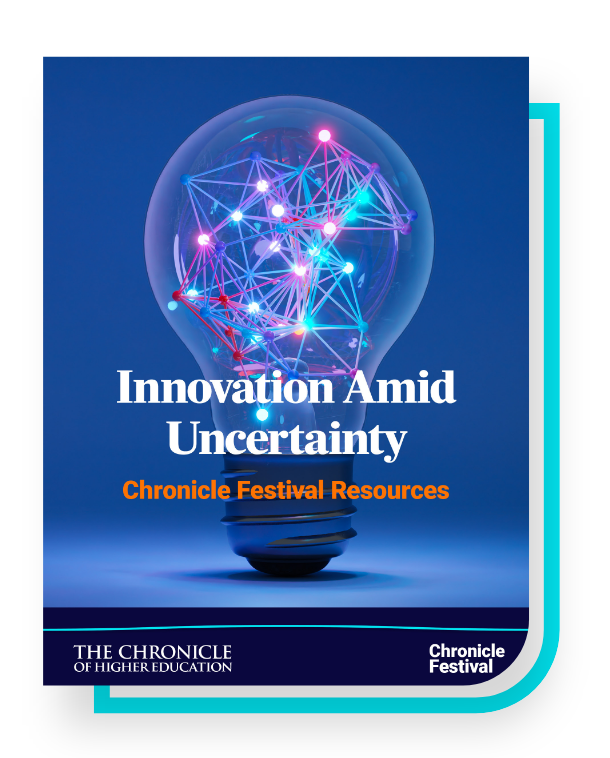
Plus, when you register, you will gain immediate access to a free Chronicle Festival companion collection containing excerpts from our most popular in-depth newsroom reports. Our Innovation Amid Uncertainty collection aims to provide valuable insights into the key themes of this year’s Festival.

Register Today

Thanks for reading Capturing Voices! Subscribe for free to receive new posts and support my work.

1255 23rd Street, N.W. Washington, D.C. 20037

© 2025 The Chronicle of Higher Education

Privacy Policy |
Unsubscribe or update your email preferences here

OHA’s Annual Business Meeting – Virtual Event

OHA’s Annual Business Meeting – Virtual Event

OHA’s Annual Business Meeting is happening virtually on September 30th from 2:30PM to 4:00 PM CDT. This is a great opportunity to get updated on important developments within our organization, review our financial position, discuss future plans, and vote on bylaw changes. Registration is required. Please register via the link below. Once registered, you should receive […]

Synthetic sugar-coated nanoparticle blocks Covid-19 from infecting human cells

https://www.news-medical.net/news/20250811/Synthetic-sugar-coated-nanoparticle-blocks-Covid-19-from-infecting-human-cells.aspx

Groundbreaking research led by a Swansea University academic has revealed a synthetic glycosystem – a sugar-coated polymer nanoparticle – that can block Covid-19 from infecting human cells, reducing infection rates by nearly 99%.

The glycosystem is a specially designed particle that mimics natural sugars found on human cells. These sugars, known as polysialosides, are made of repeating units of sialic acid – structures that viruses often target to begin infection. By copying this structure, the synthetic molecule acts as a decoy, binding to the virus’s spike protein and preventing it from attaching to real cells.

Unlike vaccines, which trigger immune responses, this molecule acts as a physical shield, offering a novel approach to infection prevention.

Using advanced lab techniques to measure molecular interactions and simulate virus binding, researchers found that the glycosystem binds to the virus 500 times more strongly than a similar compound containing sulphates but no sugars. It was also effective at very low doses and worked against both the original SARS-CoV-2 strain and the more infectious D614G variant.

Tests on human lung cells showed a 98.6% reduction in infection when the molecule was present. Crucially, the research highlighted that its effectiveness stems not just from its charge, but from its precise sugar structure – giving this glycosystem its powerful infection-blocking capability.

The discovery is the result of collaboration between Swansea University, Freie Universität Berlin, and Charité – Universitätsmedizin Berlin.

Ultimate guide to the essential tools for the characterization of proteins, polymers and nanoparticles eBook Compilation of the top interviews, articles, and news in the last year.Download the latest edition

As the main corresponding author and research supervisor, Dr Sumati Bhatia, Senior Lecturer in Chemistry at Swansea University, said: “Leading this research, alongside our international partners, has been incredibly rewarding. It opens a new direction for using glycosystems as a therapeutic strategy against SARS-CoV-2 and could lay the foundation for a new class of antiviral therapies to protect those most at risk.”

The team is now preparing for further biological testing in high-containment laboratories to assess the molecule’s effectiveness against multiple virus strains.

T

Thanks for reading Capturing Voices! Subscribe for free to receive new posts and support my work.

his breakthrough could pave the way for antiviral nasal sprays, surface disinfectants, and treatments to protect vulnerable groups, offering a new line of defense against Covid-19 and future pandemics.

Source:

Swansea University

Journal reference:

Khatri, V., et al. (2025). Polysialosides Outperform Sulfated Analogs for Binding with SARS-CoV-2. Small. doi.org/10.1002/smll.202500719.

July Q&A from the Chicago Manual of Style

July Q&A from the Chicago Manual of Style

New Questions and Answers

Q. I copyedit a technical journal, and I have a question about how CMOS would handle the term “Fortune 500.” Is “Fortune” (as the name of a publication) set in italics while “500” is not, or is “Fortune 500” treated as a standalone brand or fixed term akin to a trademark, where “Fortune” would be set roman? Thanks.

A. That term could go either way, but we’d refer to it as the Fortune 500, without italics for “Fortune,” following CMOS 8.174: “When the title of a newspaper or periodical is part of the name of a building, organization, prize, or the like, it is not italicized.”

The Fortune 500 (an annual ranking of the top 500 companies in the United States published by Fortune magazine) is analogous to a prize, and the fact that the word “Fortune” is part of the name of the list is what determines our choice.

The Billboard Hot 100 presents a similar case. Some editors would style that as the Billboard Hot 100. But we’d use italics only if referring to that list in terms of the magazine that publishes it, as in Billboard magazine’s Hot 100, or Billboard’s Hot 100 for short.

Thanks for reading Capturing Voices! This post is public so feel free to share it.

Share

Q. Which is correct: “one should do one’s duty” or “one should do his or her duty”—or, using singular they, “one should do their duty”?

A. In your example, one is closer to the personal pronoun you than to the indefinite pronoun everyone. Everyone would normally pair with his, her, or singular their, as in everyone should do their duty (see also CMOS 5.51). One, by contrast, can simply switch to the possessive case like other such pronouns:

I should do my duty; you should do your duty; he should do his duty; she should do her duty; they should do their duty; we should do our duty; one should do one’s duty

According to Bryan Garner, however, writers have tended to pair one with he (and, by extension, one with his), despite objections from “strict grammarians” and others (see Garner’s Modern English Usage, 5th ed. [Oxford, 2022], under “One . . . he”).

We can only hope, then, that we’re doing our duty as arbiters of style by recommending a pairing of one with one’s.

One more, I love their comment “ It can be hard to ignore Microsoft Word’s blue underlines, especially when they’re worded in a way that suggests you’d be wrong to keep the text as is: ‘After an introductory word or phrase, a comma is best.’”

Q. Hello, Chicago. Thanks for your time. I’d like you to confirm the optional comma after a one-word adverb of time (tonight, yesterday, today) starting a sentence. One of my fiction authors is upset because Word is showing blue lines under those words. I told her a comma is optional and Word doesn’t get the nuances. Would you please confirm this so I can calm my jittery author? Thanks again.

A. It can be hard to ignore Microsoft Word’s blue underlines, especially when they’re worded in a way that suggests you’d be wrong to keep the text as is: “After an introductory word or phrase, a comma is best.”

But you can tell your author that we agree with you. In the words of CMOS 6.34, “Although an introductory adverbial phrase can usually be followed by a comma, it need not be unless misreading is likely. Shorter adverbial phrases are less likely to merit a comma than longer ones.”

The adverbs yesterday, tonight, and today aren’t phrases, but each of them derives from one (yesterday comes from Old English giestran dæg), and it’s clear that each is grammatically equivalent to a phrase like next week or in 1965. Plus, any one of these words would qualify as short in the context of introductory adverbial phrases.

To be fair to Word, tonight is the only one among the words and phrases mentioned above (from yesterday through in 1965) that Word’s grammar checker flagged in our tests when it wasn’t followed by a comma (as of July 1, 2025). Conversely, Word didn’t stop on any of them when they were followed by a comma. So it’s not that far out of line with CMOS.

Thanks for reading Capturing Voices! Subscribe for free to receive new posts and support my work.

Tip: To avoid falling under the influence of Word’s blue underlines, some writers prefer to toggle them off as they draft.

A convenient way of doing this is to add a button to the ribbon. In Word for Windows (the desktop version), go to File > Options > Customize Ribbon. Then select All Commands under “Choose commands from” and scroll down until you find Hide Grammar Errors. You can then add that command to a new group under the Home tab (or wherever you want it to appear). Steps for Word for Mac will be similar.

If you use the option under Customize Ribbon to assign a keyboard shortcut to the equivalent command (look for ToolsGrammarHide under the All Commands category in the separate dialog box for keyboard shortcuts), keep the button, which has the important advantage of showing whether it’s on or off (via shading/outline).

Stephen Fry on Words Words Words

Stephen Fry on Words Words Words

I’m so crazy about Stephen Fry, and I have been since the 1990s, watching Stephen Fry and Hugh Laurie in “Jeeves and Wooster.” They were hilarious. And you might not be aware that P.G. Wodehouse was writing to improve British morale between the wars.

The Guardian says: “Countless readers of Wodehouse have testified to the way his novels have their own “stimulating effect” on morale, providing not just comic, but almost medicinal effects: the exiled Kaiser Wilhelm, after his defeat in the first world war, consoled himself by reading Wodehouse to his “mystified” staff; the late Queen Mother allegedly read “The Master” on a nightly basis, to set aside the “strains of the day”; more recently, news reports tell of the imprisoned Burmese comedian Zargana finding comfort in Wodehouse during solitary confinement. “Books are my best friends”, he confided. “I liked the PG Wodehouse best. Joy in the Morning – Jeeves, Wooster and the fearsome Aunt Agatha. It’s difficult to understand, but I’ve read it three times at least. And I used it as a pillow too.” https://www.theguardian.com/books/2011/nov/04/pg-wodehouse-life-in-letters

Sophie Ratcliffe Fri 4 Nov 2011 18.55 EDT

I was fascinated by that and fascinated by the inane comedic stylings of Fry and Lawrie. I’m not the only one; they were enormously popular in England. Imagine my shock when I saw the first episode of House with Bertie Wooster playing a nasty old man!

Stephen Fry, in his post about writing, says “I used to have on my Twitter bio the phrase, “How can I tell you what I think until I’ve heard what I’m going to say?” I could equally as well have had “How can I tell you what I’m going to write until I’ve written it?”

This seems so seminal to the work we do as transcriptionists. We’re capturing those words as they first appear—the speaker’s first—or maybe fiftieth pass at speaking aloud what he’s thinking. That’s our job—to listen carefully, observantly, and capture all the nuances that help the speaker elucidate what he’s thinking!

Thanks for reading Capturing Voices! Subscribe for free to receive new posts and support my work.

In his latest blog post, Words words words Where do they come from?

He muses about writing and putting his thoughts into words.

The Fry Corner
Words words words
I finished a book last week. By which, I mean I finished writing one. Inasmuch as a writer ever dares say they’ve finished. You stand back from the canvas, find yourself unable to resist a closing dab here and a final dot there, but at last, a voice says, “It’s done!” and that is that. Now comes the envoi … “Go little book”, as Chaucer, Spenser, and ot…
Read more

He ends with a joke—one that is as applicable to AI as it is to elves.

Which brings me to a fine Hollywood joke.

Elwood is a screenwriter, and he has been commissioned for a script, his first. The studio has set a deadline of two months. Seven weeks have passed now, and he is getting desperate. Every day, he sits at his computer and tries to type. But he isn’t a third of the way in. Completely stuck.

Elwood stands, sits, kicks the walls. Goes for short walks. Goes for long walks. Nothing comes. He realises that he is either going to have to plead for an extension or pay back the studio’s commission. The night before delivery is due, he sits in his armchair and stares malevolently at the computer. He knows he has to work all night at something, but instead, he falls asleep.

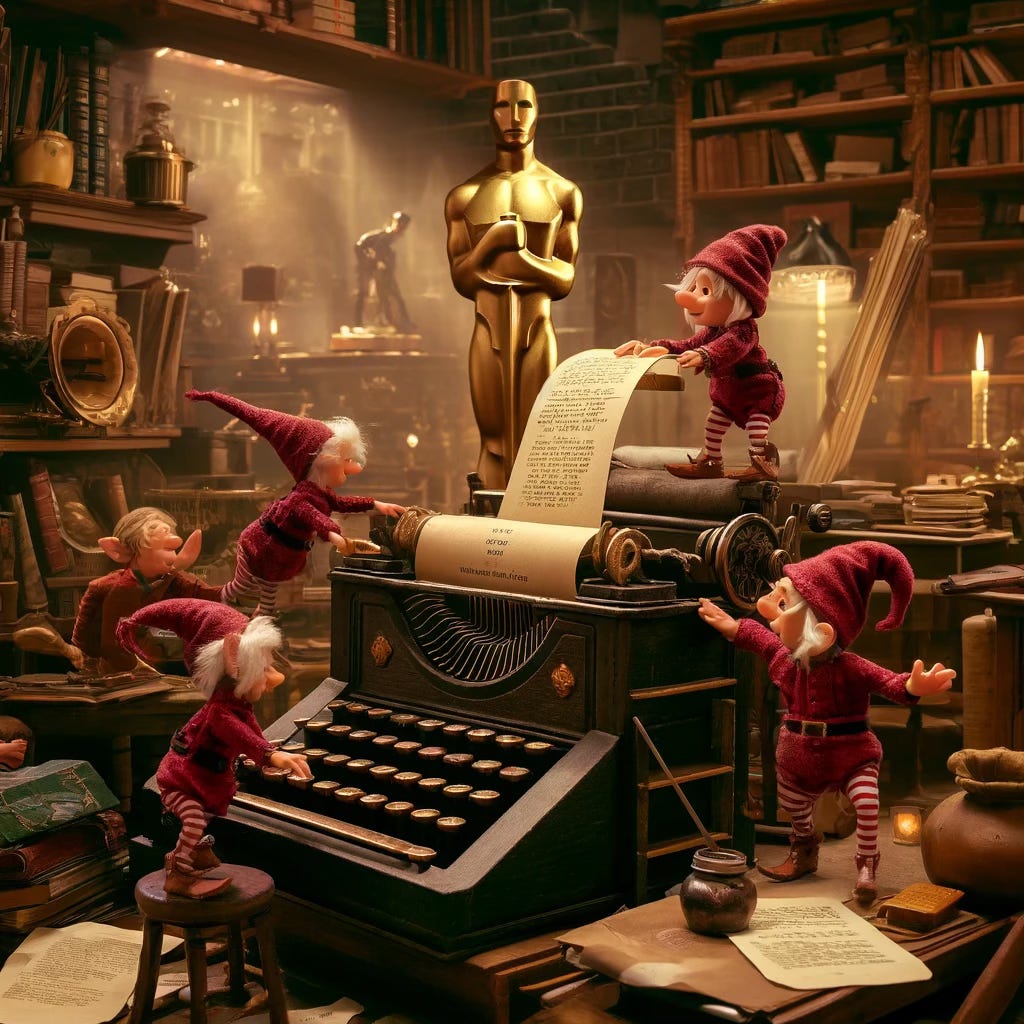
He is awoken at three in the morning by the sound of typing. He opens his eyes and cannot believe what he sees. Two elves are bouncing up and down on the keyboard. Five more elves take pages out of the printer and carefully stack them into a neat sheaf.

‘What are you doing? What’s going on?’ cries Elwood.

‘We’re elves, and we’re writing your screenplay for you.’

‘Wh … ? Huh?’

‘It’s what we do. There aren’t so many shoemakers around these days, so we help out script makers instead.’

‘Yes, but scripts have to have stories…’ Elwood picks up the top page on the sheaf, ‘…and characters and plot twists…’ his voice trails off. The script is good—very good. He takes another piece of paper and another. It’s better than he could possibly have imagined. In fact, it’s brilliant.

He tells them so. ‘Guys, this is amazingly good!’

‘Happy to help, sir.’

‘Can I get you anything? Food, drink?’

‘No, no, we’re ok. Just have three more scenes to finish and then we’re done and we’ll leave you be.’

They are as good as their word. Twenty minutes later Elwood has in his hands a completed screenplay of dazzling quality and originality.

He sends it off to his agent first thing in the morning. A day and a half later, he hears back. The studio is beyond impressed and pleased, and they want a five-picture contract with Elwood. They offer a sum of money that knocks him sideways with joy.

Six months later, he is sitting in his armchair watching script number three chug from the printer. There is now an Oscar on his mantelpiece. Elves are bouncing on the keyboard. All is well.

‘Guys,’ says Elwood for the hundredth time, ‘Are you sure there’s nothing I can get you? Coffee, cookies, marshmallows, anything?’

‘Seriously, we’re good … just happy doing our job.’

‘But money. Surely some money? I’ll give you half, two-thirds of what I’m earning. It’s only fair.’

‘Kind thought, but we don’t use money…’

‘Tell you what though …’ one of the elves on the keyboard stops bouncing up and down, ‘I suppose there is one thing …’

‘Name it!’ says Elwood, thrilled that there might be any means of repayment.

‘You might consider …’ said the elf, ‘that is to say … if we could have, maybe, a screen credit?’

‘Are you out of your fucking minds? Fuck you!’

Muse or Muses, elves, genies, djinns or sprites, no matter how mysterious or even mystical the process of writing may be, no matter how varied the sources of ‘inspiration’, we will take all the credit going, thank you very much.


Thanks for reading Capturing Voices! This post is public so feel free to share it.

Share