Learn your audience’s values, beliefs, and preferred words before developing your material.

Learn your audience’s values, beliefs, and preferred words before developing your material.

This may seem tangential to transcription, but understanding oral history speakers is more than a matter of recording the words. We’ve got to try to understand all the nuances of their speech as well. This video from the CDC illustrates the challenges we face in listening to people—often speaking about incidents that happened long ago—in a time we can’t even remember and have no direct experience with.

Centers for Disease Control and Prevention

Thanks for reading Capturing Voices! Subscribe for free to receive new posts and support my work.

CDC 24/7: Saving Lives, Protecting People™

Do You Have the Words?

Know your audience is one of the basic principles of communication. Learn your audience’s values, beliefs, and preferred words before developing your material. This is especially important when communicating with an audience whose language is different from yours. Some cultures and languages may not have words for the terms you want to use.

A (now retired) CDC public health educator and her team faced this challenge when they wanted to create messaging about colorectal cancer prevention for Iñupiaq tribal communities in Alaska. American Indian and Alaska Native people have much higher rates of colorectal cancer than non-Hispanic White people, but until recently, the Iñupiaq language lacked words for cancer, screening, and other relevant terms. Watch this video to find out what the educator and her team did to overcome this challenge to clear communication. 

Culture and Language Video

Also, check out the Clear Communication Index, a research-based tool that helps you develop and assess communication materials for your intended audience.

Thanks for reading Capturing Voices! Subscribe for free to receive new posts and support my work.

Learn your audience’s values, beliefs, and preferred words before developing your material.

Learn your audience’s values, beliefs, and preferred words before developing your material.

This may seem tangential to transcription, but understanding oral history speakers is more than a matter of recording the words. We’ve got to try to understand all the nuances of their speech as well. This video from the CDC illustrates the challenges we face in listening to people—often speaking about incidents that happened long ago—in a time we can’t even remember and have no direct experience with.

Centers for Disease Control and Prevention

Thanks for reading Capturing Voices! Subscribe for free to receive new posts and support my work.

CDC 24/7: Saving Lives, Protecting People™

Do You Have the Words?

Know your audience is one of the basic principles of communication. Learn your audience’s values, beliefs, and preferred words before developing your material. This is especially important when communicating with an audience whose language is different from yours. Some cultures and languages may not have words for the terms you want to use.

A (now retired) CDC public health educator and her team faced this challenge when they wanted to create messaging about colorectal cancer prevention for Iñupiaq tribal communities in Alaska. American Indian and Alaska Native people have much higher rates of colorectal cancer than non-Hispanic White people, but until recently, the Iñupiaq language lacked words for cancer, screening, and other relevant terms. Watch this video to find out what the educator and her team did to overcome this challenge to clear communication. 

Culture and Language Video

Also, check out the Clear Communication Index, a research-based tool that helps you develop and assess communication materials for your intended audience.

Thanks for reading Capturing Voices! Subscribe for free to receive new posts and support my work.

From the New York Times and Frank Bruni. I LOVE “For the Love of Sentences”

From the New York Times and Frank Bruni. I LOVE “For the Love of Sentences”

For the Love of Sentences

Joyce Dopkeen/The New York Times

For just this week, as a gift to ourselves, let’s have a politics-free edition of this feature. And let’s begin on a musical note. In The News & Observer of Raleigh, N.C., Josh Shaffer pondered the peculiarity of the bagpipe, “shaped like an octopus in plaid pants, sounding to some like a goose with its foot caught in an escalator and played during history’s most lopsided battles — by the losing side.” (Thanks to Mardy Grothe of Southern Pines, N.C., and Pam James of Durham, N.C., among others, for nominating this.)

Thanks for reading Capturing Voices! Subscribe for free to receive new posts and support my work.

On to matters demographic. In The Washington Post, Andrew Van Dam examined Michigan’s boom-and-bust cycles, noting: “In 1950 and 1960, it still ranked in the top 15 for growth, as its factories vacuumed up workers from around the country and spat out cornflakes and Chryslers.” Later, though, “fan-belt production gave way to rust-belt destruction.” (Ellen Herman, Berkeley Heights, N.J.)

Also in The Washington Post, Ron Charles looked back at Norman Mailer, who “belonged to a time when writers could be jerks — and worse. He was virile, vile and viral.” Charles added: “Perhaps it’s a mercy that Mailer died just a few months after Twitter captured the public’s attention. Were the Great American Novelist alive today, the furies would peck his bones bare.” (Marc Gunther, Bethesda, Md.)

In The New Yorker, Anthony Lane reviewed the documentary “Turn Every Page,” about the writer Robert Caro’s relationship with the editor Robert Gottlieb: “The movie is directed by Gottlieb’s daughter, Lizzie Gottlieb, who was forbidden, by her two subjects, to film them in scribente delicto, as they toil over a manuscript. ‘They said the work between a writer and an editor is too private,’ she tells us. (I sniff an opportunity here for an underground trade: basement peepshows, where you feed a nickel into a slot and watch one guy remove another guy’s dangling participles.)” (Trena Cleland, Eugene, Ore.)

In The Atlantic, Tom Nichols flashed back to “Match Game,” a television hit from the 1970s, “when people dressed like their home appliances in a riot of autumn rust, harvest gold, and avocado green.” (Tina Seibel, Upper Gwynedd, Penn., and Nancy Dolan, Oxnard, Calif., among others)

In The Herald-Mail, Tim Rowland analyzed Bed Bath & Beyond’s closing of scores of stores: “Even in the best of times, no one paid full price for anything at BBB due to its ubiquitous discount mailers. In fact, there are aboriginal tribes in Malaysia whose only contact with the outside world is a 20 percent off coupon for Bed Bath & Beyond.” Also: “On the very rare chance you didn’t have one, the person in front of you in line would invariably try to pass one (or six) off on you, whether you wanted them or not. For years, BBB coupons were the zucchini of retail.” (George Gale, Peru, N.Y.)

In the Connecticut Post, Keith Raffel urged a reappraisal of what law schools teach, so that students “see the practice of law fundamentally as a calling to do justice, not simply as a portal to power and plenty.” (Susan Samuelson, Boston)

In The Globe & Mail of Toronto, Cathal Kelly reflected on Novak Djokovic’s defeat of Stefanos Tsitsipas to win the Australian Open: “On paper, Tsitsipas is the future of the sport. He’s a bigger Federer, a sort of Greek Army Knife of tennis weapons. But every time he faces Djokovic, he looks like a guy with his arm extended in horror while a slow-moving steamroller comes at him.” (Barbara Love, Kingston, Ontario)

And in The Times, Margaret Renkl examined the nature of grief: “For six months my father was dying, and then he kept dying for two years more. I was still working and raising a family, but running beneath the thin soil of my own life was a river of death.” (David Calfee, Lake Forest, Ill.)

To nominate favorite bits of recent writing from The Times or other publications to be mentioned in “For the Love of Sentences,” please use this link to email me and include your name and place of residence.


Thanks for reading Capturing Voices! Subscribe for free to receive new posts and support my work.

From the New York Times and Frank Bruni. I LOVE “For the Love of Sentences”

From the New York Times and Frank Bruni. I LOVE “For the Love of Sentences”

For the Love of Sentences

Joyce Dopkeen/The New York Times

For just this week, as a gift to ourselves, let’s have a politics-free edition of this feature. And let’s begin on a musical note. In The News & Observer of Raleigh, N.C., Josh Shaffer pondered the peculiarity of the bagpipe, “shaped like an octopus in plaid pants, sounding to some like a goose with its foot caught in an escalator and played during history’s most lopsided battles — by the losing side.” (Thanks to Mardy Grothe of Southern Pines, N.C., and Pam James of Durham, N.C., among others, for nominating this.)

Thanks for reading Capturing Voices! Subscribe for free to receive new posts and support my work.

On to matters demographic. In The Washington Post, Andrew Van Dam examined Michigan’s boom-and-bust cycles, noting: “In 1950 and 1960, it still ranked in the top 15 for growth, as its factories vacuumed up workers from around the country and spat out cornflakes and Chryslers.” Later, though, “fan-belt production gave way to rust-belt destruction.” (Ellen Herman, Berkeley Heights, N.J.)

Also in The Washington Post, Ron Charles looked back at Norman Mailer, who “belonged to a time when writers could be jerks — and worse. He was virile, vile and viral.” Charles added: “Perhaps it’s a mercy that Mailer died just a few months after Twitter captured the public’s attention. Were the Great American Novelist alive today, the furies would peck his bones bare.” (Marc Gunther, Bethesda, Md.)

In The New Yorker, Anthony Lane reviewed the documentary “Turn Every Page,” about the writer Robert Caro’s relationship with the editor Robert Gottlieb: “The movie is directed by Gottlieb’s daughter, Lizzie Gottlieb, who was forbidden, by her two subjects, to film them in scribente delicto, as they toil over a manuscript. ‘They said the work between a writer and an editor is too private,’ she tells us. (I sniff an opportunity here for an underground trade: basement peepshows, where you feed a nickel into a slot and watch one guy remove another guy’s dangling participles.)” (Trena Cleland, Eugene, Ore.)

In The Atlantic, Tom Nichols flashed back to “Match Game,” a television hit from the 1970s, “when people dressed like their home appliances in a riot of autumn rust, harvest gold, and avocado green.” (Tina Seibel, Upper Gwynedd, Penn., and Nancy Dolan, Oxnard, Calif., among others)

In The Herald-Mail, Tim Rowland analyzed Bed Bath & Beyond’s closing of scores of stores: “Even in the best of times, no one paid full price for anything at BBB due to its ubiquitous discount mailers. In fact, there are aboriginal tribes in Malaysia whose only contact with the outside world is a 20 percent off coupon for Bed Bath & Beyond.” Also: “On the very rare chance you didn’t have one, the person in front of you in line would invariably try to pass one (or six) off on you, whether you wanted them or not. For years, BBB coupons were the zucchini of retail.” (George Gale, Peru, N.Y.)

In the Connecticut Post, Keith Raffel urged a reappraisal of what law schools teach, so that students “see the practice of law fundamentally as a calling to do justice, not simply as a portal to power and plenty.” (Susan Samuelson, Boston)

In The Globe & Mail of Toronto, Cathal Kelly reflected on Novak Djokovic’s defeat of Stefanos Tsitsipas to win the Australian Open: “On paper, Tsitsipas is the future of the sport. He’s a bigger Federer, a sort of Greek Army Knife of tennis weapons. But every time he faces Djokovic, he looks like a guy with his arm extended in horror while a slow-moving steamroller comes at him.” (Barbara Love, Kingston, Ontario)

And in The Times, Margaret Renkl examined the nature of grief: “For six months my father was dying, and then he kept dying for two years more. I was still working and raising a family, but running beneath the thin soil of my own life was a river of death.” (David Calfee, Lake Forest, Ill.)

To nominate favorite bits of recent writing from The Times or other publications to be mentioned in “For the Love of Sentences,” please use this link to email me and include your name and place of residence.

Thanks for reading Capturing Voices! Subscribe for free to receive new posts and support my work.

The thing about oral histories is . . .

The thing about oral histories is . . .

We’re transcribing an oral history and we can’t understand something the interviewee is saying. So I decided to search the internet for another interview. Some of these veterans have been interviewed multiple times, and sometimes you can pick up an indecipherable word from another interview.

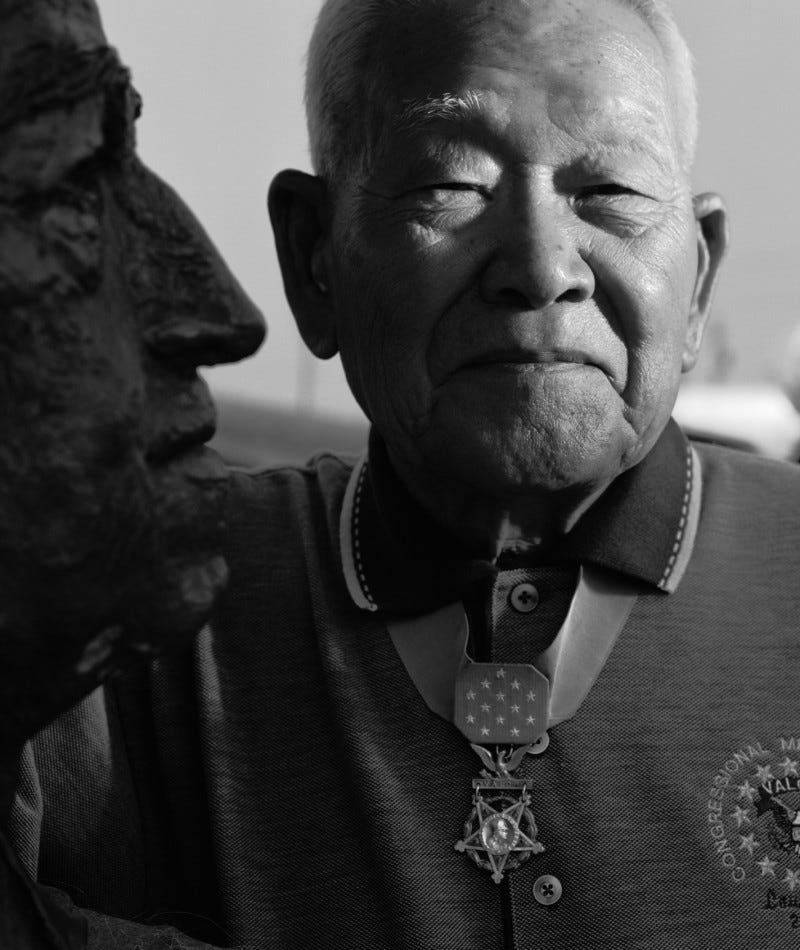
I was just listening to the word. I didn’t realize this gentleman had won the Congressional Medal of Honor. He was a Japanese-American during World War 2. He was born in Hawaii, as he said, he was as American as anybody else. But he was drafted, but he was kept on a cleaning detail, cleaning the road, sweeping the officer’s quadrant, things like that. After Pearl Harbor, they were shipped to Wisconsin, to a compound fenced with barbed-wire, so their first thought was that they were being sent to a concentration camp.

Thanks for reading Capturing Voices! Subscribe for free to receive new posts and support my work.

But later in his service, this happened. Mr. Hayashi was a private, relegated to cleaning duty. They were shipped to Oran to guard supply trains. He volunteered to join the all-Nisei 100th Battalion. Then this happened.

World War II – U.S. Army

SHIZUYA HAYASHI

DETAILS

RANK: PRIVATE

CONFLICT/ERA: WORLD WAR II

UNIT/COMMAND:
COMPANY A,
100TH INFANTRY BATTALION (SEPARATE)

MILITARY SERVICE BRANCH: U.S. ARMY

MEDAL OF HONOR ACTION DATE: NOVEMBER 29, 1943

MEDAL OF HONOR ACTION PLACE: NEAR CERASUOLO, ITALY

CITATION

For conspicuous gallantry and intrepidity at risk of his life above and beyond the call of duty. Private Shizuya Hayashi distinguished himself by extraordinary heroism in action on 29 November 1943, near Cerasuolo, Italy. During a flank assault on high ground held by the enemy, Private Hayashi rose alone in the face of grenade, rifle, and machine gun fire. Firing his automatic rifle from the hip, he charged and overtook an enemy machine gun position, killing seven men in the nest and two more as they fled. After his platoon advanced 200 yards from this point, an enemy antiaircraft gun opened fire on the men. Private Hayashi returned fire at the hostile position, killing nine of the enemy, taking four prisoners, and forcing the remainder of the force to withdraw from the hill. Private Hayashi’s extraordinary heroism and devotion to duty are in keeping with the highest traditions of military service and reflect great credit on him, his unit, and the United States Army.

USED WITH PERMISSION, COPYRIGHT NICK DELCALZO

ADDITIONAL DETAILS

ACCREDITED TO: WAIALUA, OAHU, HONOLULU COUNTY

AWARDED POSTHUMOUSLY: NO

PRESENTATION DATE & DETAILS: JUNE 21, 2000
THE WHITE HOUSE – PRESENTED BY PRESIDENT WILLIAM J. CLINTON

BORN: NOVEMBER 28, 1917, WAIALUA, OAHU, HONOLULU COUNTY

DIED: MARCH 12, 2008, PEARL CITY, HI, UNITED STATES

BURIED: NATIONAL MEMORIAL CEMETERY OF THE PACIFIC, HONOLULU, HI, UNITED STATES

PHOTO GALLERY

Thanks for reading Capturing Voices! Subscribe for free to receive new posts and support my work.

The thing about oral histories is . . .

The thing about oral histories is . . .

We’re transcribing an oral history and we can’t understand something the interviewee is saying. So I decided to search the internet for another interview. Some of these veterans have been interviewed multiple times, and sometimes you can pick up an indecipherable word from another interview.

I was just listening to the word. I didn’t realize this gentleman had won the Congressional Medal of Honor. He was a Japanese-American during World War 2. He was born in Hawaii, as he said, he was as American as anybody else. But he was drafted, but he was kept on a cleaning detail, cleaning the road, sweeping the officer’s quadrant, things like that. After Pearl Harbor, they were shipped to Wisconsin, to a compound fenced with barbed-wire, so their first thought was that they were being sent to a concentration camp.

Thanks for reading Capturing Voices! Subscribe for free to receive new posts and support my work.

But later in his service, this happened. Mr. Hayashi was a private, relegated to cleaning duty. They were shipped to Oran to guard supply trains. He volunteered to join the all-Nisei 100th Battalion. Then this happened.

World War II – U.S. Army

SHIZUYA HAYASHI

DETAILS

RANK: PRIVATE

CONFLICT/ERA: WORLD WAR II

UNIT/COMMAND:
COMPANY A,
100TH INFANTRY BATTALION (SEPARATE)

MILITARY SERVICE BRANCH: U.S. ARMY

MEDAL OF HONOR ACTION DATE: NOVEMBER 29, 1943

MEDAL OF HONOR ACTION PLACE: NEAR CERASUOLO, ITALY

CITATION

For conspicuous gallantry and intrepidity at risk of his life above and beyond the call of duty. Private Shizuya Hayashi distinguished himself by extraordinary heroism in action on 29 November 1943, near Cerasuolo, Italy. During a flank assault on high ground held by the enemy, Private Hayashi rose alone in the face of grenade, rifle, and machine gun fire. Firing his automatic rifle from the hip, he charged and overtook an enemy machine gun position, killing seven men in the nest and two more as they fled. After his platoon advanced 200 yards from this point, an enemy antiaircraft gun opened fire on the men. Private Hayashi returned fire at the hostile position, killing nine of the enemy, taking four prisoners, and forcing the remainder of the force to withdraw from the hill. Private Hayashi’s extraordinary heroism and devotion to duty are in keeping with the highest traditions of military service and reflect great credit on him, his unit, and the United States Army.

USED WITH PERMISSION, COPYRIGHT NICK DELCALZO

ADDITIONAL DETAILS

ACCREDITED TO: WAIALUA, OAHU, HONOLULU COUNTY

AWARDED POSTHUMOUSLY: NO

PRESENTATION DATE & DETAILS: JUNE 21, 2000
THE WHITE HOUSE – PRESENTED BY PRESIDENT WILLIAM J. CLINTON

BORN: NOVEMBER 28, 1917, WAIALUA, OAHU, HONOLULU COUNTY

DIED: MARCH 12, 2008, PEARL CITY, HI, UNITED STATES

BURIED: NATIONAL MEMORIAL CEMETERY OF THE PACIFIC, HONOLULU, HI, UNITED STATES

PHOTO GALLERY

Thanks for reading Capturing Voices! Subscribe for free to receive new posts and support my work.