Delivering the Atomic Bombs: The Silverplate B-29

Delivering the Atomic Bombs: The Silverplate B-29

It’s a widely acknowledged fact that the Boeing B-29 Superfortress was the aircraft that executed the historic first atomic attacks, forever altering the course of history. However, the B-29s delivering America’s first atomic weapons were far from ordinary.

Thanks for reading Capturing Voices! Subscribe for free to receive new posts and support my work.

The Boeing B-29 Superfortress is an iconic aircraft that symbolizes American ingenuity, capability, and aviation prowess. Its sleek, aerodynamic lines and cutting-edge technological features were a significant leap in aviation design. This sinusoidal shaped aircraft followed the B-17 and B-24 bombers used by the US Army Air Forces (USAAF). In January 1940, the Air Corps published a requirement for a bomber capable of flying at 400 mph and carrying 10 tons of bombs with a 2,500-mile combat radius. Eventually Boeing’s Model 345 design was approved by Air Corps Chief of Staff General Harley “Hap” Arnold on June 14, 1940, and the aircraft’s prototype made its first flight on September 21, 1942. The B-29 would not only require a significant amount of American aviation production capacity but would eventually become the nation’s single largest military expenditure of the war: With the Manhattan Engineer District (MED) costing the American taxpayer $2 billion, the B-29 program far surpassed that figure with a price tag of $3 billion.

Despite the plane’s technological innovations such as remote-control turrets, computerized targeting, pressurized cabins, powerful new engines, flush riveting, and butt-jointed skin, the innovative design was also rife with technical issues. At the time, USAAF Major General Curtis LeMay, who masterminded the Tokyo firebombing raids and was head of XXI Bomber command, said of the plane: “The B-29 had as many bugs as the entomological department of the Smithsonian. Fast as the bugs got licked, new ones crawled out from beneath the cowling. … If you ever saw a buggy airplane, this was it.”  Despite these initial drawbacks the B-29 eventually proved to be a lethal and effective aircraft over the skies of Japan.

As B-29 production was ramping up, the MED under Major General Leslie Groves and J. Robert Oppenheimer initiated work at the Las Alamos Scientific Lab in New Mexico. While these men and their team of scientists, physicists, and engineers looked to split the atom, another team at Los Alamos addressed the integration of a fission-based weapon with a delivery vehicle. Group E-7 of the Ordnance Department under Norman Ramsey had a rough understanding of the possible weight and dimensions of the weapons under development. They quickly surmised that only two aircraft were capable of carrying a fission-based bomb weighing in at ten tons. The troublesome new B-29 certainly had the capacity and range for such a weapon, but so too did the proven British Avro Lancaster. But the British design was quickly dropped from consideration for two reasons: First, the bomb bay was too narrow to accommodate the envisioned weapon. Second, Arnold refused to allow any aircraft other than an American design to carry an atomic bomb.

THE B-29 ‘SILVER PLATED PROJECT’

Supporting the integration effort, in December 1943, USAAF Headquarters directed that Material Command at Wright Army Airfield in Dayton, Ohio, begin modifying a single B-29 for a secret purpose; a sole B-29 flew from Smoky Hill Army Airfield in Kansas to Dayton to become the first airframe in what was called the “Silver Plated Project.” Eventually shortened to just “Silverplate,” these modified B-29s were significantly different from those conducting conventional bombing raids over Japan. Given the expected explosion, shockwave blast, and radiation from the attack, the Silverplate B-29s required a higher performance envelope in addition to a modified bomb bay to carry the weapon. 

The first Superfortress designated for modification was B-29-5-BW-42-6259. Upon receipt of the aircraft at Wright Field it was immediately modified to the carry the “Thin Man” plutonium-based bomb. While this weapon proved to be a failure, it was the impetus for the first Silverplate. The planned bomb was 17 feet long and unable to fit into either of the B-29’s two bomb bays. As a result, the center fuselage section on the bomber’s belly was removed, as well as the usually mounted radome that sat between the two sets of bomb bay doors. Just under the wing spar, a separate bomb suspension system was needed to secure the weapon into the modified fuselage. However, first tests of this configuration conducted at Muroc Field in California in March resulted in damage to the bay doors, requiring the bomber to return to Wright Field for repair. While a new suspension system was devised, test flights in June 1944 were suspended when Los Alamos personnel realized the futility of the Thin Man design.

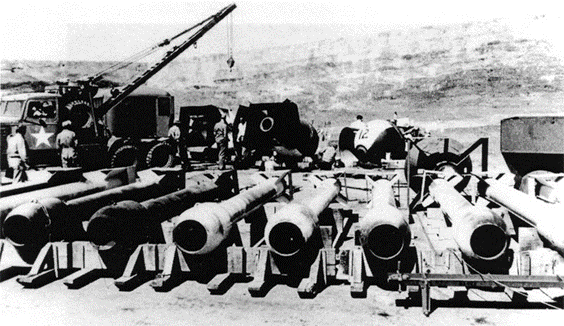
Thin Man bomb casings. This bomb design was unsuccessful but served as the impetus for the Silverplate program. (Wikimedia)

The uranium-based bomb known as “Little Boy” was much shorter at only 10 feet, with a diameter of 28 inches. However, it weighed in at 9,700 pounds, near the maximum limit of the B-29’s payload capacity. While Little Boy could easily fit into a single bomb bay, aircraft 42-6259 was returned to its original two-bomb configuration but required a different and more robust release system. This same bomb bay configuration also accommodated the second plutonium design known as the “Fat Man.” After these modifications, the prototype Silverplate B-29 flew to Wendover Army Airfield in Utah and was assigned to the 216th Base Unit. Wendover was a desolate location often referred to derisively by airmen as “Leftover Field.” Despite its remoteness, the location was nearer to Los Alamos and more convenient for the planes used in MED-related testing. Aircraft 42-6259 continued as a test bed until it was damaged in a landing accident in late 1944 and scrapped in 1948.

Postcard from the field where the first Silverplate B-29s were stationed. The card depicts a B-17 Flying Fortress as the post was also the home of many “Flying Fortress” units before they headed for the war in Europe.

However, in August 1944, the second phase of Silverplate began with B-29s constructed at the Glenn L. Martin Aircraft Plant in Omaha, Nebraska (the building still sits today on Offutt Air Force Base). These 17 aircraft, copies of 42-6259, began to arrive at Wendover in October. Once this new batch of aircraft arrived, maintenance crews began to remove the upper and lower turrets to lighten the plane’s overall weight. Three of these airframes were used specifically for Los Alamos test programs helping design bomb components and build ballistic tables. The other 14 were used by the 509th Composite Group for aircrew training. Formed under Lieutenant Colonel Paul Tibbets on December 17, 1944, 509th crews became familiar with these new airframes, flying training missions over the American southwest. In January 1945, Tibbets, along with Los Alamos representatives, met with Boeing engineers to discuss further modifications to the existing Silverplate program. Based upon the mission profiles flown in support of MED testing, additional changes were suggested and incorporated into the third phase of Silverplate development.

The sleek outline of Silverplate B-29s in formation. Sixty-four of these special aircraft were built between 1944 and 1947. (US Air Force photo)

After the January meeting, Tibbets visited Wright Field to arrange this next batch of aircraft. However, instead of modifying the current fleet, the Martin Plant in Omaha, under the auspices of Project 98228-S, provided 20 new Silverplate aircraft that incorporated the discussed changes. With these modifications, this third batch of aircraft were significantly different from the first two, especially the installation of new engines. The Wright R-3350-41 incorporated better cooling, fuel injection, and improved fuel and manifold systems. Mounted on the -41 engines were new propellers with reverse pitch capability, allowing the plane to improve power braking when landing. Additionally, the bomb bay doors used pneumatic actuators, replacing the slower hydraulic system and allowing for a shorter transition period when opening and closing the doors. Just as the crews at Wendover had removed the defensive turrets, this armament was also omitted as part of Phase III, with aircraft rolling off the production line retaining only the rear gunner’s armament.

The Glenn Martin Aircraft Factory Building at Offutt Field near Omaha Nebraska circa 1945. This factory was responsible for the construction of the Phase III Silverplate B-29s. The building still stands today and is known as Building “D” at Offutt Air Force Base. (National Archives)

Perhaps most importantly, the bomb bay was now fitted with an H-frame structure with improved sway braces that accommodated both Little Boy and Fat Man. The bomb bays also included both a dual electric and manual release system for the payload as it sat in the forward bay. Connected to these bomb-related modifications, a new crew position was also created. Just behind the radioman’s seat, an electronics test officer station was installed. This new crewman monitored the various electronic equipment and cables associated with the bomb once airborne. For the atomic raids, this crewman and an assistant fully armed and prepared the weapon for use.

These modifications were required not only to deliver the bomb over Japan but also,  perhaps more importantly, to make good the egress of the plane and crew from the target area once the weapon was delivered. The B-29 is a large aircraft, with a 141-foot wingspan and a 99-foot fuselage, and weighing 105,000 pounds. Despite this large size, after release of the weapon, the aircrew was to execute a 155-degree diving right turn at a 60-degree angle of bank. While losing 1,700 feet of attitude, the plane’s engines also had to be flown at full tilt to give the crew a 10-mile separation from the point of impact. The lightening of the load, the more powerful engines, and the quick cycling of the weapons bomb bay door were all important factors in putting as much space as possible between the bomber and bomb.

DELIVERING THE ATOMIC BOMBS

At Tinian, the 509th had a complement of 15 Silverplates and conducted orientation, training, and combat missions before the atomic attacks. Many of the crews dropped what was referred to as “pumpkin” bombs that were the same dimensions of the Fat Man but had similar ballistic characteristics. However, instead of fissionable material, these bombs were loaded with conventional explosives and weighed only 6,300 pounds. In addition to training missions, 509th aircrews also flew 51 combat sorties over Japan armed with the pumpkins. All of the planes involved in the atomic attacks of August 6 and 9 were Phase III Silverplates. While the atomic attack itself required only one bomber, the planned missions involved multiple aircraft. The Enola Gay mission that dropped Little Boy on Hiroshima included six other Silverplate airframes that either carried scientific instruments measuring effects of the blast, served as weather reconnaissance platforms, were assigned photographic responsibilities, or stood by as backup platforms. The Bockscar mission dropping Fat Man on Nagasaki was also planned to have six Silverplates but failed to rendezvous with its assigned photographic escort.   

There would be two more phases of Silverplate production for a total run of 64 aircraft. These special bombers were in use for six years, serving as America’s sole platform for atomic weapons following the war. Assigned to the US Air Force’s Strategic Air Command, they remained in frontline service until 1949 when they were finally replaced by the B-50 and B-36 Peacemaker bombers. Until these new airframes were available, the handful of Silverplates were flown regularly and by the time of their retirement were described as “quite weary.” Until their removal from the inventory, they provided a yeoman service during a key time in American history. Not only were they weapons of war, but they served as symbols of American military might and resolve. 

Thanks for reading Capturing Voices! Subscribe for free to receive new posts and support my work.

Beg the Question: It’s not begging at all

Beg the Question: It’s not begging at all

In contemporary English, “Beg the question” has expanded its range of meanings beyond its initial definition. While the original sense of the phrase remains in use, linguistic experts and lexicographers assert that it has ceased to be the primary interpretation since the mid-18th century. This article by Merriam-Webster delves into the intricacies of “begging the question,” exploring its meaning, origins, and how to employ it – or rather not employ it.

Thanks for reading Capturing Voices! Subscribe for free to receive new posts and support my work.

What to Know

Begging the question means “to elicit a specific question as a reaction or response,” and can often be replaced with “a question that begs to be answered.” However, a lesser used and more formal definition is “to ignore a question under the assumption it has already been answered.” The phrase itself comes from a translation of an Aristotelian phrase rendered as “beg the question” but meaning “assume the conclusion.”

Beg the question: it’s an odd phrase if you think about it, but most of us don’t:

The U.S. Postal service says that personal letter delivery is at an all-time low…. Which begs the question: are open letters the only kind the future will know?
— Charlotte Alter, Time, 2 Dec. 2015

Capabilities, says Mr [Amartya] Sen, are ends that economists should strive to maximize…. That begs the question of which capabilities a society should maximise.
The Economist, 20 Dec. 2014

It’s not the first time a fan has been injured by a batted ball or broken bat flying into the stands, nor is it likely to be the last. But that begs the question: Why are teams putting fans at risk in the first place?
— Matt Lindner, The Chicago Tribune, 25 Aug. 2015

What Does Beg the Question Actually Mean

In each of these, beg the question means “to cause someone to ask a specified question as a reaction or response.” What’s the beg about? Why isn’t it “elicit the question” or “raise the question”?

‘Beg the question’ is a phrase from formal logic—it’s a 16th century translator’s rendering of Aristotle’s ‘petitio principii’. A better translation would have been “assume the conclusion.”

It makes more sense in a newer version of the phrase. Since the 1960s we’ve seen a steady increase in phrases like a question that begs to be answered and one question begs an answer:

The influx of big data has boosted granular targeting capabilities, and with the rate at which data is being generated, a natural question that begs to be asked is, “what’s next?”
— Val Katayev, Forbes, 23 Nov. 2015

Still, the question begs to be asked: How could a team with one road win possibly be overconfident?
— Janie McCauley, The Associated Press, 14 Dec. 2015

The other key question that begs to be answered is: what is valuable in Yahoo to buy?
— Leslie Settles, The Wall Street Observer, 5 Dec. 2015

These uses still trail beg the question by a lot, but they’re increasing—most likely because the logic in them is more easily seen.

There’s a segment of the population that would be enormously relieved if phrases like a question that begs an answer replaced the usual begs the question uses. These are people who think using beg the question to mean “to cause someone to ask a specified question as a reaction or response” is completely and thoroughly wrong. There are probably more of these people than you think, and they are judging the rest of us.

Other Uses of Beg the Question

For these people, the only “correct” way to use the phrase beg the question is with the meaning “to ignore a question or issue by assuming it has been answered or settled.” They think these examples are acceptable:

Rich parents send their daughters to all-female schools; why shouldn’t the daughters of the poor enjoy similar advantages? That’s an appeal bound to elicit sympathy, especially from guilty liberals, but it begs the question of whether the daughters of the rich benefit from single-sex education. Perhaps they benefit merely from being rich and attending elite private schools with favorable student-teacher ratios and superior facilities and curricula.
— Wendy Kaminer, The Atlantic, April 1998

But the notion of a homunculus—a “little man”—inside the brain who watches the world on something like a little television set is hardly an explanation, because it begs the question of how the little man himself is able to perceive things. Concealed in him must be an even smaller man who watches an itsy-bitsier TV, and so on ad infinitum, like nested Chinese boxes.
— Paul Hoffman, Discover, September 1987

The problem is that beg the question is only very rarely used this way, as language blogger Stan Carey explains here. In our dictionary the sense bears the label “formal.”

The formal meaning does, though, help us get to the origin of the phrase itself.

Origin of Beg the Question

Beg the question is a phrase from formal logic. We have Aristotle to thank for it—or, actually, an anonymous 16th century translator who took Aristotle’s phrase petitio principii and rendered it in English as “beg the question.” A better translation would have been “assume the conclusion,” as linguist Mark Liberman at Language Log explains; petitio principii is used to name the logical fallacy in which an argument assumes the very thing it’s trying to prove. Here’s an example:

If left to themselves, children will naturally do the right thing because people are intrinsically good.

This statement tries to prove that children will naturally do the right thing by using the unproven assertion that people are intrinsically good. That assertion is problematic because it is little more than a broader version of the thing that is being proven.

So that’s where beg the question comes from, but all this, ahem, begs the question of what you should do with all this knowledge about the phrase. Liberman recommends that people avoid it altogether (but also “cultivate an attitude of serene detachment in the face of its use by others”).

You may take his recommendation, or you may use beg the question to mean either “to cause someone to ask a specified question as a reaction or response” or “to ignore a question or issue by assuming it has been answered or settled.” Both uses are established, and the first one is ubiquitous.

One more little matter here: the “to ignore a question or issue” meaning of beg the question has led to a meaning of beg defined as “evade” or “sidestep.” It’s typically found in phrases like “beg the issue” or “beg the point”:

Some of you may be quick to notice that steroids and other PEDs [performance enhancing drugs] are banned. It’s cheating to use them. But not so surgery, which is entirely on the up and up. But this just begs the issue. Why have we banned use of performance enhancing medicine but not surgery?
— Alva Noë, NPR.org, 26 July 2013

The haters don’t like that either, but it too is fully established.

Thanks for reading Capturing Voices! Subscribe for free to receive new posts and support my work.

Beg the Question: It’s not begging at all

Beg the Question: It’s not begging at all

In contemporary English, “Beg the question” has expanded its range of meanings beyond its initial definition. While the original sense of the phrase remains in use, linguistic experts and lexicographers assert that it has ceased to be the primary interpretation since the mid-18th century. This article by Merriam-Webster delves into the intricacies of “begging the question,” exploring its meaning, origins, and how to employ it – or rather not employ it.

Thanks for reading Capturing Voices! Subscribe for free to receive new posts and support my work.

What to Know

Begging the question means “to elicit a specific question as a reaction or response,” and can often be replaced with “a question that begs to be answered.” However, a lesser used and more formal definition is “to ignore a question under the assumption it has already been answered.” The phrase itself comes from a translation of an Aristotelian phrase rendered as “beg the question” but meaning “assume the conclusion.”

Beg the question: it’s an odd phrase if you think about it, but most of us don’t:

The U.S. Postal service says that personal letter delivery is at an all-time low…. Which begs the question: are open letters the only kind the future will know?
— Charlotte Alter, Time, 2 Dec. 2015

Capabilities, says Mr [Amartya] Sen, are ends that economists should strive to maximize…. That begs the question of which capabilities a society should maximise.
The Economist, 20 Dec. 2014

It’s not the first time a fan has been injured by a batted ball or broken bat flying into the stands, nor is it likely to be the last. But that begs the question: Why are teams putting fans at risk in the first place?
— Matt Lindner, The Chicago Tribune, 25 Aug. 2015

What Does Beg the Question Actually Mean

In each of these, beg the question means “to cause someone to ask a specified question as a reaction or response.” What’s the beg about? Why isn’t it “elicit the question” or “raise the question”?

‘Beg the question’ is a phrase from formal logic—it’s a 16th century translator’s rendering of Aristotle’s ‘petitio principii’. A better translation would have been “assume the conclusion.”

It makes more sense in a newer version of the phrase. Since the 1960s we’ve seen a steady increase in phrases like a question that begs to be answered and one question begs an answer:

The influx of big data has boosted granular targeting capabilities, and with the rate at which data is being generated, a natural question that begs to be asked is, “what’s next?”
— Val Katayev, Forbes, 23 Nov. 2015

Still, the question begs to be asked: How could a team with one road win possibly be overconfident?
— Janie McCauley, The Associated Press, 14 Dec. 2015

The other key question that begs to be answered is: what is valuable in Yahoo to buy?
— Leslie Settles, The Wall Street Observer, 5 Dec. 2015

These uses still trail beg the question by a lot, but they’re increasing—most likely because the logic in them is more easily seen.

There’s a segment of the population that would be enormously relieved if phrases like a question that begs an answer replaced the usual begs the question uses. These are people who think using beg the question to mean “to cause someone to ask a specified question as a reaction or response” is completely and thoroughly wrong. There are probably more of these people than you think, and they are judging the rest of us.

Other Uses of Beg the Question

For these people, the only “correct” way to use the phrase beg the question is with the meaning “to ignore a question or issue by assuming it has been answered or settled.” They think these examples are acceptable:

Rich parents send their daughters to all-female schools; why shouldn’t the daughters of the poor enjoy similar advantages? That’s an appeal bound to elicit sympathy, especially from guilty liberals, but it begs the question of whether the daughters of the rich benefit from single-sex education. Perhaps they benefit merely from being rich and attending elite private schools with favorable student-teacher ratios and superior facilities and curricula.
— Wendy Kaminer, The Atlantic, April 1998

But the notion of a homunculus—a “little man”—inside the brain who watches the world on something like a little television set is hardly an explanation, because it begs the question of how the little man himself is able to perceive things. Concealed in him must be an even smaller man who watches an itsy-bitsier TV, and so on ad infinitum, like nested Chinese boxes.
— Paul Hoffman, Discover, September 1987

The problem is that beg the question is only very rarely used this way, as language blogger Stan Carey explains here. In our dictionary the sense bears the label “formal.”

The formal meaning does, though, help us get to the origin of the phrase itself.

Origin of Beg the Question

Beg the question is a phrase from formal logic. We have Aristotle to thank for it—or, actually, an anonymous 16th century translator who took Aristotle’s phrase petitio principii and rendered it in English as “beg the question.” A better translation would have been “assume the conclusion,” as linguist Mark Liberman at Language Log explains; petitio principii is used to name the logical fallacy in which an argument assumes the very thing it’s trying to prove. Here’s an example:

If left to themselves, children will naturally do the right thing because people are intrinsically good.

This statement tries to prove that children will naturally do the right thing by using the unproven assertion that people are intrinsically good. That assertion is problematic because it is little more than a broader version of the thing that is being proven.

So that’s where beg the question comes from, but all this, ahem, begs the question of what you should do with all this knowledge about the phrase. Liberman recommends that people avoid it altogether (but also “cultivate an attitude of serene detachment in the face of its use by others”).

You may take his recommendation, or you may use beg the question to mean either “to cause someone to ask a specified question as a reaction or response” or “to ignore a question or issue by assuming it has been answered or settled.” Both uses are established, and the first one is ubiquitous.

One more little matter here: the “to ignore a question or issue” meaning of beg the question has led to a meaning of beg defined as “evade” or “sidestep.” It’s typically found in phrases like “beg the issue” or “beg the point”:

Some of you may be quick to notice that steroids and other PEDs [performance enhancing drugs] are banned. It’s cheating to use them. But not so surgery, which is entirely on the up and up. But this just begs the issue. Why have we banned use of performance enhancing medicine but not surgery?
— Alva Noë, NPR.org, 26 July 2013

The haters don’t like that either, but it too is fully established.

Thanks for reading Capturing Voices! Subscribe for free to receive new posts and support my work.

Schweinfurt–Regensburg Raid: August 17, 1943

Schweinfurt–Regensburg Raid: August 17, 1943

The inaugural foray of the Eighth Air Force into Nazi Germany marked a pivotal chapter in World War II’s history. This momentous event was more than just a military operation. For the Eighth Air Force, it was a baptism by fire, paving the way for more refined and effective approaches in the relentless campaign against Nazi Germany.

Thanks for reading Capturing Voices! Subscribe for free to receive new posts and support my work.

During World War II, the US Army Air Forces (USAAF) subscribed to the concept of daylight precision bombing. Working with the British Royal Air Force’s (RAF) Bomber Command, the two nations conducted what became known as the Combined Bomber Offensive (CBO). Operating under the dictates of the January 1943 Casablanca directive, each respective air force executed operations in accordance with their existing doctrines. The intent was to destroy both German morale and war-making capabilities through a sustained aerial assault. While the USAAF remained committed to hitting specific targets within a confined area during the day, their RAF counterparts operated at night and struck large swaths of the German urban landscape. With the British conducting area bombardment at night and the Americans executing precision strikes during the day, the two nations initiated the “round-the-clock” aerial offensive. Starting in January 1943, the Eighth US Air Force stationed in the United Kingdom began hitting targets in Germany on a regular basis. However, these initial results were lukewarm as losses in both aircrews and aircraft mounted. USAAF Chief of Staff General Harley “Hap” Arnold was increasingly disappointed with the Eighth Air Force’s effort and hectored his subordinates for better effects and to prove the efficacy of airpower in the global conflict.

THE SCHWEINFURT–REGENSBURG RAID

In August, hoping to substantially affect Nazi war industry and address Arnold’s concerns, US air planners developed the idea of a dual strike mission hitting two significant targets deep inside Germany. Evolving from an earlier plan code-named JUGGLER, a modified strike targeted the Messerschmitt aircraft factory at Regensburg and ball bearing production plants at Schweinfurt. By attacking these targets, air planners hoped for a two-pronged effect: curb Luftwaffe fighter production while creating a ball bearing shortage, resulting in a wholesale industrial collapse. The plan was more than just a strike on two locations; it was to be a sequenced assault using two air divisions operating in concert. The two divisions were to take off, form, and fly toward their designated targets separated by a 30-minute interval. By launching two separate raids on the same morning, planners expected to split Luftwaffe aerial defenses, thereby reducing attacks on either bomber force. In addition to the dual strike methodology, one of the bomber formations would not return to England on its usual trek. Instead, the bombers hitting Regensburg would divert on a southerly course over the Alps and fly to the newly liberated areas of North Africa. Much like the dual strike approach, this southern egress was also expected to throw the Luftwaffe off the bombers’ trail and frustrate the German fighters’ defensive efforts. In addition to the dual strikes, diversion raids from medium bombers and fighters were also planned, to draw further attention away from the larger inbound formations. 

This mission profile was replete with danger. It called for an aerial battle that was approximately 1,000 miles long and five miles above the earth. At that altitude, subzero temperatures and a lack of oxygen were a constant concern for crews flying in unpressurized aircraft. Hypoxia and frostbite were constant companions as the bomber crews fought both the Luftwaffe and the elements. Unlike their ground counterparts, who could find shelter in a fighting position or a prepared bunker, airmen flew in thin, uninsulated, aluminum fuselages with little armor against German 88 mm Flak guns and 20 mm cannons. There was no place to hide. In addition, if a crewman was hit, there was no corpsman or medic available, nor an aid station to evacuate the wounded. With nowhere to go, casualties were stuck in place for the mission’s duration.

While initially scheduled for August 7, the plan was delayed for weather and postponed until the 17th.  A total of 376 B-17s from the 1st and 3rd Air Divisions were scheduled to take off that morning. The commander of the 3rd Air Division, Colonel Curtis LeMay, briefed his crews on their target at Regensburg and then addressed their route toward Africa. He reminded his men to “prepare for sleeping on the ground for a day or two, no Savoy’s or Claridge’s [hotels] in the North African desert, you know. …” Following the 3rd, the 1st Air Division was to depart 30 minutes later and fly toward Schweinfurt with a return to East Anglia after the raid. Still, there was an important distinction between the two wings. LeMay stressed instrument flying in his division as a part of his relentless training schedules. Familiar with such flying, his crews could take off even as British fog descended upon their airfields. However, LeMay’s counterpart, Brigadier General Robert Williams’s 1st Bomb Division, was not practiced in such flying with the command stuck on the ground until the weather cleared.  

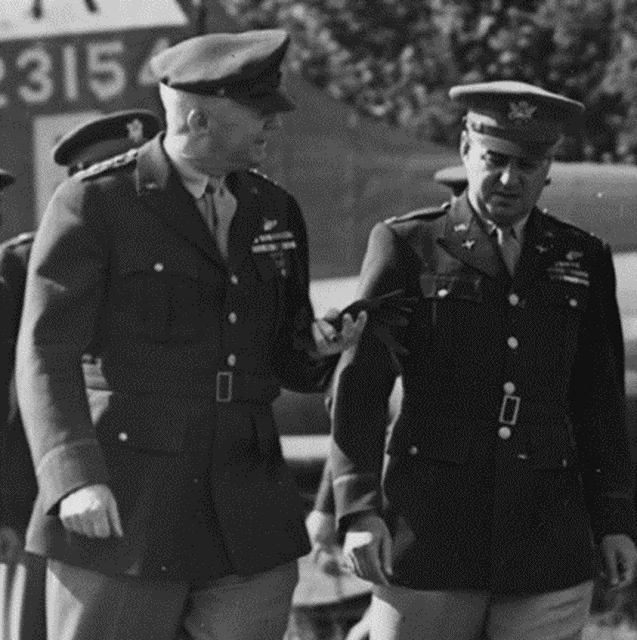
General Hap Arnold talks with Colonel Curtis LeMay in September 1943 shortly after the Schweinfurt–Regensburg mission of August 17. (American Air Museum in Britain photo)

LeMay’s seven bomb groups began their takeoffs around 0800. Given the low ceiling, he was amazed there were no midair collisions during form-up as the bombers penetrated two layers of overcast. Climbing through overcast during form-up was always fraught: dozens of planes flying in the same airspace attempting to link up with limited visual references was a recipe for disaster. Eventually, 146 B-17s of the 3rd Air Division formed and orbited over the navigation beacon in East Anglia. In the meantime, the 1st Air Division remained on the ground with no indication of becoming airborne soon. Watching their fuel gauges begin to move, the 3rd Air Division formation had to either scrub the mission or depart for their target. LeMay chose the latter. The 1st Air Division remained on the ground for the next three hours, well after LeMay’s command departed on its 500-mile journey to the target. In the 3rd Air Division’s lead aircraft, LeMay headed toward Regensburg, crossing the Dutch coast by 1000. By mid-morning, it was clear that the planned dual strike with the hope of splitting German air defenses had failed. The results would be devastating. 

Providing additional protection to the inbound bombers were two groups of American P-47 Thunderbolt fighters. While a capable aircraft, the P-47 at this time was limited in range with fighter escort available only up to the German border. During this mission, some of the P-47s arrived late at the rendezvous point, and others failed to arrive at all. The Thunderbolts that did show up were too few and covered only the forward groups in the bomber formations, leaving the rear formations uncovered.  Adding to the 3rd Air Division’s woes was the same weather that grounded 1st Air Division, delaying the planned diversion missions. With the diversion scrubbed, all available Luftwaffe fighters could now focus on the 3rd Air Division as it went forward all alone.

Even before the P-47s departed for home, the Luftwaffe began pressing its attacks, hitting the bomber formations in the rear. With the aerial battle fully joined by 1025, it was only minutes later when the American fighters that made the rendezvous had to return home. Disappointed with the P-47 coverage and lack of fighter support, LeMay sardonically stated afterward: “Our [only] fighter escort had black crosses [of the Luftwaffe fighters] on their wings.” Now without any friendly fighter escort and heading deeper into Germany, LeMay’s command endured a continuous aerial onslaught. Slashing through the American formations, German pilots attacked the lumbering bombers, knowing that the B-17s’ defenses were weakest in the front. Some also came vertically from above, targeting the bomber’s top turret and flight deck.  Others dropped aerial bombs or launched rockets. 

Heading to the target 150 miles past the Rhine River, the battle continued eastward at a speed of 180 mph. Wave after wave of German fighters engaged the hapless bomber formation as it moved en masse. Passing Mannheim, twin-engine ME-110 and JU-88 fighters engaged with their heavier caliber armament. A trail of smoking bombers marked the formation’s path. During this period, 17 bombers were shot down, most of them from the lower and rear squadrons of the formation. The only positive for the 3rd Air Division was the clear weather, allowing bombardiers to easily sight the Messerschmitt factory. The 129 surviving bombers found the Regensburg facility and dropped 300 tons of high explosives and incendiaries. They damaged most of the buildings and (unknowingly) the fuselage jigs for a new aircraft designated the ME-262. LeMay recalled the objective being “totally destroyed,” with one group placing 58 percent of its ordnance within 1,000 feet of the aim point and 94 percent within 2,000 feet. While the raid itself was successful, the mission was still far from over. The 3rd Air Division still had to fly to North Africa.

Strike photo of 3rd Air Division’s raid on the Regensburg aircraft factory on August 17, 1943. (American Air Museum in Britain photo)

After their weather cleared, the 1st Air Division eventually took off with 230 B-17s on a 400-mile trek to the target. Given the three-hour delay, German fighters had ample time to land and reload to counter the second strike. The 1st Air Division’s B-17s were hit as they arrived over Antwerp with assaults also coming in waves. Attacking out of the sun and hitting the high squadron, Luftwaffe pilots zoomed through the bomber groups and into the lower formations. In addition to these diving attacks, the exposed and lightly defended trailing bomber squadrons were again targeted. Arriving over Mannheim, the 1st Air Division turned northeast and lined up for their initial point for the bomb run over the Schweinfurt factories. Fighting their way to the target, they dropped their payloads, with 80 hits on two main plants and 20 more in a third. Returning home, the 1st Air Division received the same treatment as it did when inbound: German fighters continued their attacks until the bomber formation cleared the continent. Two of the participating bomber groups suffered extensively, with the 91st losing 43 percent of its crews launched and the 381st losing 50 percent.   

1st Bomb Wing over Schweinfurt on August 17, 1943, attacking German ball bearing factories. (Wikimedia)

IMPACT OF SCHWEINFURT–REGENSBURG RAID

As a result of the raid, German ball bearing production dropped from 140 tons in July to just 69 in August and 50 in September. Along with this significant drop, larger lessons were learned for both sides. Given the strike, German ball bearing manufacturing adjusted, with much of it diffused, rebuilt, or sourced from other locations. With these adjustments, the Third Reich was never deficient in ball bearings.  On a larger scale, German industrial production also learned and became increasingly diffused, placed underground, or quickly rebuilt using forced/slave labor. Furthermore, by 1943, the Nazis finally mobilized the nation’s full economic capability, effectively countering much of the CBO’s earlier effects. With all these considerations and adjustments, German industrial production became more resilient until late in the war. 

While the short-term damage to German manufacturing was at least encouraging, the cost was still high. The 1st Air Division lost 36 B-17s and 370 airmen out of the 183 aircraft that dropped their bombs. It was an unstainable loss rate of 20 percent. Given such percentages, Eighth Air Force crews would not statistically survive their required tours of 25 missions. With these losses, one of the obvious lessons for the Americans was the need for a long-range fighter escort capability. Another was the need to revisit targets: as the Germans rebuilt their bombed factories, it became clear one strike was never fully decisive.          

After departing the Regensburg area, the 3rd Air Division headed south toward the Alps, the Mediterranean Sea, and their planned bases in Africa. The unexpected turn south befuddled some German defenses, and it saved the wing from further intense combat. But it did not mean the surviving bombers here home free. A few damaged planes and crews were able to limp to Switzerland, where aircraft were confiscated and the crews captured. Given the earlier delay in launching the raid and waiting for the 1st Air Division, the flight over the Mediterranean saw five more planes drop out of formation and into the sea due to fuel starvation. Around 1730, after some 11 hours of flight, the surviving crews arrived at the North African coast. Confusion reigned, however, as crews attempted to land at their assigned airfields, but undermanned control towers gave faulty instructions. Exhausted, damaged, or running out of fuel, crews landed bombers wherever they could find a suitable location. 

Telergma airfield was supposedly a maintenance depot, and 3rd Air Division crews expected plenty of mechanics and spare parts to help repair their damaged aircraft. But upon landing, the battered crews found little of either. With little external support, they serviced, repaired, or jury-rigged their bombers by hook or by crook. The command eventually pieced together approximately 80 airworthy bombers while abandoning dozens in place. As warned by LeMay during the mission briefing days earlier, crews found that deluxe accommodations in North Africa included sleeping on a cot, while others “enjoyed” the pleasures of a slit trench in the African desert. On the final leg home, the crews made a final bomb run over the French airfield at Bordeaux. Given the marginal condition of many returning airframes, three planes crashed due to malfunction before the rest returned to England with none downed by enemy action. In all, 3rd Air Division lost 24 aircraft during the shuttle mission with the percentage unfortunately like that of the 1st Air Division.

Crewmen of the 3rd Air Division (385th Bomb Group) pose with local herdsmen at Telergma. Note the cot under the bomber’s horizontal stabilizer and on top of the wing. Cots were considered “plush” accommodations during the stay in North Africa. (American Air Museum in Britain photo)

While the raids themselves had been successful in hitting the targets, the losses were steep, costing 60 bombers and their highly trained crews. Furthermore, the results were largely temporary as the Germans recovered quickly. Given this experience, the Eighth Air Force did not send another unescorted raid deep into Germany for months. In the following weeks, bomber crews struck targets within range of fighter escorts or along the continent’s coastline. Additionally, planners scrapped the idea of future shuttle missions to North Africa. Hoping to leverage the Mediterranean theater’s characteristically better weather, the logistical shortfalls and difficulties experienced by the 3rd Air Division in North Africa dashed any hopes of regularly scheduled shuttle missions. While more and more planes and crews arrived in the United Kingdom, the American strategic bombing offensive was clearly in a crisis. For the next few months, the Eighth Air Force would experience more of the same mauling. Months would pass before Americans would begin to see significant changes in their leadership, equipment, and doctrine. Only after January 1944 would the scales in the air war begin to tip in the Allies’ favor.  

Thanks for reading Capturing Voices! Subscribe for free to receive new posts and support my work.

Schweinfurt–Regensburg Raid: August 17, 1943

Schweinfurt–Regensburg Raid: August 17, 1943

The inaugural foray of the Eighth Air Force into Nazi Germany marked a pivotal chapter in World War II’s history. This momentous event was more than just a military operation. For the Eighth Air Force, it was a baptism by fire, paving the way for more refined and effective approaches in the relentless campaign against Nazi Germany.

Thanks for reading Capturing Voices! Subscribe for free to receive new posts and support my work.

During World War II, the US Army Air Forces (USAAF) subscribed to the concept of daylight precision bombing. Working with the British Royal Air Force’s (RAF) Bomber Command, the two nations conducted what became known as the Combined Bomber Offensive (CBO). Operating under the dictates of the January 1943 Casablanca directive, each respective air force executed operations in accordance with their existing doctrines. The intent was to destroy both German morale and war-making capabilities through a sustained aerial assault. While the USAAF remained committed to hitting specific targets within a confined area during the day, their RAF counterparts operated at night and struck large swaths of the German urban landscape. With the British conducting area bombardment at night and the Americans executing precision strikes during the day, the two nations initiated the “round-the-clock” aerial offensive. Starting in January 1943, the Eighth US Air Force stationed in the United Kingdom began hitting targets in Germany on a regular basis. However, these initial results were lukewarm as losses in both aircrews and aircraft mounted. USAAF Chief of Staff General Harley “Hap” Arnold was increasingly disappointed with the Eighth Air Force’s effort and hectored his subordinates for better effects and to prove the efficacy of airpower in the global conflict.

THE SCHWEINFURT–REGENSBURG RAID

In August, hoping to substantially affect Nazi war industry and address Arnold’s concerns, US air planners developed the idea of a dual strike mission hitting two significant targets deep inside Germany. Evolving from an earlier plan code-named JUGGLER, a modified strike targeted the Messerschmitt aircraft factory at Regensburg and ball bearing production plants at Schweinfurt. By attacking these targets, air planners hoped for a two-pronged effect: curb Luftwaffe fighter production while creating a ball bearing shortage, resulting in a wholesale industrial collapse. The plan was more than just a strike on two locations; it was to be a sequenced assault using two air divisions operating in concert. The two divisions were to take off, form, and fly toward their designated targets separated by a 30-minute interval. By launching two separate raids on the same morning, planners expected to split Luftwaffe aerial defenses, thereby reducing attacks on either bomber force. In addition to the dual strike methodology, one of the bomber formations would not return to England on its usual trek. Instead, the bombers hitting Regensburg would divert on a southerly course over the Alps and fly to the newly liberated areas of North Africa. Much like the dual strike approach, this southern egress was also expected to throw the Luftwaffe off the bombers’ trail and frustrate the German fighters’ defensive efforts. In addition to the dual strikes, diversion raids from medium bombers and fighters were also planned, to draw further attention away from the larger inbound formations. 

This mission profile was replete with danger. It called for an aerial battle that was approximately 1,000 miles long and five miles above the earth. At that altitude, subzero temperatures and a lack of oxygen were a constant concern for crews flying in unpressurized aircraft. Hypoxia and frostbite were constant companions as the bomber crews fought both the Luftwaffe and the elements. Unlike their ground counterparts, who could find shelter in a fighting position or a prepared bunker, airmen flew in thin, uninsulated, aluminum fuselages with little armor against German 88 mm Flak guns and 20 mm cannons. There was no place to hide. In addition, if a crewman was hit, there was no corpsman or medic available, nor an aid station to evacuate the wounded. With nowhere to go, casualties were stuck in place for the mission’s duration.

While initially scheduled for August 7, the plan was delayed for weather and postponed until the 17th.  A total of 376 B-17s from the 1st and 3rd Air Divisions were scheduled to take off that morning. The commander of the 3rd Air Division, Colonel Curtis LeMay, briefed his crews on their target at Regensburg and then addressed their route toward Africa. He reminded his men to “prepare for sleeping on the ground for a day or two, no Savoy’s or Claridge’s [hotels] in the North African desert, you know. …” Following the 3rd, the 1st Air Division was to depart 30 minutes later and fly toward Schweinfurt with a return to East Anglia after the raid. Still, there was an important distinction between the two wings. LeMay stressed instrument flying in his division as a part of his relentless training schedules. Familiar with such flying, his crews could take off even as British fog descended upon their airfields. However, LeMay’s counterpart, Brigadier General Robert Williams’s 1st Bomb Division, was not practiced in such flying with the command stuck on the ground until the weather cleared.  

General Hap Arnold talks with Colonel Curtis LeMay in September 1943 shortly after the Schweinfurt–Regensburg mission of August 17. (American Air Museum in Britain photo)

LeMay’s seven bomb groups began their takeoffs around 0800. Given the low ceiling, he was amazed there were no midair collisions during form-up as the bombers penetrated two layers of overcast. Climbing through overcast during form-up was always fraught: dozens of planes flying in the same airspace attempting to link up with limited visual references was a recipe for disaster. Eventually, 146 B-17s of the 3rd Air Division formed and orbited over the navigation beacon in East Anglia. In the meantime, the 1st Air Division remained on the ground with no indication of becoming airborne soon. Watching their fuel gauges begin to move, the 3rd Air Division formation had to either scrub the mission or depart for their target. LeMay chose the latter. The 1st Air Division remained on the ground for the next three hours, well after LeMay’s command departed on its 500-mile journey to the target. In the 3rd Air Division’s lead aircraft, LeMay headed toward Regensburg, crossing the Dutch coast by 1000. By mid-morning, it was clear that the planned dual strike with the hope of splitting German air defenses had failed. The results would be devastating. 

Providing additional protection to the inbound bombers were two groups of American P-47 Thunderbolt fighters. While a capable aircraft, the P-47 at this time was limited in range with fighter escort available only up to the German border. During this mission, some of the P-47s arrived late at the rendezvous point, and others failed to arrive at all. The Thunderbolts that did show up were too few and covered only the forward groups in the bomber formations, leaving the rear formations uncovered.  Adding to the 3rd Air Division’s woes was the same weather that grounded 1st Air Division, delaying the planned diversion missions. With the diversion scrubbed, all available Luftwaffe fighters could now focus on the 3rd Air Division as it went forward all alone.

Even before the P-47s departed for home, the Luftwaffe began pressing its attacks, hitting the bomber formations in the rear. With the aerial battle fully joined by 1025, it was only minutes later when the American fighters that made the rendezvous had to return home. Disappointed with the P-47 coverage and lack of fighter support, LeMay sardonically stated afterward: “Our [only] fighter escort had black crosses [of the Luftwaffe fighters] on their wings.” Now without any friendly fighter escort and heading deeper into Germany, LeMay’s command endured a continuous aerial onslaught. Slashing through the American formations, German pilots attacked the lumbering bombers, knowing that the B-17s’ defenses were weakest in the front. Some also came vertically from above, targeting the bomber’s top turret and flight deck.  Others dropped aerial bombs or launched rockets. 

Heading to the target 150 miles past the Rhine River, the battle continued eastward at a speed of 180 mph. Wave after wave of German fighters engaged the hapless bomber formation as it moved en masse. Passing Mannheim, twin-engine ME-110 and JU-88 fighters engaged with their heavier caliber armament. A trail of smoking bombers marked the formation’s path. During this period, 17 bombers were shot down, most of them from the lower and rear squadrons of the formation. The only positive for the 3rd Air Division was the clear weather, allowing bombardiers to easily sight the Messerschmitt factory. The 129 surviving bombers found the Regensburg facility and dropped 300 tons of high explosives and incendiaries. They damaged most of the buildings and (unknowingly) the fuselage jigs for a new aircraft designated the ME-262. LeMay recalled the objective being “totally destroyed,” with one group placing 58 percent of its ordnance within 1,000 feet of the aim point and 94 percent within 2,000 feet. While the raid itself was successful, the mission was still far from over. The 3rd Air Division still had to fly to North Africa.

Strike photo of 3rd Air Division’s raid on the Regensburg aircraft factory on August 17, 1943. (American Air Museum in Britain photo)

After their weather cleared, the 1st Air Division eventually took off with 230 B-17s on a 400-mile trek to the target. Given the three-hour delay, German fighters had ample time to land and reload to counter the second strike. The 1st Air Division’s B-17s were hit as they arrived over Antwerp with assaults also coming in waves. Attacking out of the sun and hitting the high squadron, Luftwaffe pilots zoomed through the bomber groups and into the lower formations. In addition to these diving attacks, the exposed and lightly defended trailing bomber squadrons were again targeted. Arriving over Mannheim, the 1st Air Division turned northeast and lined up for their initial point for the bomb run over the Schweinfurt factories. Fighting their way to the target, they dropped their payloads, with 80 hits on two main plants and 20 more in a third. Returning home, the 1st Air Division received the same treatment as it did when inbound: German fighters continued their attacks until the bomber formation cleared the continent. Two of the participating bomber groups suffered extensively, with the 91st losing 43 percent of its crews launched and the 381st losing 50 percent.   

1st Bomb Wing over Schweinfurt on August 17, 1943, attacking German ball bearing factories. (Wikimedia)

IMPACT OF SCHWEINFURT–REGENSBURG RAID

As a result of the raid, German ball bearing production dropped from 140 tons in July to just 69 in August and 50 in September. Along with this significant drop, larger lessons were learned for both sides. Given the strike, German ball bearing manufacturing adjusted, with much of it diffused, rebuilt, or sourced from other locations. With these adjustments, the Third Reich was never deficient in ball bearings.  On a larger scale, German industrial production also learned and became increasingly diffused, placed underground, or quickly rebuilt using forced/slave labor. Furthermore, by 1943, the Nazis finally mobilized the nation’s full economic capability, effectively countering much of the CBO’s earlier effects. With all these considerations and adjustments, German industrial production became more resilient until late in the war. 

While the short-term damage to German manufacturing was at least encouraging, the cost was still high. The 1st Air Division lost 36 B-17s and 370 airmen out of the 183 aircraft that dropped their bombs. It was an unstainable loss rate of 20 percent. Given such percentages, Eighth Air Force crews would not statistically survive their required tours of 25 missions. With these losses, one of the obvious lessons for the Americans was the need for a long-range fighter escort capability. Another was the need to revisit targets: as the Germans rebuilt their bombed factories, it became clear one strike was never fully decisive.          

After departing the Regensburg area, the 3rd Air Division headed south toward the Alps, the Mediterranean Sea, and their planned bases in Africa. The unexpected turn south befuddled some German defenses, and it saved the wing from further intense combat. But it did not mean the surviving bombers here home free. A few damaged planes and crews were able to limp to Switzerland, where aircraft were confiscated and the crews captured. Given the earlier delay in launching the raid and waiting for the 1st Air Division, the flight over the Mediterranean saw five more planes drop out of formation and into the sea due to fuel starvation. Around 1730, after some 11 hours of flight, the surviving crews arrived at the North African coast. Confusion reigned, however, as crews attempted to land at their assigned airfields, but undermanned control towers gave faulty instructions. Exhausted, damaged, or running out of fuel, crews landed bombers wherever they could find a suitable location. 

Telergma airfield was supposedly a maintenance depot, and 3rd Air Division crews expected plenty of mechanics and spare parts to help repair their damaged aircraft. But upon landing, the battered crews found little of either. With little external support, they serviced, repaired, or jury-rigged their bombers by hook or by crook. The command eventually pieced together approximately 80 airworthy bombers while abandoning dozens in place. As warned by LeMay during the mission briefing days earlier, crews found that deluxe accommodations in North Africa included sleeping on a cot, while others “enjoyed” the pleasures of a slit trench in the African desert. On the final leg home, the crews made a final bomb run over the French airfield at Bordeaux. Given the marginal condition of many returning airframes, three planes crashed due to malfunction before the rest returned to England with none downed by enemy action. In all, 3rd Air Division lost 24 aircraft during the shuttle mission with the percentage unfortunately like that of the 1st Air Division.

Crewmen of the 3rd Air Division (385th Bomb Group) pose with local herdsmen at Telergma. Note the cot under the bomber’s horizontal stabilizer and on top of the wing. Cots were considered “plush” accommodations during the stay in North Africa. (American Air Museum in Britain photo)

While the raids themselves had been successful in hitting the targets, the losses were steep, costing 60 bombers and their highly trained crews. Furthermore, the results were largely temporary as the Germans recovered quickly. Given this experience, the Eighth Air Force did not send another unescorted raid deep into Germany for months. In the following weeks, bomber crews struck targets within range of fighter escorts or along the continent’s coastline. Additionally, planners scrapped the idea of future shuttle missions to North Africa. Hoping to leverage the Mediterranean theater’s characteristically better weather, the logistical shortfalls and difficulties experienced by the 3rd Air Division in North Africa dashed any hopes of regularly scheduled shuttle missions. While more and more planes and crews arrived in the United Kingdom, the American strategic bombing offensive was clearly in a crisis. For the next few months, the Eighth Air Force would experience more of the same mauling. Months would pass before Americans would begin to see significant changes in their leadership, equipment, and doctrine. Only after January 1944 would the scales in the air war begin to tip in the Allies’ favor.  

Thanks for reading Capturing Voices! Subscribe for free to receive new posts and support my work.

A Guide to Using Colons

A Guide to Using Colons

One punctuation mark that often perplexes writers is the colon. To demystify its usage and provide clarity to writers of all levels, Merriam-Webster has compiled a comprehensive guide on when and how to use the colon effectively.

Thanks for reading Capturing Voices! Subscribe for free to receive new posts and support my work.

What to Know

Colons (:) introduce clauses or phrases that serve to describe, amplify, or restate what precedes them. Often they are used to introduce a quote or a list that satisfies the previous statement. For example, this summary could be written as “Colons can introduce many things: descriptors, quotes, lists, and more.”

What Is a Colon?

We all know the colon, right? It’s a punctuation mark that looks like two dots stacked, like a period with another period hovering above it :

It’s typically a mark of introduction, used to let the reader know that what follows the colon has been pointed to or described by what precedes the colon. (This is quite a different function from that of the semicolon, which is mostly used to separate two independent sentence parts that are related in meaning.)

In the running prose that we encounter in books, magazines, articles, and the like, colons are mostly used to introduce a clause or a phrase that explains, illustrates, amplifies, or restates what precedes them. (Reminder: clauses and phrases are both groups of words within a sentence; the basic difference between them is that a clause has its own subject and verb, while a phrase does not.)

Colons Introduce Clauses and Phrases

Let’s first look at some colons introducing clauses and phrases that explain, illustrate, amplify, and restate what’s come before:

Harry the Dog and Mabel the Cat were having an impassioned argument about umbrellas: are umbrellas properly to be used only for rain?

In this example, what comes after the colon explains just what the argument referred to in the first part of the sentence is all about. Note that what follows the colon is not capitalized, but it could be. As a clause—it has its own subject and verb and could in fact function alone as its own sentence, albeit a sentence of the question variety—it certainly looks like something that can start with a capital letter, but whether it does or not is simply a matter of style. (Note that in British English the style is typically to go lowercase. Lowercase also happens to be Merriam-Webster’s style.) Be consistent: capitalize the first letter in every clause that follows a colon, or always use lowercase.

Mabel the Cat was adamant that Harry recognize the usefulness of umbrellas for all wet weather: as protection against rain, sleet, and snow.

Here, the phrase following the colon illustrates what comes before it. Being a phrase and all, there is no capital letter. (There of course would be a capital letter if the first word of the phrase were a proper noun or acronym.)

“But why limit it, then, to wet weather?” Harry wanted to know. “Sun too beats down: is not an umbrella also appropriate protection against sun?”

Harry’s clause, which would begin with a capital “I” if that were our style, amplifies what precedes it.

Mabel was having none of it: she remained unmoved.

Here, the clause following the colon restates what precedes it.

A colon can also introduce something that acts as an appositive. (Reminder: An appositive is a noun or noun phrase that refers to the same thing as another noun or noun phrase in the same sentence, and is usually right next to that other noun or noun phrase, like in “my neighbor the doctor.” The two nouns/noun phrases—in this case “my neighbor” and “the doctor”—are said to stand “in grammatical apposition,” which means that they have the same syntactical relation to the rest of the sentence.) The appositive that follows the colon can be an amplifying word, phrase, or clause:

“Harry,” said Mabel, “umbrellas are about one thing: dry fur.”

The noun phrase “dry fur” is in apposition to the “one thing” noun phrase on the other side of the colon.

“But Mabel,” Harry pressed, “isn’t the crux of it all in truth this: an umbrella is a collapsible shield for protection against weather generally?”

The clause following the colon is in apposition to “this” (which is a pronoun referring to “the crux of it all,” if we’re going to get technical about it).

“Oh Harry,” replied Mabel, “a similar object that protects against sun has another name altogether: parasol.”

The word “parasol” is in apposition to the noun phrase “another name altogether.”

How NOT to Use Colons

We note in this aside that a colon is not used to separate a subject from its predicate; a noun from its verb; a verb from its object or complement; or a preposition from its object:

avoid – The sheer size of Mabel’s umbrella collection: is stunning.

avoid – Harry’s favorite umbrella: broke.

avoid – The umbrella’s opening mechanism was: hopelessly jammed.

avoid – Mabel presented Harry with a choice umbrella of: her own.

Colons Can Introduce Lists and Series

And then there is the colon that introduces a list or series. What follows the colon is typically a word or phrase, so capitals are not be expected unless there’s a proper noun or acronym:

Harry was not about to abandon his position. If Mabel was going to insist that umbrellas be conceived as appropriate for more than rain, then he was going to insist that they be deemed appropriate in all weather conditions: rain, sleet, snow, hail, and sun.

The list or series can also be composed of phrases:

Mabel’s reply was emphatic. “You may be eternally encumbered by an umbrella then, Harry, but I will bear the following: an umbrella for wet weather, a parasol for hot sun, and a beret whenever I feel like it.”

The list or series can also come before a summary statement:

Harry’s rejoinder was equally emphatic. “Rain, sleet, snow, hail, sun: an umbrella will work for me, Mabel.”

Colons Can Introduce Quotations

Colons are also commonly used in prose to introduce quotations. When the quoted material is lengthy, it’s usually set off from the rest of the text by indentation but not by quotation marks:

Mabel was suddenly inspired to recite a bit of Lewis Carroll—specifically an excerpt from his 1871 Through the Looking-Glass and What Alice Found There:

All this time Tweedledee was trying his best to fold up the umbrella, with himself in it…. But he couldn’t quite succeed, and it ended in his rolling over, bundled up in the umbrella, with only his head out: and there he lay, opening and shutting his mouth and his large eyes—’looking more like a fish than anything else,’ Alice thought.

A colon can also be used before a quotation in running text, especially when the quotation is lengthy; or when it is a formal statement or a statement being given special emphasis; or when a full independent clause precedes the colon. Here’s an example of the first kind:

“You know, Mabel,” mused Harry, “while an avalanche perhaps does not quite qualify as ‘weather,’ an umbrella can also be used as protection against it. According to Mark Twain, anyway: ‘We might have made the summit before night, but for a delay caused by the loss of an umbrella. I was allowing the umbrella to remain lost, but the men murmured, and with reason, for in this exposed region we stood in peculiar need of protection against avalanches; so I went into camp and detached a strong party to go after the missing article.’ That’s from A Tramp Abroad.”

And here’s an example with a formal statement, or statement given special emphasis:

“I’ll remind you, Harry,” stated Mabel somewhat imperiously, “that this same text poses the absurd rhetorical question: ‘… what is an umbrella but a parachute?'”

And here’s an example in which a full independent clause precedes the colon:

Harry, nonplussed, lunged toward a non sequitur. “I recently learned,” he averred, “that the word ‘umbrella’ appears 26 times in James Joyce’s Ulysses, and that three of those appearances occur in a single sentence: ‘She disliked umbrella with rain, he liked woman with umbrella, she disliked new hat with rain, he liked woman with new hat, he bought new hat with rain, she carried umbrella with new hat.'”

Mabel’s response is unknown, which is just as well: the fact is that we’ve got nothing more to say about colon use in prose.