
Why Are Unidentified People Called John or Jane Doe?

Why Are Unidentified People Called John or Jane Doe?

If you are, at all, an Investigation Discovery or Law and Order fan, you know that unidentified people are called John or Jane Doe until their identity is revealed. But how did this become the norm? This post by Matt Soniak for the Mental Floss blog explains it!

Thanks for reading Capturing Voices! Subscribe for free to receive new posts and support my work.

From the courts to the morgue, if the government doesn’t know a person’s name, or wants to withhold it for some reason, they generally use the name John Doe or Jane Doe as a placeholder. But why?

The John Doe custom was born out of a strange and long since vanished British legal process called an action of ejectment. Under old English common law, the actions landowners could take against squatters or defaulting tenants in court were often too technical and difficult to be of any use. So landlords would instead bring an action of ejectment on behalf of a fictitious tenant against another fictitious person who had allegedly evicted or ousted him. In order to figure out what rights to the property the made-up persons had, the courts first had to establish that the landlord really was the owner of the property, which settled their real reason for action without the landlord having to jump through too many legal hoops.

Frequently, landlords named the fictitious parties in their actions John Doe (the plaintiff) and Richard Roe (the defendant), though no one has been able to find the case where these names were first used or figure out why they were picked. The names don’t appear to have any particular relevance, and it might be that the first names were chosen because they were among the most common at the time. The surnames, meanwhile, both reference deer—a doe being a female deer and roe being a specific deer species (Capreolus capreolus) common in Britain. They might also have been the actual names of real people that a particular landlord knew and decided to use. Unfortunately, we just don’t know.

Whatever their ultimate origin, the names eventually became standard placeholders for unidentified, anonymous, or hypothetical parties to a court case. Most U.S. jurisdictions continue to use John Doe and his female counterpart, Jane Doe, as placeholder names, and will bring in Roe if two anonymous or unknown parties are involved in the same case. The Feds use these placeholders, too, perhaps most famously in Roe v. Wade. The Jane Roe in that case was actually Norma Leah McCorvey, who revealed herself soon after the Supreme Court decision.

Thanks for reading Capturing Voices! Subscribe for free to receive new posts and support my work.

Where Did the Term ‘Up to Snuff’ Originate?

Where Did the Term ‘Up to Snuff’ Originate?

Ever wondered where this quirky idiomatic expression comes from? Well, it’s a gem! This article from Mental Floss takes us on a ride through the history of “up to snuff,” from its funky 18th-century roots to how it’s still making it’s way in today’s conversations. It’s like time travel, but with words!

Thanks for reading Capturing Voices! Subscribe for free to receive new posts and support my work.

By the 1800s, snuff—powdered, usually snort-able tobacco—had become such a long-standing societal fixture in the UK and U.S. that phrases started popping up around the word itself. To beat to snuff, for instance, meant to best your opponent so thoroughly that you figuratively reduced them to powder. In high snuff, meanwhile, described someone in high spirits (maybe a nod to the buzz you’d get after using tobacco).

But the most prevailing example is probably up to snuff, which the Oxford English Dictionary defines as “knowing, sharp, not easily deceived,” and “up to the required or usual standard.” Unlike the aforementioned phrases, the connection between pulverized tobacco and being savvy or meeting requirements isn’t quite clear. On his World Wide Words blog, Michael Quinion suggests that it may have had to do with snuff’s largest user demographic: wealthy men “who would be able to appreciate the quality of snuff and distinguish between examples of different value.”

What we do know is that up to snuff had entered the British lexicon by 1807, when it appeared in a London newspaper—the earliest known written mention of the phrase, according to Merriam-Webster. Only fragments of the passage are legible: “ … asked a young lady if she would have a pinch of snuff, and on … in the negative, he facetiously observed … suppose you are up to snuff.”

It came up again in Hamlet Travestie: In Three Acts, an 1810 parody of Shakespeare’s Hamlet by British playwright John Poole. Rosencrantz and Guildenstern are explaining to the king that Hamlet won’t reveal why he’s been strangely disconsolate, and Guildenstern says, “He’ll not be sounded; he knows well enough / The game we’re after: Zooks, he’s up to snuff.”

After the play’s conclusion, Poole added annotations and commentary that he himself wrote in the voices of literary luminaries and Shakespearean scholars of eras past, including Alexander Pope, Samuel Johnson, George Steevens, and William Warburton. Though Poole-as-Warburton argues that up to snuff was referring to Hamlet’s ability to literally sniff out Rosencrantz and Guildenstern’s ulterior motive, Poole-as-Johnson asserts that it was likely being used in its “common acceptation” as a reference to Hamlet’s being “a knowing one.” Grose’s Classical Dictionary of the Vulgar Tongue echoed Poole-as-Johnson’s understanding of the phrase in its 1823 edition, and so did Merriam-Webster in its 1864 dictionary.

As for how the idiom evolved to describe someone or something that meets standards, there’s no clear path—though it makes sense that someone considered knowing and astute would also be generally regarded as a person of merit.

Thanks for reading Capturing Voices! Subscribe for free to receive new posts and support my work.

Where Did the Term ‘Up to Snuff’ Originate?

Where Did the Term ‘Up to Snuff’ Originate?

Ever wondered where this quirky idiomatic expression comes from? Well, it’s a gem! This article from Mental Floss takes us on a ride through the history of “up to snuff,” from its funky 18th-century roots to how it’s still making it’s way in today’s conversations. It’s like time travel, but with words!

Thanks for reading Capturing Voices! Subscribe for free to receive new posts and support my work.

By the 1800s, snuff—powdered, usually snort-able tobacco—had become such a long-standing societal fixture in the UK and U.S. that phrases started popping up around the word itself. To beat to snuff, for instance, meant to best your opponent so thoroughly that you figuratively reduced them to powder. In high snuff, meanwhile, described someone in high spirits (maybe a nod to the buzz you’d get after using tobacco).

But the most prevailing example is probably up to snuff, which the Oxford English Dictionary defines as “knowing, sharp, not easily deceived,” and “up to the required or usual standard.” Unlike the aforementioned phrases, the connection between pulverized tobacco and being savvy or meeting requirements isn’t quite clear. On his World Wide Words blog, Michael Quinion suggests that it may have had to do with snuff’s largest user demographic: wealthy men “who would be able to appreciate the quality of snuff and distinguish between examples of different value.”

What we do know is that up to snuff had entered the British lexicon by 1807, when it appeared in a London newspaper—the earliest known written mention of the phrase, according to Merriam-Webster. Only fragments of the passage are legible: “ … asked a young lady if she would have a pinch of snuff, and on … in the negative, he facetiously observed … suppose you are up to snuff.”

It came up again in Hamlet Travestie: In Three Acts, an 1810 parody of Shakespeare’s Hamlet by British playwright John Poole. Rosencrantz and Guildenstern are explaining to the king that Hamlet won’t reveal why he’s been strangely disconsolate, and Guildenstern says, “He’ll not be sounded; he knows well enough / The game we’re after: Zooks, he’s up to snuff.”

After the play’s conclusion, Poole added annotations and commentary that he himself wrote in the voices of literary luminaries and Shakespearean scholars of eras past, including Alexander Pope, Samuel Johnson, George Steevens, and William Warburton. Though Poole-as-Warburton argues that up to snuff was referring to Hamlet’s ability to literally sniff out Rosencrantz and Guildenstern’s ulterior motive, Poole-as-Johnson asserts that it was likely being used in its “common acceptation” as a reference to Hamlet’s being “a knowing one.” Grose’s Classical Dictionary of the Vulgar Tongue echoed Poole-as-Johnson’s understanding of the phrase in its 1823 edition, and so did Merriam-Webster in its 1864 dictionary.

As for how the idiom evolved to describe someone or something that meets standards, there’s no clear path—though it makes sense that someone considered knowing and astute would also be generally regarded as a person of merit.

Thanks for reading Capturing Voices! Subscribe for free to receive new posts and support my work.

The Origins of the International Tracing Service

The Origins of the International Tracing Service

In the aftermath of World War II, a monumental effort to piece together the shattered lives and lost connections of millions of survivors and victims took shape through the International Tracing Service (ITS). This organization, founded in 1943, became the custodian of an extensive archive documenting the fates of those affected by the war.

Thanks for reading Capturing Voices! Subscribe for free to receive new posts and support my work.

The Allies created the International Tracing Service (ITS), now referred to as the Arolsen Archives, to centralize postwar efforts to locate missing persons and help survivors discover the fate of family members in the aftermath of World War II and the Holocaust.

After World War II, tens of millions of people were left stranded in Western Europe as the result of deportation, forced labor, ethnic cleansing, murder, forced migration, and immigration during the war. The Supreme Headquarters Allied Expeditionary Force (SHAEF) and Soviet officials estimated that by September 1945, approximately 13,664,000 displaced persons living in occupied Germany and Austria had applied for some sort of assistance. Typically, international relief agencies such as the United Nations Relief and Rehabilitation Administration (UNRRA) helped manage the material aid, registration, and repatriation of millions of displaced persons. Increasingly, however, many international aid organizations spent time helping those displaced find missing family members and friends. 

As Tara Zahra explains in her book The Lost Children: Reconstructing Europe’s Families after World War II, the process of searching for people after the war proved to be heart-wrenching and extremely challenging:

As the Nazi empire crumbled, millions of people roamed the continent in search of lost family members. They placed ads in newspapers, waited on train platforms, and wrote letters to new international agencies and government officials. During the war many Europeans sustained themselves with fantasies of reunion with their loved ones. After the war they waited and hoped, often in vain for signs of life.

Initially, efforts to reunite family members proved extremely difficult because no centrally located documentation center existed. By the mid-1950s, however, Allied personnel had collected over 30 tons of documents and materials, which were housed in Arolsen, Germany, to help displaced persons discover the fate of their loved ones.

THE EARLY YEARS: COLLECTING AND REGISTERING

As early as 1943, prominent archivists called for plans to administer and capture German war records. Ernst Posner, a distinguished German-Jewish archivist who was interned in the Sachsenhausen concentration camp before arriving in the United States in 1939, was among the first to broach the topic with President Franklin Roosevelt and General Dwight Eisenhower. He reportedly stated that “the protection of the records of occupied territory had to be acknowledged by the conqueror as a kind of moral obligation.” To ensure this task was carried out, Posner prepared reports on the German archival profession, wrote numerous War Department manuals concerning German record-keeping practices, and served as an adviser for the US Army’s Department Records branch on German documents. 

In part due to Posner’s efforts, as the Allies liberated Western Europe, special attention was given to collecting, organizing, and housing German documents and materials. On February 15, 1944, SHAEF set up an official registration and tracing service for missing people called the Central Tracing Bureau (CTB), which was located in London. And, during the liberation of France in August 1944, SHAEF paid special attention to the collection of all documentation left by Nazi occupation forces, specifically documents containing concentration camp lists, inmate transport lists, individual prisoner cards, death certificates, inventories, and infirmary lists. During the liberation process, SHAEF also began registering and assigning all displaced persons specific identification cards, the copies of which were held in Versailles, France.

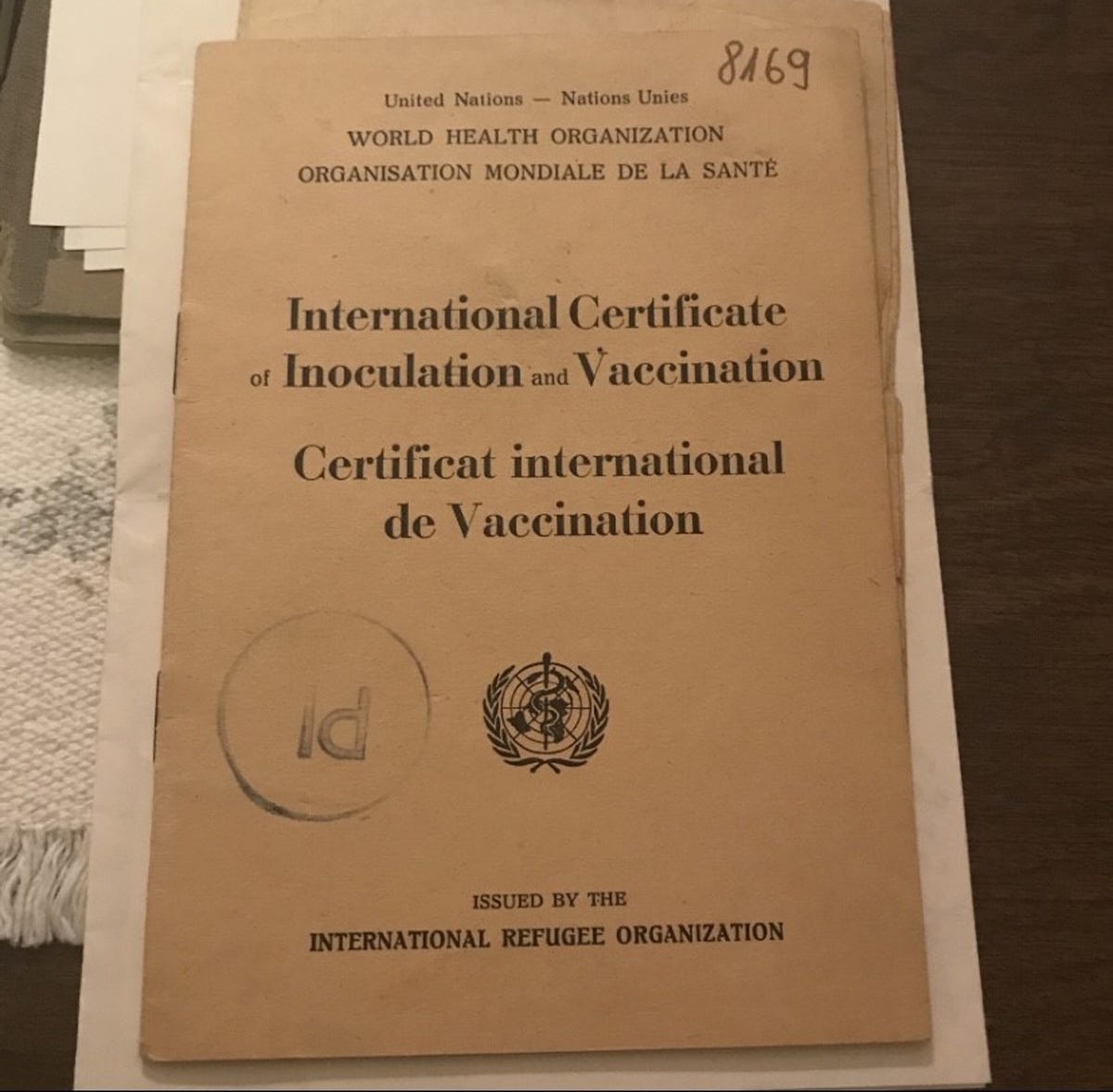
International Certification of Inoculation and Vaccination issued by the International Refugee Organization for Maria Popowycz—an example of the kind of documents ITS holds in its collection. Photograph property of the author.

As Allied forces liberated more territories in Europe, they continued to confiscate depository files from concentration camps, eventually storing them in a former SS school and barracks in the town of Arolsen, Germany (now known as Bad Arolsen). In fact, one of Buchenwald’s satellite forced labor camps, located inside the SS training school, became the first site of the burgeoning archive. The Allies chose Arolsen because it had not suffered much damage from the war, had intact telephone and telegraph lines, and was strategically situated at the juncture of American, French, British, and Russian occupation zones.  

In July 1945, UNRRA became the agency solely responsible for organizing and indexing all Nazi documents that had been gathered by Allied forces. This included collecting and managing a wide range of documents such as transport lists, Gestapo reports, police documents, and records of forced labor. It was also at this time that Allied officials transferred records from the CTB in London and copies of registrations held in France to Arolsen. According to the historian Susan Slyomovics, “the creation of this ‘small archive’ represented one of the foremost, enduring projects of humanitarian documentation and intervention.”

THE INTERNATIONAL TRACING SERVICE, 1948-2012

In 1947, the International Refugee Organization (IRO) replaced the UNRRA as the main supervisory organ that oversaw the management of this growing archive. On January 1, 1948, the IRO renamed the Central Tracing Bureau as the International Tracing System (ITS) and officially opened it as a resource reservoir for displaced persons to find relatives, friends, and other missing persons. Since the institution held relatively few documents at the time, in addition to the material already collected, the IRO also registered and interviewed displaced persons, investigated death marches, and sent questionnaires out to thousands of local authorities and former prisoners. For instance, the research project known as the “graves re-check” created detailed maps of death marches in order to determine where and when certain people died. This collection of investigative reports and questionnaires in which former prisoners provided information about little-known detention centers became one of the main sources ITS cross-referenced when filling requests to search for missing persons. 

By 1955, Belgium, France, Germany, Israel, Italy, Luxembourg, the Netherlands, the United Kingdom, and the United States created an International Commission (IC) to oversee and govern the nascent archive in Arolsen. The IC later expanded to include representatives from Poland and Greece. It was during this time that a number of extremely valuable collections came to Arolsen, including documents from Buchenwald, Dachau, Mauthausen, and other concentration camps that Allied personnel and survivors managed to save. Additionally, the archive collected hundreds of thousands of lists and registration documents pertaining to foreign forced laborers. By the end of 1952, over 30 tons of documents and materials had been obtained by the Allies and housed in Arolsen.

International Refugee Organization Certification for Maria Popowycz, a copy of which resides in the Arolsen archives, photograph property of the author.

After the 1950s, the International Committee of the Red Cross (ICRC) took over the management of ITS. Once supervision was handed over to the Red Cross, ITS became a closed archive. However, archivists accepted requests from people hoping to trace the fate of their friends and family members and played a prominent role in providing documents for restitution claims to the German government. As ITS’s deed of purpose states, the main goal of the archive was to “serve as restitution for the victims and their families, be a warning to all future generations to never again allow such a horror to inflict humanity.” To date, there have been approximately 2.3 million T/D (Tracing Documentation) case file requests since 1946 from generations of individuals in search of family members and their itineraries during the Nazi period.

AROLSEN ARCHIVES, 2012-PRESENT

Today, the archive, now referred to as the Arolsen Archives-International Center on Nazi Persecution, contains the world’s largest single depository of wartime material documenting Nazi persecution as well as material from many postwar trials. It includes over 30 million files, index cards, and lists detailing the fates of victims of the Holocaust and Nazi persecution, including POWs, concentration camp prisoners, and foreign forced laborers.

The mission statement of the Arolsen Archives states, “Based on our unique collection on the victims of Nazi persecution, we honor their legacy by engaging with today’s society to preserve historical truth and stand up for respect, diversity, and democracy.” Consequently, the archive primarily contains sources pertaining to the postwar experiences of survivors, including but not limited to: displace persons registration forms; Care and Maintenance (CM/1) forms produced by the IRO; the IRO and UNRRA’s administration proceedings; documents relating to German businesses that use foreign forced labor; vast quantities of information on Nazi concentration camps; and correspondences relating to postwar compensation claims. Most importantly, ITS contains Tracing Documentation files and the Central Name Index (CNI), a vast collection of card files with over 17.5 million individuals, which physically lists deportees, internees, prisoners, concentration camp inmates, ghetto inhabitants, and displaced persons.  

The ITS was created to centralize postwar efforts to discover the fates of missing people in the aftermath of World War II and the Holocaust. As Thomas Buergenthal, a survivor of Nazi persecution, stated: “We must never forget that the documents on deposit in Bad Arolsen are a sacred memorial held in trust to honor the memories of the millions of victims of the Holocaust and other Nazi atrocities.” The Allied efforts to rescue, collect, and document the atrocities committed by the Nazi regime not only helped displaced persons find loved ones, but also continues to be an important resource for future generations wishing to learn about their relatives’ experiences during World War II.

Thanks for reading Capturing Voices! Subscribe for free to receive new posts and support my work.

The Origins of the International Tracing Service

The Origins of the International Tracing Service

In the aftermath of World War II, a monumental effort to piece together the shattered lives and lost connections of millions of survivors and victims took shape through the International Tracing Service (ITS). This organization, founded in 1943, became the custodian of an extensive archive documenting the fates of those affected by the war.

Thanks for reading Capturing Voices! Subscribe for free to receive new posts and support my work.

The Allies created the International Tracing Service (ITS), now referred to as the Arolsen Archives, to centralize postwar efforts to locate missing persons and help survivors discover the fate of family members in the aftermath of World War II and the Holocaust.

After World War II, tens of millions of people were left stranded in Western Europe as the result of deportation, forced labor, ethnic cleansing, murder, forced migration, and immigration during the war. The Supreme Headquarters Allied Expeditionary Force (SHAEF) and Soviet officials estimated that by September 1945, approximately 13,664,000 displaced persons living in occupied Germany and Austria had applied for some sort of assistance. Typically, international relief agencies such as the United Nations Relief and Rehabilitation Administration (UNRRA) helped manage the material aid, registration, and repatriation of millions of displaced persons. Increasingly, however, many international aid organizations spent time helping those displaced find missing family members and friends. 

As Tara Zahra explains in her book The Lost Children: Reconstructing Europe’s Families after World War II, the process of searching for people after the war proved to be heart-wrenching and extremely challenging:

As the Nazi empire crumbled, millions of people roamed the continent in search of lost family members. They placed ads in newspapers, waited on train platforms, and wrote letters to new international agencies and government officials. During the war many Europeans sustained themselves with fantasies of reunion with their loved ones. After the war they waited and hoped, often in vain for signs of life.

Initially, efforts to reunite family members proved extremely difficult because no centrally located documentation center existed. By the mid-1950s, however, Allied personnel had collected over 30 tons of documents and materials, which were housed in Arolsen, Germany, to help displaced persons discover the fate of their loved ones.

THE EARLY YEARS: COLLECTING AND REGISTERING

As early as 1943, prominent archivists called for plans to administer and capture German war records. Ernst Posner, a distinguished German-Jewish archivist who was interned in the Sachsenhausen concentration camp before arriving in the United States in 1939, was among the first to broach the topic with President Franklin Roosevelt and General Dwight Eisenhower. He reportedly stated that “the protection of the records of occupied territory had to be acknowledged by the conqueror as a kind of moral obligation.” To ensure this task was carried out, Posner prepared reports on the German archival profession, wrote numerous War Department manuals concerning German record-keeping practices, and served as an adviser for the US Army’s Department Records branch on German documents. 

In part due to Posner’s efforts, as the Allies liberated Western Europe, special attention was given to collecting, organizing, and housing German documents and materials. On February 15, 1944, SHAEF set up an official registration and tracing service for missing people called the Central Tracing Bureau (CTB), which was located in London. And, during the liberation of France in August 1944, SHAEF paid special attention to the collection of all documentation left by Nazi occupation forces, specifically documents containing concentration camp lists, inmate transport lists, individual prisoner cards, death certificates, inventories, and infirmary lists. During the liberation process, SHAEF also began registering and assigning all displaced persons specific identification cards, the copies of which were held in Versailles, France.

International Certification of Inoculation and Vaccination issued by the International Refugee Organization for Maria Popowycz—an example of the kind of documents ITS holds in its collection. Photograph property of the author.

As Allied forces liberated more territories in Europe, they continued to confiscate depository files from concentration camps, eventually storing them in a former SS school and barracks in the town of Arolsen, Germany (now known as Bad Arolsen). In fact, one of Buchenwald’s satellite forced labor camps, located inside the SS training school, became the first site of the burgeoning archive. The Allies chose Arolsen because it had not suffered much damage from the war, had intact telephone and telegraph lines, and was strategically situated at the juncture of American, French, British, and Russian occupation zones.  

In July 1945, UNRRA became the agency solely responsible for organizing and indexing all Nazi documents that had been gathered by Allied forces. This included collecting and managing a wide range of documents such as transport lists, Gestapo reports, police documents, and records of forced labor. It was also at this time that Allied officials transferred records from the CTB in London and copies of registrations held in France to Arolsen. According to the historian Susan Slyomovics, “the creation of this ‘small archive’ represented one of the foremost, enduring projects of humanitarian documentation and intervention.”

THE INTERNATIONAL TRACING SERVICE, 1948-2012

In 1947, the International Refugee Organization (IRO) replaced the UNRRA as the main supervisory organ that oversaw the management of this growing archive. On January 1, 1948, the IRO renamed the Central Tracing Bureau as the International Tracing System (ITS) and officially opened it as a resource reservoir for displaced persons to find relatives, friends, and other missing persons. Since the institution held relatively few documents at the time, in addition to the material already collected, the IRO also registered and interviewed displaced persons, investigated death marches, and sent questionnaires out to thousands of local authorities and former prisoners. For instance, the research project known as the “graves re-check” created detailed maps of death marches in order to determine where and when certain people died. This collection of investigative reports and questionnaires in which former prisoners provided information about little-known detention centers became one of the main sources ITS cross-referenced when filling requests to search for missing persons. 

By 1955, Belgium, France, Germany, Israel, Italy, Luxembourg, the Netherlands, the United Kingdom, and the United States created an International Commission (IC) to oversee and govern the nascent archive in Arolsen. The IC later expanded to include representatives from Poland and Greece. It was during this time that a number of extremely valuable collections came to Arolsen, including documents from Buchenwald, Dachau, Mauthausen, and other concentration camps that Allied personnel and survivors managed to save. Additionally, the archive collected hundreds of thousands of lists and registration documents pertaining to foreign forced laborers. By the end of 1952, over 30 tons of documents and materials had been obtained by the Allies and housed in Arolsen.

International Refugee Organization Certification for Maria Popowycz, a copy of which resides in the Arolsen archives, photograph property of the author.

After the 1950s, the International Committee of the Red Cross (ICRC) took over the management of ITS. Once supervision was handed over to the Red Cross, ITS became a closed archive. However, archivists accepted requests from people hoping to trace the fate of their friends and family members and played a prominent role in providing documents for restitution claims to the German government. As ITS’s deed of purpose states, the main goal of the archive was to “serve as restitution for the victims and their families, be a warning to all future generations to never again allow such a horror to inflict humanity.” To date, there have been approximately 2.3 million T/D (Tracing Documentation) case file requests since 1946 from generations of individuals in search of family members and their itineraries during the Nazi period.

AROLSEN ARCHIVES, 2012-PRESENT

Today, the archive, now referred to as the Arolsen Archives-International Center on Nazi Persecution, contains the world’s largest single depository of wartime material documenting Nazi persecution as well as material from many postwar trials. It includes over 30 million files, index cards, and lists detailing the fates of victims of the Holocaust and Nazi persecution, including POWs, concentration camp prisoners, and foreign forced laborers.

The mission statement of the Arolsen Archives states, “Based on our unique collection on the victims of Nazi persecution, we honor their legacy by engaging with today’s society to preserve historical truth and stand up for respect, diversity, and democracy.” Consequently, the archive primarily contains sources pertaining to the postwar experiences of survivors, including but not limited to: displace persons registration forms; Care and Maintenance (CM/1) forms produced by the IRO; the IRO and UNRRA’s administration proceedings; documents relating to German businesses that use foreign forced labor; vast quantities of information on Nazi concentration camps; and correspondences relating to postwar compensation claims. Most importantly, ITS contains Tracing Documentation files and the Central Name Index (CNI), a vast collection of card files with over 17.5 million individuals, which physically lists deportees, internees, prisoners, concentration camp inmates, ghetto inhabitants, and displaced persons.  

The ITS was created to centralize postwar efforts to discover the fates of missing people in the aftermath of World War II and the Holocaust. As Thomas Buergenthal, a survivor of Nazi persecution, stated: “We must never forget that the documents on deposit in Bad Arolsen are a sacred memorial held in trust to honor the memories of the millions of victims of the Holocaust and other Nazi atrocities.” The Allied efforts to rescue, collect, and document the atrocities committed by the Nazi regime not only helped displaced persons find loved ones, but also continues to be an important resource for future generations wishing to learn about their relatives’ experiences during World War II.
Thanks for reading Capturing Voices! Subscribe for free to receive new posts and support my work.

AI speech recognition technology vs. reality!

AI speech recognition technology vs. reality!

We use voice recognition to “prep” our audio files for transcription. We carefully edit for errors due to:

-Improper use and expectations of SRT’s capabilities.
-Disregard for standards of style, grammar and readability.
-Errors due to poor recording quality, idioms, slang, idiosyncratic speech.
Many of these errors are subtle and many are perplexing. Sometimes they make you laugh out loud! Here are a few!

Thanks for reading Capturing Voices! Subscribe for free to receive new posts and support my work.

VR:  And I think by the time I was ten years old, my brother cut down a set of golf clubs for me that were all wooden, wooden shafted, wooden heads—I mean, not wooden heads, but wooden shafts. So he’d read Greek, gripped the handles of the–grips on the golf clubs. And that introduced me to golf. 

REALITY:  What he actually said was So he’d re-gripped the handles.

As far as I know, that doesn’t require a knowledge of Greek!

VR:  He was Dion.

REALITY: He was dying.

Dion, I presume, was alive. But this guy was not.

VR: They did this from Raymond. They did it from from the gardenia.

REALITY: They did this from Bremen. They did it from Gdynia.
(Oh that Raymond and his gardenias!)

VR: We were talking to our kids. 

REALITY: We were towing targets.
I know there are times when it might feel . . . so. . . tempting!

VR:  That happened Raekwon . . . 

REALITY:  That happened right when . . . 
Okay, Raekwon? Really?

VR:  We had to getrillionreports . . . 

REALITY:  We had to you know, get reports . . .

I guess a WHOLE LOT of reports?

VR:  No, I write books! 

REALITY: No, I drive a bus.

Oh, God, I hope not simultaneously!

VR:  Now, we’ve already done the gag and the garrote.  

REALITY: Now, we’ve already done the gag (order) and the Garrity (warning)

Sadly, the listener didn’t live to sign anything!

Thanks for reading Capturing Voices! Subscribe for free to receive new posts and support my work.