Thanks for reading Capturing Voices! Subscribe for free to receive new posts and support my work.
Thanks for reading Capturing Voices! Subscribe for free to receive new posts and support my work.


Join our virtual roundtable conversation on teaching oral history! Get practical advice from teachers who have experimented with bringing oral history into their classrooms. We’ll discuss a range of options, from having students analyze an existing oral history interview to creating opportunities for students to conduct their own interviews. Our goal is for participants to […]
The National World War II Museum, one of the incredible organizations Adept is proud to work with, has just released Part 1 of their World War II: Legacy Electronic Field Trip—now available on-demand. At Adept, we’re honored to support the Museum’s mission by helping capture voices and transcribe vital Oral Histories—ensuring that the stories of bravery, sacrifice, and resilience are preserved for generations to come. Don’t miss this powerful journey through the past, and stay tuned for Part 2, premiering May 8.
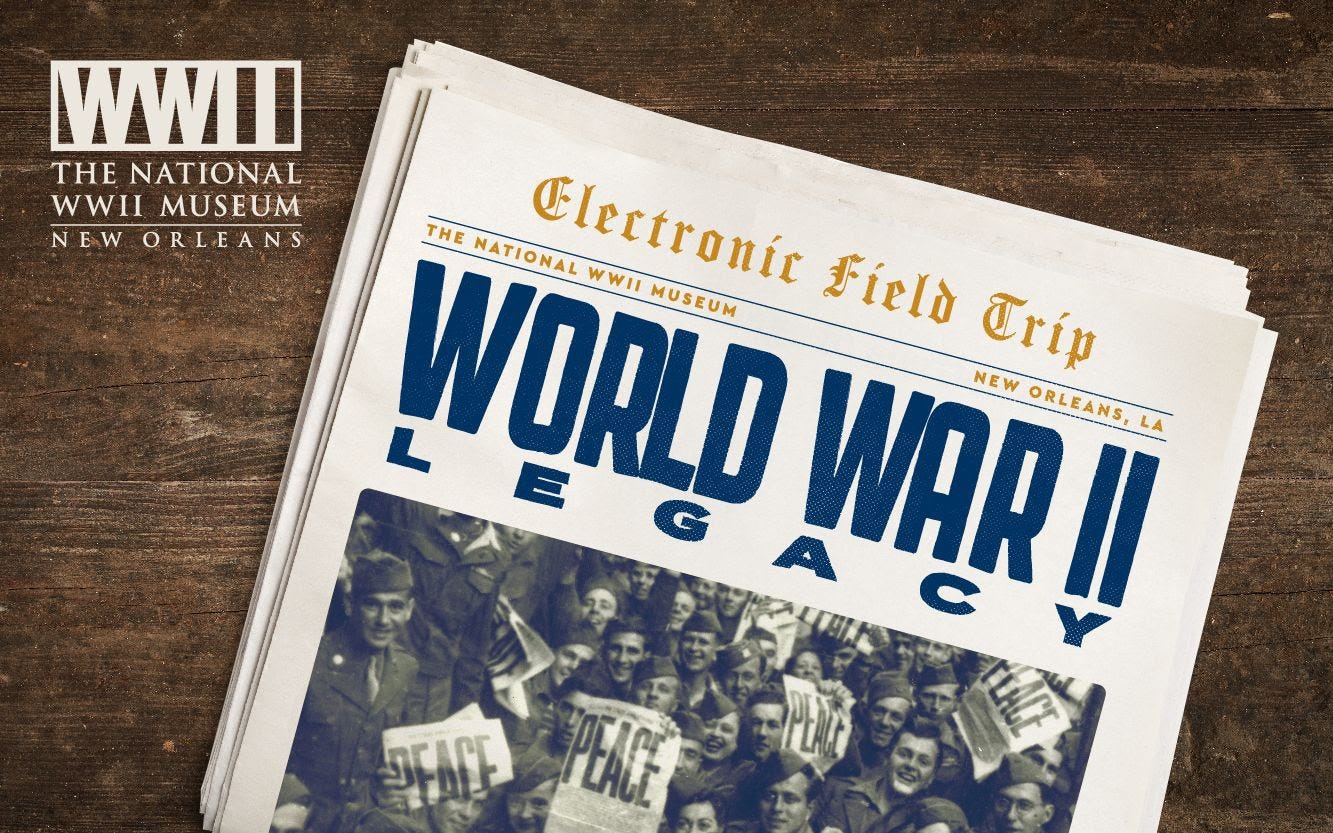
Part 1 of The National WWII Museum’s World War II: Legacy Electronic Field Trip is now available. Explore the final months of World War II and how major battles and key decisions brought about the surrenders of Germany and Japan. Learn about the devastating loss and destruction as well as the liberation and jubilation that came with the conclusion of the war. Student reporters and their teachers will journey to sites where history happened and explore the galleries of The National WWII Museum. Part 1 is available for you to access and view at your convenience—today, tomorrow, and into the future.
Part 2 will premiere May 8 at 9:00 a.m. CT and will examine the emerging tensions between communism and democracy, the United States and USSR, and explore the standoffs that would mark the beginning of the Cold War.
Each part has a runtime of about 30 minutes.
Designed for grades 7–12.
Ever wondered where the phrase “claw back” comes from? Our friends at Grammarphobia have traced its surprisingly long history in “Clawing back in the age of DOGE.” While the term has recently clawed its way into the spotlight thanks to a certain tech billionaire with a flair for memes and market chaos (no names, just rockets), its roots run much deeper. Check out their deep dive into the evolution of this financial phrasal—and maybe pick up a few linguistic gems along the way.
Q: Where did the expression “claw back” (referring to money) come from? It seems to be a fairly recent usage.
A: The phrasal verb “claw back” is heard a lot now, especially as Elon Musk’s Department of Government Efficiency tries to get back money given out, but the usage isn’t quite as new as you think.
The term “claw back” has been used since the 1950s in the sense of to take back money, and the verb “claw” has been used by itself in a similar way since the mid-19th century.
The Oxford English Dictionary defines this meaning as “to regain gradually or with great effort; to take back (an allowance by additional taxation, etc.).”
The earliest citation in the OED for “claw back” used in the financial sense is from the Feb. 21, 1953, issue of the Economist. Here’s an expanded version:
“The Government would also make sure that, as in the case of Building Society dividends and interest payments, such tax relief was clawed back from surtax payers.”
The noun “clawback” (the retrieval of money already paid out) soon appeared. The first Oxford citation, which we’ve expanded, is from The Daily Telegraph (London), April 16, 1969:
“It is, however, necessary to adjust the claw-back for 1969–70 so as to reflect the fact that the 3s. extra on family allowances, which was paid for only half a year in 1968–69, will be paid for a full year in 1969–70.”
The first OED citation for “claw” used in reference to money is from Denis Duval, the unfinished last novel of William Makepeace Thackeray, published a few months after he died at the end of 1863.
Here’s an expanded version of the passage cited: “His hands were forever stretched out to claw other folks’ money towards himself” (originally published in The Cornhill Magazine, March-June, 1864).
When the verb “claw” first showed up in Old English in the late 10th century, it meant “to scratch or tear with claws,” according to the OED.
The dictionary’s earliest citation is from Aelfric’s Grammar, an introduction to Latin, written around 995 by the Benedictine abbot Ælfric of Eynsham: “Scalpo, ic clawe” (scalpo is Latin and ic clawe is Old English for “I scratch”).
In the mid-16th century, the OED says, the verb took on the sense of “to seize, grip, clutch, or pull with claws.”
The earliest citation is from “The Aged Louer Renounceth Loue,” an anonymous poem in Tottel’s Miscellany (1557), which is described in the Cambridge History of English Literature as the first printed anthology of English poetry:
“For age with stelyng [steely or implacable] steppes, Hath clawed [clutched] me with his cowche [crook].” The anthology, collected by the English publisher Richard Tottel, is also known as Songes and Sonettes Written by the Ryght Honorable Lord Henry Howard, late Earle of Surrey, Thomas Wyatt the Elder and Others.
The OED says the seize, grip, clutch, or pull sense of “claw” later came to be used figuratively—both by itself and in the phrase “claw back”—to mean regain funds slowly or with much effort, the sense you’re asking about.
We’ll end with a recent example of the phrase used figuratively in reference to Musk’s campaign to take back funds:
“From the start of the second Trump administration, Mr. Musk’s team has pushed agencies to claw back government funds for everything from teacher-training grants to H.I.V. prevention overseas” (The New York Times, April 5, 2025).
✰ Oral History & IRB Review | Oral History & The Law Webinar #1 ✰Tuesday, June 243 – 4:30 pm ESTon Zoom As a follow-up to the popular session from the OHA Annual Meeting in Cincinnati last fall, Jay-Marie Bravent and Doug Boyd will continue the community conversation focused on current trends in oral history […]