Words matter—especially when they’re being rewritten. In this sharp piece from Vanity Fair, Molly Jong-Fast examines how Donald Trump and his allies are weaponizing language itself—redefining terms, reshaping narratives, and even proposing new names for familiar landmarks. It’s not just political theater; it’s a calculated effort to control how we talk, think, and remember.
Thanks for reading Capturing Voices! Subscribe for free to receive new posts and support my work.
The administration’s attack on the AP, along with efforts to rewrite history and reframe reality, only reaffirms the maxim that language is power.
The right-wing war on all things “woke” has relied on a critical weapon: language. Trumpworld’s culture-war arsenal may contain many things—a flurry of social media posts and videos, an army of sympathetic media propagandists—but all of these tools rely on language.
It feels ironic to talk about the importance of language in MAGA’s rhetoric when Donald Trump uses so many malapropisms and shorthands to convey his ideas. Think of “the weave,” his tendency to tack back and forth between completely different, ancillary topics when speaking in public.
But while Trump may not be particularly careful about every word—or any word, really—his administration and allies are laser-focused on their intrinsic power. They’ve used phrases like “biological reality” and “maiming” to dispute transgender people’s existence and rail against gender reassignment surgery. They’ve disingenuously used words like “energy emergency” to ramp up offshore drilling. One of Trump’s early executive orders combatted nonexistent “censorship”—in actuality, a catchall term for any effort to combat the misinformation and disinformation propagated by Trump and his allies.
Now the Trump administration has barred the Associated Press from the Oval Office and Air Force One because the esteemed news agency will not follow the president’s executive order and refer to the Gulf of Mexico as the “Gulf of America.” (According to Axios, this is just one of MAGA’s frustrations with the AP stylebook.) And the National Park Service, seemingly at the direction of Trump’s anti-“gender ideology” executive order, has deleted all mentions of “transgender” and “queer” people from the Stonewall National Monument’s websites—a Stalinesque erasure of the T and Q in LGBTQ, despite their crucial role in early queer-rights movements.
Trump and his allies understand the power of words, and his administration is quickly becoming one that’s obsessed with perverting their meaning. George Orwell reminded us of the political power of language in 1984 by using two different very complementary ideas—“newspeak” a euphemism for the heavily simplified language of propaganda, and “doublethink,” one example of which is “freedom is slavery,” a phrase similar to “arbeit macht frei,” translated to “work makes one free,” infamously used by Nazi Germany. Those concepts ring heavily in Trump’s executive order titled “Prioritizing Military Excellence And Readiness.” The name belies the fact that the order bans trans people from serving in the US military and prohibits the use of identification-based pronouns in the Department of Defense. How does banning trans people prioritize “excellence”? How does abolishing identification-based pronouns figure into “readiness”?
The Trump executive order abolishing diversity, equity, and inclusion (DEI) initiatives in the military is called “Restoring America’s Fighting Force.” What exactly is being restored? Does a pre-1960s army somehow fight better than a post-1960s army? None of these questions actually matter to Trumpworld, because precision of language isn’t the point—it’s just overly simplistic propaganda.
And then there’s Trumpworld’s retaking the word “democracy” for their own purposes. Elon Musk told a Pennsylvania town hall crowd in October that the people “who say Trump is a threat to democracy are themselves a threat to democracy.” Musk spends a lot of time tweeting about democracy, but such posts seem to intentionally twist the meaning of the word to fit his own needs. For example, when a judge temporarily blocked his and Trump’s early actions, Musk tweeted last week that “Democracy in America is being destroyed by judicial coup. An activist judge is not a real judge.” Two days later, he tweeted, “If ANY judge ANYWHERE can stop EVERY Presidential action EVERYWHERE, we do NOT live in a democracy.” From a simple Twitter search of Musk’s username and the word “democracy,” it becomes evident that when the world’s richest man says something or someone is threatening democracy, he really just means it’s something he doesn’t like.
The Trump administration has also worked hard to replace our traditional political lexicon with contradictory doublethink. As Shawn McCreeshwrote in TheNew York Times, “An entire lexicon of progressive terminology nurtured by the last administration has been squelched.” Words like patriotism (see: “patriotic education”), freedom, and a favorite of the far right, “anti-American,” are frequently deployed in ways that mean their opposite. (The phrase “un-American” was a key buzzword of McCarthyism, a movement that just like Trumpism targeted intellectuals and academics, including my grandfather Howard Fast. The central premise was that communism was so profoundly corrosive that if communists were allowed to write movies or books or magazine articles, they could have Svengali-like influence over the reading public, forcing them to ditch capitalism. This administration seems to view “DEI” as a similar catchall for ideas they don’t like.)
Washington Post fact-checker Glenn Kesslerwrote about Trumpworld’s dishonest relationship with words and phrases like “transparency” (while firing multiple inspectors general), “free speech” (despite the censorious nature of their edicts), and “deficit” (which Trump’s desired tax cuts would only increase). Kessler also noted how the Trump administration, including Musk’s DOGE, seems to call policies it doesn’t agree with “fraud,” when that is not what the word fraud means.
Even The Atlantic’s conservative columnist Thomas Chatterton Williams admits that Trumpworld is at war with the English language, utilizing the tools of censorship while somehow also claiming the mantle of free speech warriors. “Most of the banned words related to gender and diversity, and this time the rules had the force of the government behind them,” Williams wrote. “The compelled politesse of the left has been swapped out for the reflexive and gratuitous disrespect of the right.” This checks out when you compare the careful, halting, almost fearful language of many Democratic elected officials versus the strident, giddily hostile language of many Republicans.
But anyone who thinks Trump isn’t at war with language, with words and their meanings, should look no further than a world map. There’s reason to think that Trump’s “Gulf of America” name change is about more than just asserting American primacy in the region; it could also speak to his larger ambitions—his quest to rewrite parts of history. After all, Republicans have long been at war with history, trying to mute and soften the teaching of America’s original sin—slavery—and using book bans to prevent certain stories from being told.
It may seem odd that language has taken such a central role in an administration that seems so slapdash. But it makes sense. Trump ran an attack ad that used the line, “Kamala is for they/them, Donald Trump is for you.” It was, of course, misleading; prisons, under Trump, offered gender-affirming care, which the campaign was then criticizing Harris for supporting. But it didn’t matter because the language was effective. It was just a few words summing up Trump’s ethos by dumbing it down to: Other people are coming for your stuff.
Thanks for reading Capturing Voices! Subscribe for free to receive new posts and support my work.
In some historical circles, a mistaken impression has developed that the U.S. Navy’s Task Force 38 launched the aerial offensive on the Japanese stronghold at Rabaul, New Britain, that ultimately rendered the base useless. This idea is probably due, at least in part, to the writings of historian Samuel Eliot Morison, who held the rank of rear admiral in the U.S. Navy and who wrote with a definite pro-Navy slant.
Such, however, is not the case. While the carrier strikes in November 1943 were the first air action against the Japanese stronghold by Admiral William F. “Bull” Halsey’s South Pacific Area (SOPAC) forces, they were hardly the first attacks of the campaign, and they were far from the first against the complex. Japanese sailors, soldiers, and airmen stationed at Rabaul were no strangers to the sight of American aircraft over their bases. In fact, the famous Navy air raid on November 11, 1943, had been preceded by several weeks of air strikes by heavy and medium bombers of General George C. Kenney’s Fifth Air Force. Those raids were but the latest in a series of attacks that actually commenced in the spring of 1942, shortly after Japan occupied New Britain.
A Picturesque Island City
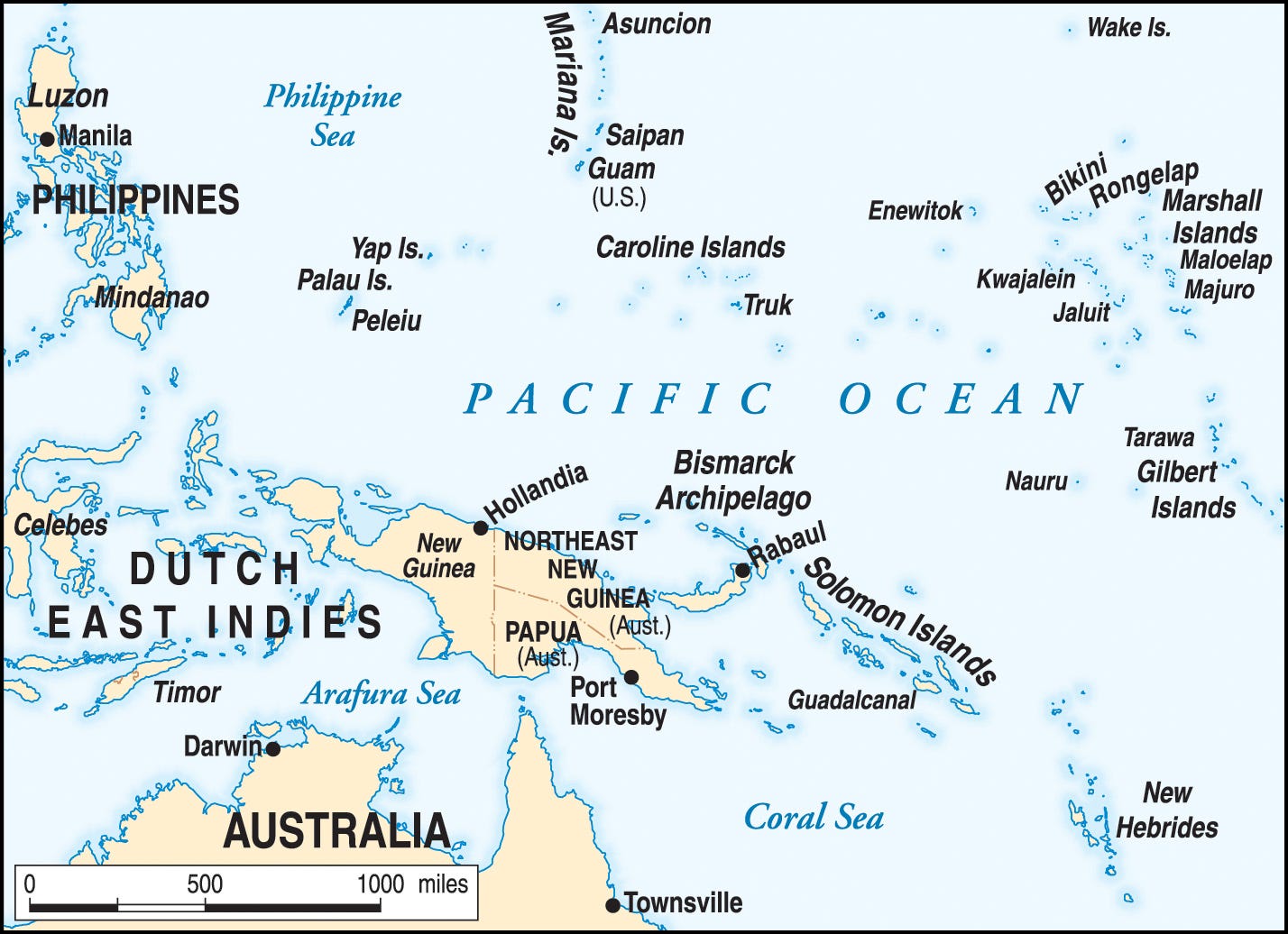
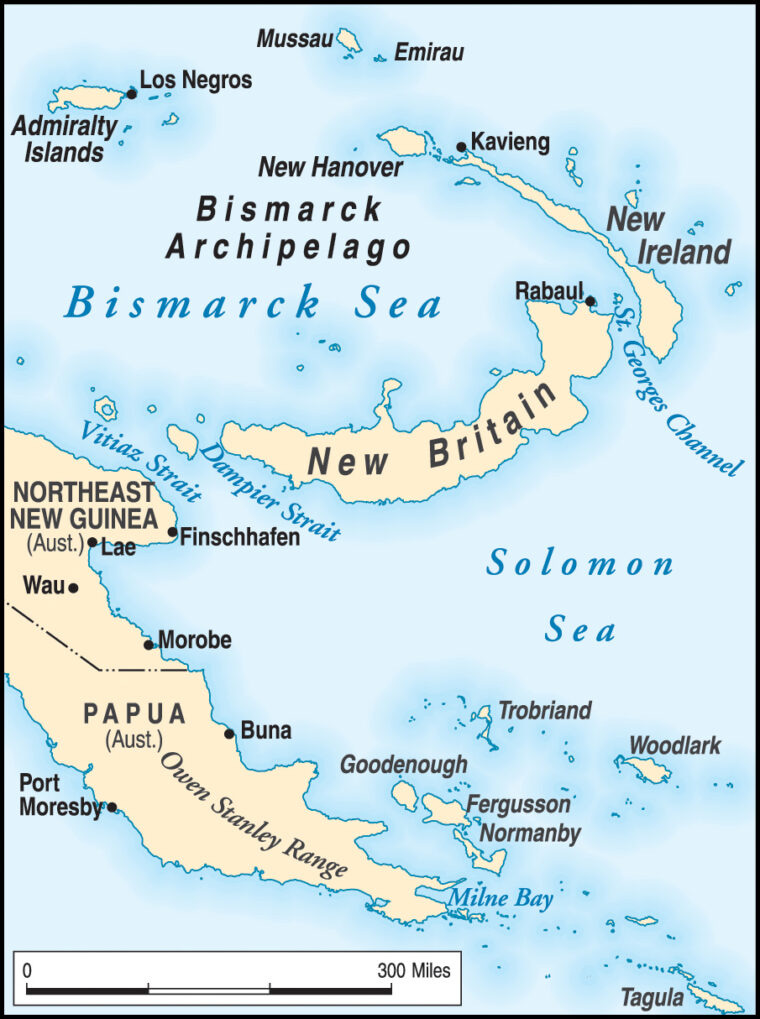
The city of Rabaul is located on the northeastern tip of New Britain, one of two islands—the other is New Ireland—that make up the Bismarck Archipelago. It sits on the narrow St. Georges Channel, which divides the two islands. Before it became the major Japanese forward base in the Southwest Pacific, Rabaul had been a picturesque island city located on the banks of one of the region’s largest natural harbors, a feature that brought it to the attention of military planners in both Washington and Tokyo as America and Japan geared up for war.
Several weeks before the attack on Pearl Harbor signaled the beginning of open hostilities in the Pacific, the U.S. Army and Navy began preparations to establish a base there that could be used to oppose the Japanese threat to the Netherlands East Indies. The U.S. Army Air Corps saw Rabaul’s two airfields as a potential refueling stop for military aircraft bound for the Philippines, and the Navy was interested in Simpson Harbor. Unfortunately for the United States, in 1941 time was on Japan’s side.
Thanks for reading Capturing Voices! Subscribe for free to receive new posts and support my work.
Quick Fortifications by Japan
The Royal Australian Air Force maintained a base at Vunakanau Airfield, where a squadron of twin-engine Lockheed Hudson bombers and a few lightly armed Wirraway observation planes were stationed. Japanese carrier-based aircraft struck Rabaul for the first time on January 20, 1942. The markedly inferior Wirraways were quickly dispatched, but not without a fight. The Hudsons managed to escape before Japanese troops landed on January 23.
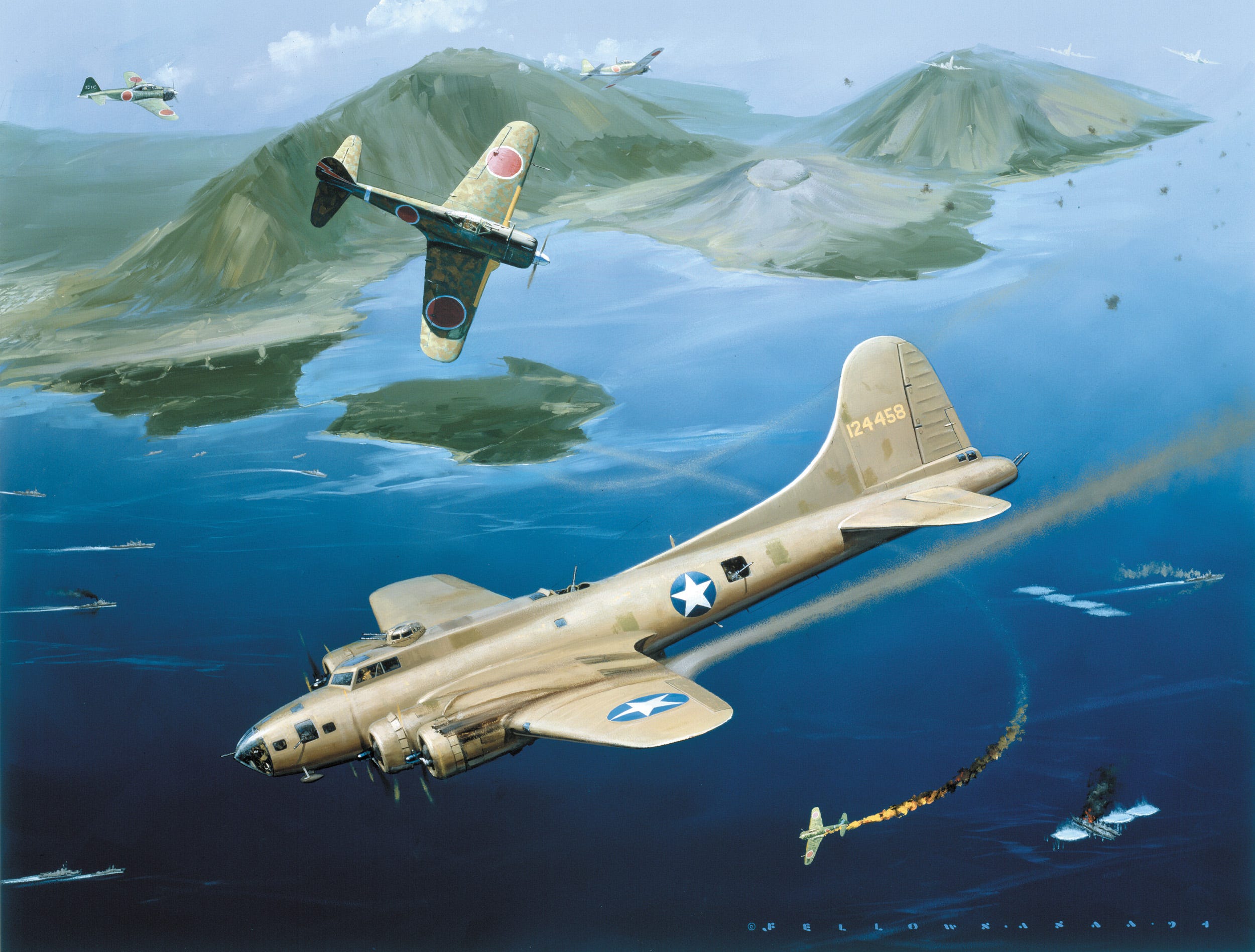
The sea stretched out beneath them, Japanese zeros swarm around a B-17 bomber during the assault on the Japanese stronghold of Rabaul in this painting by Jack Fellows.
Due to its position south of their main Pacific supply base at Truk Atoll in the Carolines, the Japanese quickly built up their presence at Rabaul, making it their advance base for the conquest of the Solomon Islands and Papua, New Guinea. The natural harbor made an ideal port for transports and warships, while the two airfields served as bases for air operations in the Solomons and New Guinea. Their efforts did not go unhampered, however. Although the Allies had been driven out of the Philippines and the Netherlands East Indies, when General Douglas MacArthur arrived to take command of the Southwest Pacific Area of Operations (SWPA) in March 1942 he immediately drew the line in New Guinea. He further decided that offensive operations there were the best defense for Australia.
Sleeping on the Wings of Their Airplanes
In early 1942, the only means of offensive operations in the region were the remnants of two squadrons of Boeing B-17 Flying Fortress heavy bombers belonging to the 19th Bombardment Group, which had been brought out of the Philippines, then reinforced with additional aircraft and personnel sent from the United States. A second group, the 7th Bomb Group, operated out of Australia for a time but was suddenly diverted to India immediately after the fall of Java.
The B-17s of the 19th Group began offensive operations from Australia on February 23, 1942, and flew about a dozen missions by April 1, of which half were directed against the Japanese installations around Rabaul. The raids were small scale, consisting of an average of three airplanes, and were usually flown at night to avoid fighter interception. Just mounting a mission was a struggle in itself. To fly to Rabaul, the bomber crews had to depart their base near Townsville and fly 600 miles north to Port Moresby, where the bombers were refueled and armed while the crews tried to grab some rest wherever they could. This usually meant sleeping on the wings of their airplanes, or under them if it rained. It rained often in New Guinea.
Departing From Port Moresby
The bombers would depart Moresby in the wee hours of the morning and cross the 13,000-foot Owen-Stanley Mountains, which were often covered by turbulent storm clouds, then continue across the Bismarck Sea and along the coast of New Britain to the target. The initial raids were generally ineffective as far as doing serious damage, but they served as a good source of intelligence on Japanese strength at Rabaul.
The only other Allied bombers in the theater in early 1942 were several Lockheed Hudson light bombers operated by the Royal Australian Air Force. The Hudsons were a military version of the Lodestar transport, but they offered very limited capabilities. In March 1942, Major Paul I. “Pappy” Gunn entered the picture when he engineered the “transfer” of a dozen North American B-25 Mitchell bombers from the Netherlands East Indies Air Force to the 3rd Attack Group.
The 3rd had been operating Douglas A-24 Dauntless dive-bombers that had been on the way to the Philippines when the war broke out. It was originally supposed to operate Douglas A-20 Havoc light bombers but, although the personnel were in Australia, their airplanes had yet to arrive. The first B-25 mission was against Gasmata, a Japanese airfield on the southwestern end of New Britain. A few days later, on March 25, V Bomber Command was further reinforced with the arrival of several Martin B-26 Marauders of the 22nd Bombardment Group.
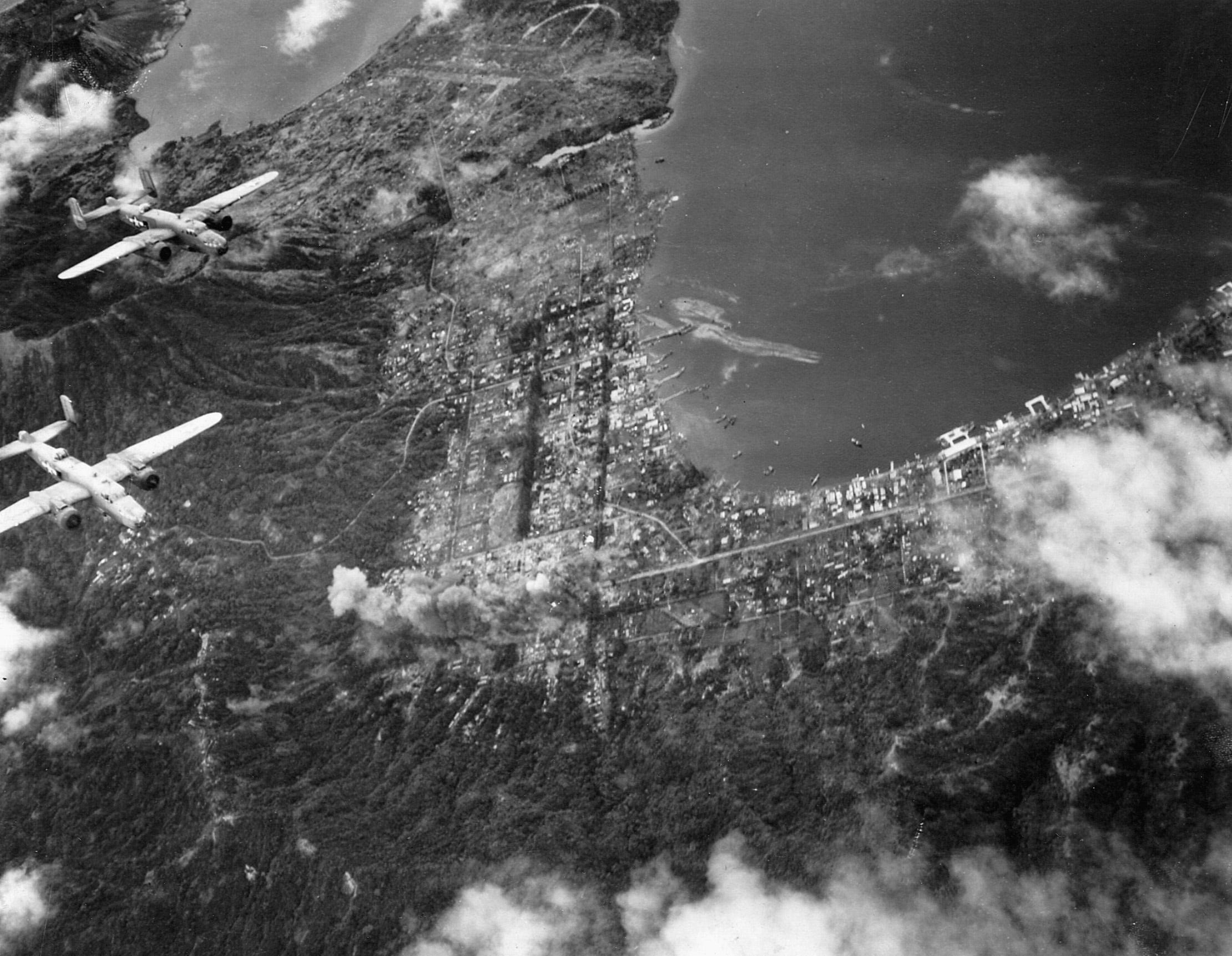
The great Japanese supply depot and bastion at Rabaul on the island of New Britain was a major target for bombers of the U.S. Fifth Air Force, as well as America’s allies.
Plagued With Supply Problems
Although the B-17 had been designed for strategic bombing, the Flying Fortresses were plagued with maintenance and supply problems. It was often impossible to scrape up enough airplanes for even a small-scale mission. Consequently, V Bomber Command assigned the newly arrived 22nd Group to missions against Rabaul until the B-17 force could be brought up to strength. Beginning on April 6, 1942, the 22nd Group B-26s flew 16 missions with more than 80 sorties before medium bomber missions to Rabaul were discontinued.
Although the B-26s were able to attack Lakunai and Vunakanau airfields as well as ships in the harbor and shore installations, they were operating at the very edge of their limits. The distances involved required the installation of bomb bay fuel tanks, which reduced their bomb loads to four 500-pound bombs or 20 100-pounders. Ordinarily, the bomb capacity of a B-26 was half that of a B-17, but the long-range fuel tanks halved it again.
The whole idea of aerial bombing is to put as much high explosive onto a target as possible, but the B-26s’ limited bomb loads greatly reduced their effectiveness.
Before the medium bombers were taken off the Rabaul run, their crews claimed hits on three transports, two merchant ships, and an aircraft carrier. Marauder gunners claimed 16 Japanese fighters. In spite of fighter opposition and antiaircraft fire, B-26 losses were surprisingly low; only three Marauders were lost in combat between April 24 and July 24.
The B-17s continued operations against Rabaul whenever enough airplanes could be patched together for a mission. From April to June, the 19th Group flew 16 missions, a total of 60 sorties. Like the B-26s, their results were mixed. Bad weather over the target often prevented accurate bombing and an effective assessment of the results. Heavy bomber crews reported hits on at least two Japanese vessels and secondary fires on shore. Both the B-17s and B-26s attacked from medium to high altitude, often bombing through layers of cloud. Their numbers were very low, thanks largely to the strategic decision made by the U.S. and British governments to defeat Germany first.
Most of the production of military aircraft, especially bombers, was allocated to units in training for operations in the European theater. An additional B-17 group, the 43rd, arrived in Australia in the late spring but wasn’t ready for combat for several weeks.
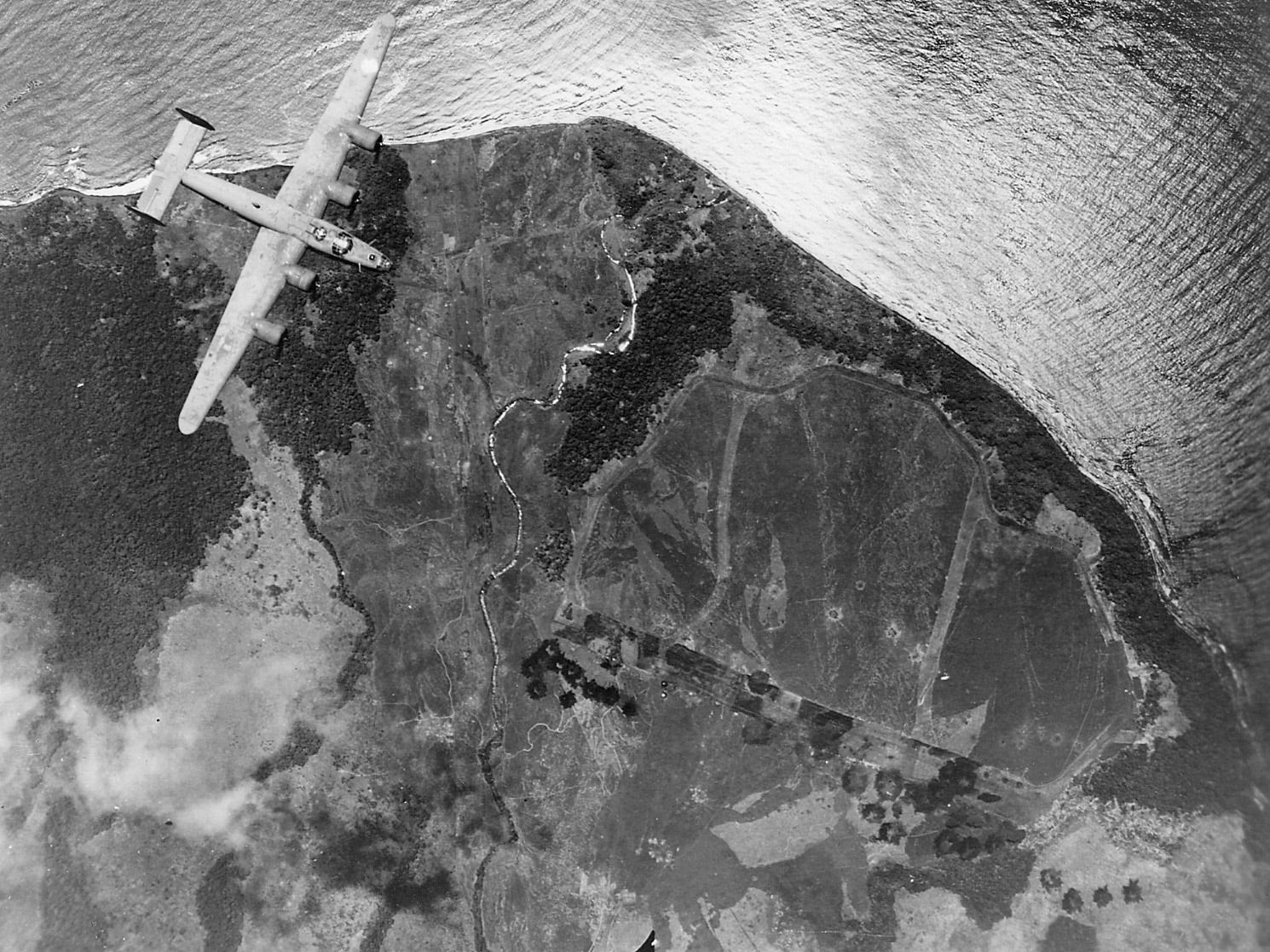
A B-24 of the 5th Airforce flies over the Japanese airfield at Cape Cloucher, New Britain.
General Kenney Takes Command
In late July, General Kenney arrived in Australia to take charge of the Allied air forces under MacArthur’s command, arriving only a week before the planned invasion of Tulagi and Guadalcanal by Pacific Ocean Area forces under Admiral Chester Nimitz. The two islands were actually located in MacArthur’s theater, but he agreed to a westward shift of the boundary so they fell in the South Pacific Area and promised air support for the landings.
After a whirlwind inspection of the combat squadrons, MacArthur’s new air boss ordered a stand-down of combat operations during which maintenance crews would work day and night to get the heavy bombers ready for a big mission. Kenney informed MacArthur that he had grounded all of the bombers but would have them ready in time to send 16 B-17s against Vunakanau Airfield, where an estimated 150 Japanese aircraft were based, to support the Marine landings that were to take place on August 7.
Kenney officially took command of the Allied Air Forces on August 4. One of his first actions was to activate the Fifth Air Force, which had been authorized several months before but which had yet to be staffed. The move was designed to divide the American and Australian air forces into separate commands. Two days later, true to Kenney’s word, V Bomber Command mounted a 16-airplane mission against Rabaul.
Lieutenant Colonel Ralph Carmichael led the mission. Unfortunately, one airplane crashed on takeoff and two others turned back due to mechanical problems. Even though they were attacked by Japanese fighters while still some 40 to 50 miles from the target, the remaining 13 B-17s went over Rabaul at 22,000 feet and dropped their bomb loads on the airfield. The crews noted that Simpson Harbor was filled with ships and antiaircraft fire was heavy. How effective the mission had been was impossible to tell, but the crews reported several hits on the target, and the B-17 gunners claimed seven kills. Radio intercepts indicated that damage to Japanese aircraft on the ground had been significant.
Nine airplanes returned to Moresby in formation, and three others followed as stragglers. Only one B-17 failed to return. Captain Harl Pease’s airplane lost an engine while en route to the target, but the veteran pilot, who had flown with the 19th Bomb Group in the Philippines, continued on three. Japanese fighters singled out the crippled bomber and pressed their attacks.
Other crews saw Pease’s crew jettison a burning bomb bay tank, then watched in horror as the airplane burst into flames and fell toward the sea. Pease and his crew had flown a reconnaissance mission the previous day from which they returned with an engine shut down. The crew had worked for hours to get another airplane ready for combat and had not arrived at Moresby until midnight. Pease was posthumously awarded the Medal of Honor, the first of several awarded to airmen for missions over Rabaul.
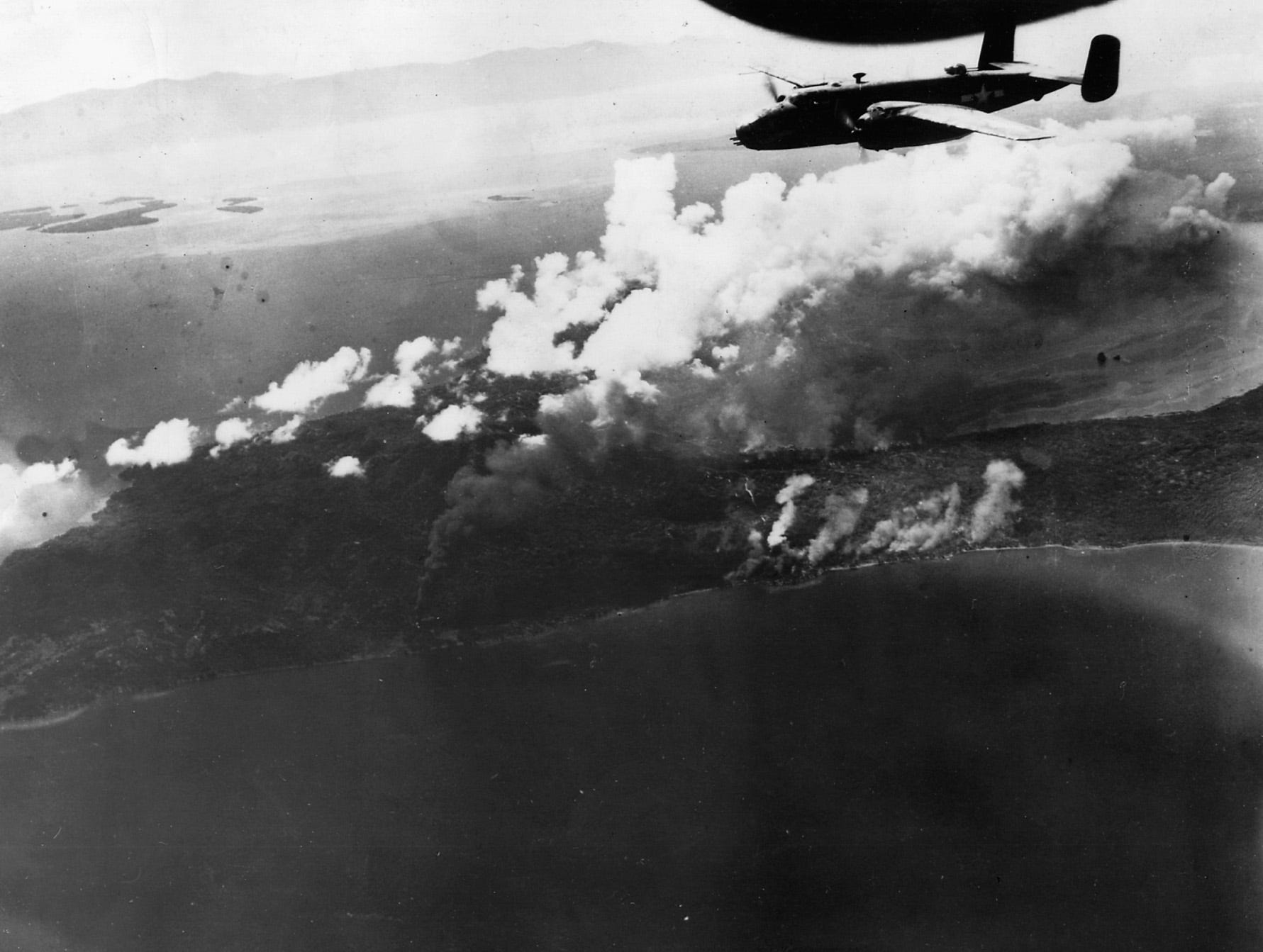
A B-25 Mitchell of the 13th Air Force roars above burning Japanese oil installations in New Britain.
Keeping the Rabaul Raiders Flying
One of the military problems for the American airmen attacking Rabaul was that no matter how many Japanese airplanes they destroyed in the air and on the ground, the enemy could replace them within a matter of days. American replacement aircraft took weeks to reach the theater, if they came at all. Damage to Japanese airfield surfaces was easily repaired. Even if a raid put an airfield out of action, the Japanese could have it operational again within hours—days at most—by simply filling in the bomb craters. Bombing of ships from high altitude was generally hit and miss.
Aircraft and aircrew replacements for the American squadrons were practically non-existent. Only the heavy bomber groups that had originally been destined for the Philippines before the war were sent to Australia, and one of those was diverted to India. Boeing B-17s were in particularly short supply since the former head of Air Force Combat Command, Lt. Gen. Carl Spaatz, was in the process of building up a massive heavy bomber force for operations out of England. This meant that whenever the 19th or 43rd Group lost an airplane and crew, replacements would not necessarily be coming. There were no Allied fighters available in 1942 that had the range to fly all the way to Rabaul. SWAPA fighter groups were equipped with Bell P-39 Airacobras and Curtiss P-40 Tomahawks, neither of which had adequate high-altitude capabilities.
To maintain an effective combat force, Fifth Air Force maintenance personnel resorted to cannibalization, removing parts from a sacrificial airplane to keep others flying. If at all possible, teams of mechanics made their way into the jungle or to remote islands to remove as many parts as they could from the wreckage of aircraft that went down. Fifth Air Force mechanics gained a reputation for their resourcefulness as they used every available part to keep their planes in the air. They even became aircraft manufacturers, as they assembled parts from various wrecks to construct a single serviceable aircraft. One of the most famous B-17s of the war was “Alexander the Swoose,” a B-17 that was assembled from parts of several wrecked Flying Fortresses.
The Japanese were not plagued by the same problems as the Americans and Australians. Rabaul lay close enough to the Japanese supply base at Truk that single-engine fighters could be delivered by air, and aircraft destroyed by Allied bombs could be easily replaced within a day or so. Truk itself lay close enough to Japan that single-engine fighters could be flown in from the home islands. American fighters and light bombers, when they were available, had to be disassembled and loaded on ships for an ocean voyage of several weeks, then had to be reassembled after they were off-loaded in Australia.
From the time a new fighter left the factory for an American unit in Australia or New Guinea, nearly two months would have lapsed. The process was even longer since newly arrived aircraft required considerable preparation before they entered combat. Four-engine heavy bombers and medium bombers could be delivered by air when they were available.
Skipping Bombs
Rabaul continued to be the major target for Fifth Air Force heavy bombers, although combat in New Guinea often required diversions to others. Most of the missions were flown at night, with the crews bombing under the light of flares. For accuracy, V Bomber Command adopted a pathfinder concept in which one or two airplanes would go over the target in advance of the main formation and mark it with incendiary bombs. The bombers would come over at altitudes ranging from 4,000 to 10,000 feet to drop their bombs. They often dropped down to low altitude so their gunners could strafe the Japanese antiaircraft and searchlight crews. A benefit of bombing from such low altitudes was that Fifth Air Force planes were able to achieve far greater accuracy than their counterparts in Europe, which were forced to drop their bombs from altitudes much higher than ever conceived in the pre-war Army Air Corps.
In early October, MacArthur’s forces began an airlifted assault on Japanese positions south of Buna on the north shore of the Lae Peninsula in New Guinea, while at the same time the Japanese started a new offensive on Guadalcanal. On October 5, Fifth Air Force bombers began a three-week sustained bombing campaign on Rabaul in an effort to interrupt the flow of Japanese supplies to both New Guinea and Guadalcanal, where the Marines were having a difficult time.
U.S. B-25 Mitchell bombers of the 13th Air Force wing their way above the Japanese bastion at Rabaul in March 1944. The major Japanese supply base and staging area was repeatedly bombed during the American offensive in the South Pacific.
Missions were flown night and day, with formations generally in the 20- to 30-airplane range. The crews noted that Simpson Harbor was filled with ships, leading the commander of the 63rd Bombardment Squadron, Major William Benn, to conclude that the time was ripe to try out a new method of attack he and some of his crews had been working on for several weeks.
Benn had come to Australia as Kenney’s aide, but immediately after their arrival his boss relieved him of the assignment and gave him a squadron in the recently arrived 43rd Bombardment Group. During their journey to Australia, the two men discussed the merits of skipping bombs across the water into the side of a ship, a method that the British had used with some success in the North Atlantic and that Navy fliers had experimented with before the war. Whether Kenney became aware of it or not, Pappy Gunn, who was a firm believer in low-altitude attack, had skip-bombed a Japanese transport in Cebu Harbor with a B-25 during the Royce Raid in early April.
Benn and his men had been flying practice missions against an old wreck in the harbor at Moresby ever since he took command of the squadron in August. On the night of October 23, Benn and selected crews from his squadron dropped down and went into Simpson Harbor at wave-top altitude. Captain K.D. McCullar skipped a bomb into the side of a Japanese destroyer. Other pilots claimed hits that threw smoke and debris into the air. Postwar evaluation of Japanese records revealed no reports of any ships being lost that night, but the flight crews believed otherwise.
90th Bombardment Group’s Liberators
Prior to October 1942, the only heavy bombers in the theater were B-17s, but that changed when the 90th Bombardment Group arrived with a complement of Consolidated B-24D Liberators. A 1940 design, the Liberator was developed to replace the B-17, which had failed to live up to expectations as a long-range bomber. Incorporating advanced aeronautical engineering techniques, the B-24 was considerably faster and could carry a larger payload over a much greater distance than its predecessor, features that made it the ideal heavy bomber for Pacific use.
The lighter B-17s were able to operate at higher altitudes, but this feature was not particularly important in the Pacific where range was the primary issue. Unfortunately, cracks were discovered in the nose landing gear of several of the airplanes, and the bombers were grounded until they could all be inspected and repaired. The first Liberator missions in mid-November were directed against Rabaul, but the results indicated that the crews were in need of additional training.
On the first mission, one airplane crashed on takeoff and smashed into two other B-24s. Ten airplanes got off, and two actually reached Rabaul; their bombs set fire to a cargo ship. But two B-17s turned up missing after the mission, including that of the group commander, Lt. Col. Art Meehan. Kenney temporarily removed the group from operational status and put it back into training to sharpen the crewmen’s skills. His decision paid off in spades. The 90th Group would go on to become one of the most successful bomber groups of the entire war.
Interdicting the flow of Japanese supplies to New Guinea and the Solomons had become the main goal of the Fifth Air Force, a mission that was proving extremely frustrating. When intelligence reports indicated that Simpson Harbor was full of ships, Kenney ordered a maximum effort on January 5. His orders stipulated that the heavy bombers should attack at dawn when the Japanese would still be sleeping. But V Bomber Command commander Brig. Gen. Ken Walker preferred a midday attack on the grounds that the bombers might have trouble assembling during darkness, even though the Japanese were known to mount air patrols during the day.
Walker elected to ignore Kenney’s instructions and made a noon attack, flying into a hornet’s nest. A 12-plane formation made up of six B-17s and six B-24s hit the target and reported hits on 10 ships. But fighter opposition was intense and the flak was heavy. Two Flying Fortresses were shot down, including the one carrying General Walker. Kenney’s orders had also stipulated that Walker was not to go on the mission. Kenney was severely distressed when Walker was reported missing, but when searchers discovered a B-17 on a reef he told MacArthur he was going to severely reprimand the young general for his disobedience and put him on leave in Australia. MacArthur responded that if Walker did not come back, he was going to recommend him for the Medal of Honor. Walker did not come back.
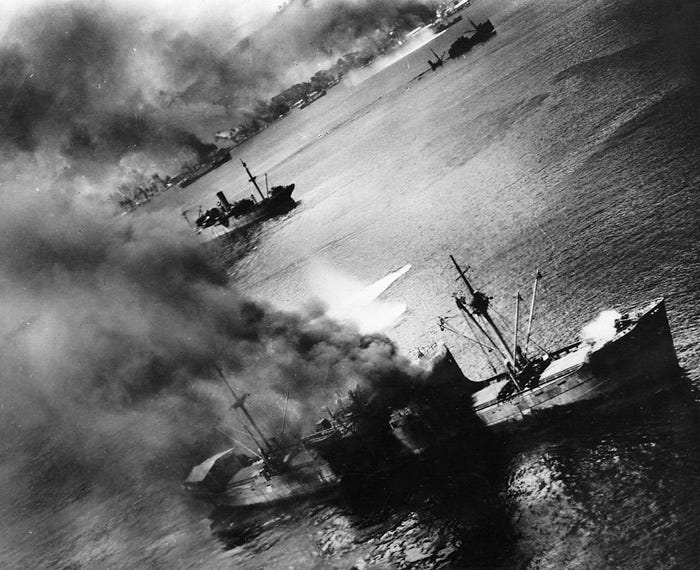
Japanese transport ships in the harbor at Rabaul suffer hits and near misses from U.S. bombers.
Pappy Gunn’s Modified Bombers
During the fall and winter of 1942, Pappy Gunn was developing the weapon that would enable the Fifth Air Force to begin successfully interdicting Japanese shipping and knocking out ground installations. Gunn’s developments had actually entered combat in September 1942 when a squadron of modified Douglas A-20 gunships began low-altitude attacks in support of Australian troops fighting the Japanese on the Kokoda Track in New Guinea.
The modified A-20s, each featuring a quartet of .50-caliber machine guns in the nose with two others installed on the sides of the fuselage, quickly proved to be highly effective in the ground attack role. The A-20s also held promise for skip bombing attacks on shipping, but they lacked the range to go to Rabaul. Gunn had actually conceived the idea of modifying B-25s earlier in the year, before the A-20s arrived in Australia, but permission for the modification had been denied due to the lack of available airframes.
Kenney saw modified B-25s as “Commerce Destroyers,” heavily armed gunships that would swoop in low on skip bombing attacks against ships. In October 1942, with more B-25s in the theater and with the A-20s having proved the concept, he gave Gunn permission to go ahead with the modification and to initially convert enough airplanes to equip a squadron. If they proved effective, others would be similarly converted. They did.
Gunn’s modification put a package of six .50-caliber machine guns in the nose of the B-25s, with two more mounted on either side of the fuselage for a total of 10 forward-firing guns. The combined firepower could rip a hole in the side of a barge or small transport, and it demoralized the Japanese gunners on the decks of transports and even warships.
During the first week of March, Gunn’s modified B-25s and A-20s demonstrated just how effective low-flying bombers could be against Japanese shipping when they practically wiped out a convoy just outside the harbor at Lae using skip bombing. Their success led Kenney to authorize the conversion of more than 175 other Mitchells to the gunship role by September 1943. The 3rd Bombardment Group, more popularly known as the 3rd Attack Group, operated both A-20s and B-25s, and its pilots soon became expert at low-altitude attack.
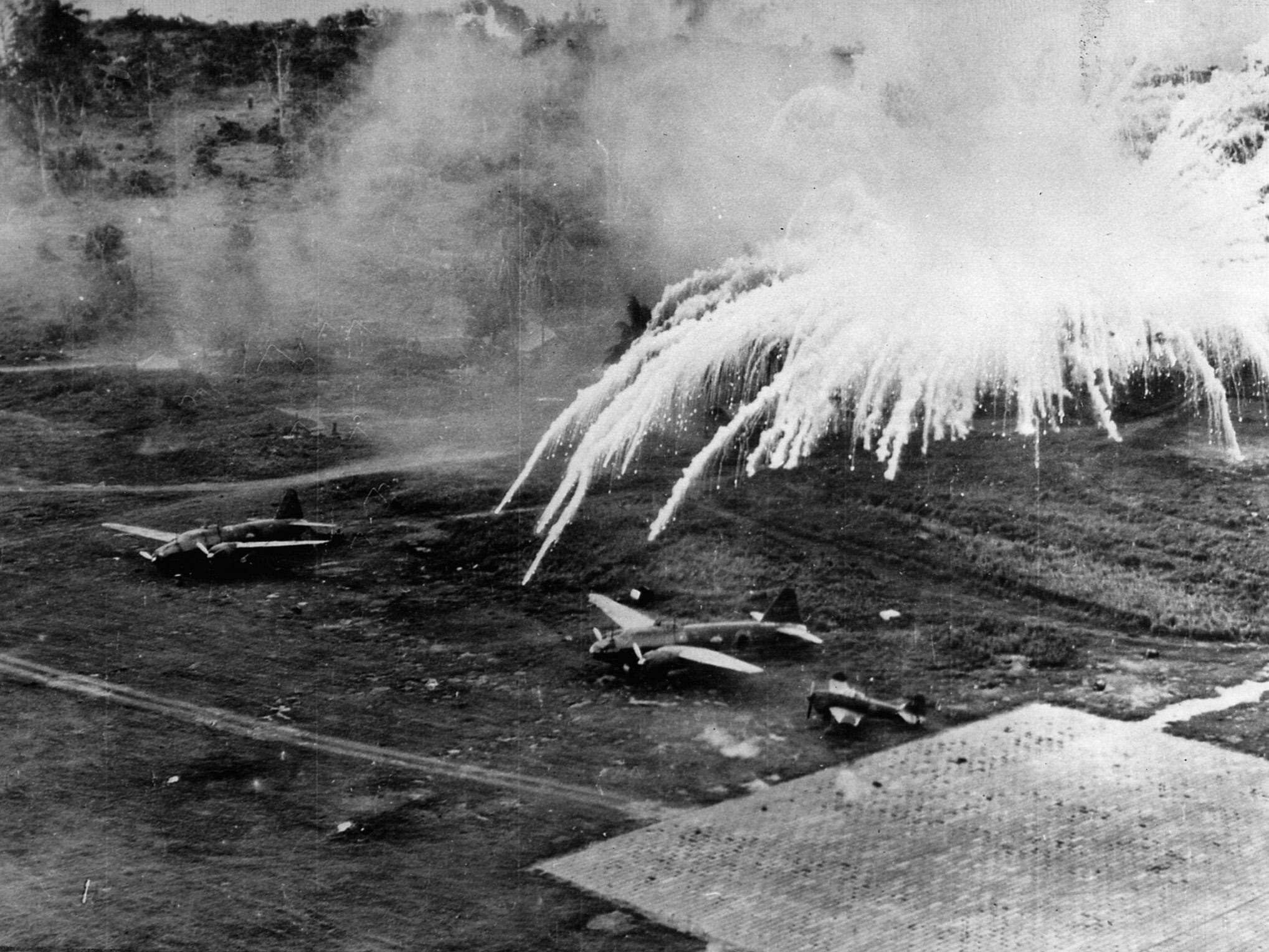
The package of .50-caliber machine guns in the nose and skip bombing techniques were not the only aspects of the gunships that made them such effective weapons. Before the war, General Kenney himself had developed small 27-pound fragmentation bombs designed to float to earth beneath parachutes. The parafrag bombs were very effective against parked aircraft. Another innovation was the “Kenney Cocktail,” a 100-pound bomb casing loaded with white phosphorous. Upon impact, the casing was designed to break open, spreading burning phosphorous over a wide area, setting fires and causing severe injury to anyone who happened to be caught by the burning mess. With the conversion of the A-20s and B-25s, Kenney’s Fifth Air Force was finally able to successfully interdict Japanese shipping between Rabaul and Lae, and the parafrag bombs were effective against airfields. But neutralizing Rabaul itself was still his major concern.
The end of 1942 saw another new development that would help the Allies in their efforts to gain air superiority in SWAPA as the Lockheed P-38 Lightning fighter made its appearance in the skies over New Guinea. The twin-engine P-38 was a remarkable fighter that would account for the destruction of more than 10,000 Japanese aircraft by the end of the war. The Lighting’s turbocharged engines allowed it to reach high altitudes, and it offered considerably longer range, enough to reach Rabaul from forward airfields in New Guinea. Another significant development took place later in the year as the medium bombers of the 22nd Bombardment Group were replaced by long-range B-24s. Liberators also replaced the B-17s in the 43rd Bombardment Group, bringing V Bomber Command heavy bomber strength to three full groups of long-range B-24s.
A Pacific Bombing Raid of Unprecedented Scale
Prior to mid-September 1943, Rabaul had been beyond the effective range of the modified B-25s. When Lae and the Markham Valley fell into Allied hands, Fifth Air Force established forward staging bases that put the B-25s much closer to the important Japanese supply base. Meanwhile, Admiral William F. Halsey’s SOPAC forces were advancing northwestward through the Solomons from Guadalcanal and preparations were being made to combine the two areas of operation under MacArthur’s command.
A U.S. Marine Corps dive-bomber scores a direct hit on a Japanese oil tanker near Rabaul in July of 1944.
MacArthur, who had operational control over the Solomons and the Bismarck Archipelago, concluded (with the encouragement of General Kenney) that instead of fighting a costly battle to capture Rabaul, the installation should be bypassed and “left to dry on the vine.” Its surface lines of supply would be cut off by the Navy while the city itself was neutralized by air attack, a decision with which Halsey concurred.
Once Halsey’s forces were in bomber range of the city, they would assume responsibility for the campaign against Rabaul and Fifth Air Force would be relieved to devote its attention to targets in New Guinea and western New Britain. Until the South Pacific forces had moved far enough north that Rabaul was in range of their air forces, Fifth Air Force would mount an air campaign against the airfields and supply bases as well as any ships in the harbor.
Aerial reconnaissance photographs indicated that Japanese fighter strength at Rabaul had risen dramatically to almost 150 aircraft between October 1 and October 11, so Kenney ordered the Fifth Air Force to mount an attack to take them out. On October 12, V Bomber Command launched the largest aerial attack so far in the Pacific War. The attack plan was twofold: three groups of modified B-25 strafers, a total of 107 airplanes, would go in low and hit the airfields at Rapopo and Vunakanau in a strafing and parafrag bomb attack. They would be followed by seven squadrons of B-24s, which would drop their bombs on the ships in Simpson Harbor. The distances involved limited the fighter escorts to P-38s since the other fighter type now active in the theater, the Republic P-47 Thunderbolt, lacked the range to go all the way to Rabaul.
Major John P. Henebry led 40 B-25s of the 3rd Attack Group over Rapopo in three vees of 12 to 15 airplanes each, with about a mile between the formations. The low-flying B-25 pilots opened fire on the antiaircraft guns, then swooped over the rows of parked airplanes and covered them with tiny but deadly parachute bombs. Dust and smoke obscured the airfield after the attack, but the men of the 3rd estimated that they had destroyed between 15 and 25 airplanes on the ground while group gunners claimed three air-to-air kills. Colonel Clint True led the other 67 strafers in an attack on Vanakanau. Later estimates of more than 100 Japanese airplanes destroyed in the ground attacks were believed to be conservative.
In spite of the low-altitude attacks, Japanese fighters were in the air when the Liberators came over the target. The Allied fighter escort was comparatively small, made up of only 28 P-38s, and its job was to keep the Japanese fighters off the 90th Bombardment Group B-24s. Only two Liberators were lost. The bombers claimed a remarkable number of hits. The 65th Squadron reported 48 hits out of 48 bombs dropped! V Bomber Command claimed three transports, three destroyers, and 113 other vessels sunk. The U.S. Navy would dispute these claims, although Navy historian Samuel Eliot Morison would qualify the dispute by stating that Japanese loss reports may not have been entirely accurate, especially since they did not record losses of smaller vessels.
Raymond H. Wilkins’ Medal of Honor
Bad weather developed over New Britain and prevented further attacks until October 18. The weather was still bad enough that day to force the P-38s to turn back and the B-24s to divert to other targets, but the B-25s dropped down to the wavetops and went beneath the weather. In spite of fierce fighter attacks, the unescorted Mitchells sank three Japanese ships and destroyed or damaged approximately 50 planes on the ground.
Attacks on the airfields continued over the next several days when weather permitted. The low-level attacks were directed at the airfields, but the Fifth Air Force braintrust was waiting for just the right opportunity to send the B-25s after Japanese shipping at Rabaul. It was not until November 2 that weather conditions finally allowed the attack. Reconnaissance photographs revealed seven destroyers, a tender, and 20 merchant vessels in the harbor.
The V Bomber Command managed to launch 80 B-25s for an afternoon attack under the protection of an equal number of fighters. Half of the B-25s were scheduled to hit the antiaircraft guns around the harbor and the airfields while Major Jock Henebry’s 3rd Attack Group, the veteran skip bombers who had won the Battle of the Bismarck Sea, went after the ships in the harbor.
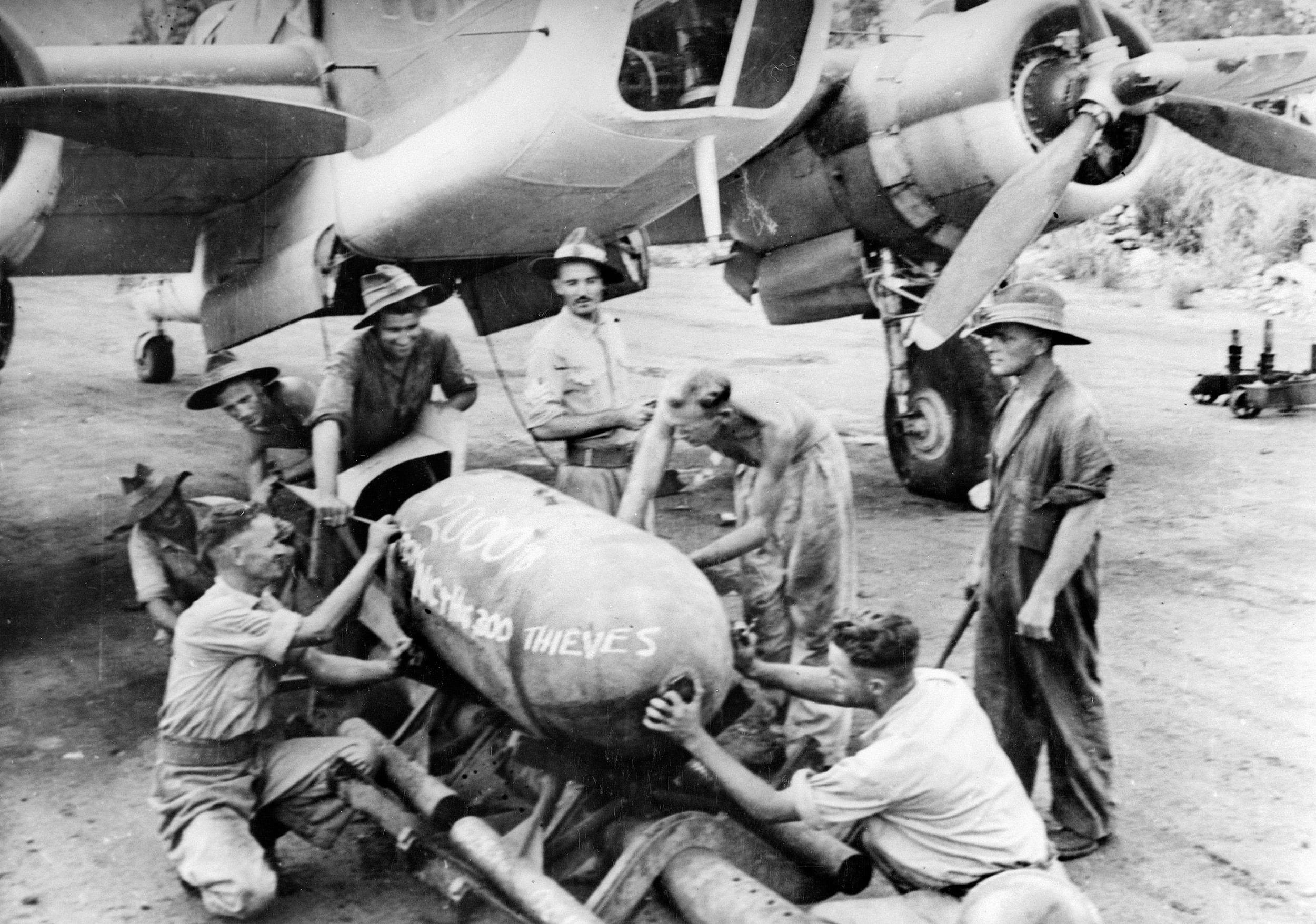
Members of an RAAF squadron leave their mark on a 2000-pound “daisy cutter” to be dropped on the Lakunai Aerodome in Rabaul.
The Japanese warships fought back with a vengeance both with their antiaircraft guns and heavy naval ordnance, which they fired into the water to cause waterspouts in an effort to knock the low-flying bombers into the water before they got into strafing range. Two destroyers were on the approach path into the harbor, and the narrow slot made them difficult to attack. Automatic weapons fire from their guns forced the bomber formation to break up into single and two-ship elements.
Henebry strafed and bombed a freighter, then his Mitchell was hit by fire from a cruiser. Captain Charles W. Howe skipped a bomb into the side of another freighter, which sank immediately. Henebry came out of the harbor in a badly damaged airplane but managed to make it to an advanced airfield on a friendly island. His friend Chuck Howe followed and landed to give the crew of the stricken B-25 a ride home.
Major Raymond H. Wilkins, commander of the 8th Bombardment Squadron, continued strafing and skip bombing even after his airplane had been badly shot up. After skip bombing a transport, Wilkins was leading his squadron out of the harbor when his airplane was struck by fire from the same cruiser that hit Henebry’s airplane. The B-25 went into the water, killing the crew. Wilkins was awarded the Medal of Honor for his actions; it was the third to go to a V Bomber Command member for action over Rabaul.
The Navy and Marines Target Rabaul
Up to this point, the Fifth Air Force had been bearing the burden of attacking Rabaul alone since none of the SOPAC forces were yet in range. On November 4, Fifth Air Force reconnaissance aircraft detected a Japanese task force of five cruisers and nine destroyers steaming south toward Rabaul. Apparently, they were on their way to oppose the Allied landings at Empress Augusta Bay, where U.S. troops had gone ashore three days before.
The Navy’s Task Force 38 had only recently reached the South Pacific, and the carriers Princeton and Saratoga were in a position to mount attacks in opposition to the Japanese advance. On November 5, Fifth Air Force B-24s hit shore positions while 97 U.S. Navy carrier planes went after Japanese shipping in Simpson Harbor. Not a single ship was sunk, but the dive-bombers and torpedo planes managed to inflict enough damage on the cruisers that they were forced to withdraw for repairs.
Navy carrier planes struck Rabaul again on November 11. Admiral Halsey requested that the Fifth Air Force B-25s hit the airfields in advance of the carrier attacks, but bad weather forced them to turn back. The carrier planes attacked in a light rain and managed to sink one destroyer and inflict damage on several others and a pair of cruisers.
The November 5 attack ended V Bomber Command’s two-year effort against Rabaul. Previous plans had called for MacArthur’s forces to focus their attention on driving the Japanese out of New Guinea and gaining control of western New Britain once Admiral Halsey’s South Pacific Forces had captured Bougainville. The plans stipulated that as soon as AIRSOLOMONS aircraft were in range of Rabaul they would assume responsibility for the target, while V Bomber Command would turn its attention elsewhere. Now that Halsey’s forces were in range of Rabaul, it was their turn.
COMAIRSOLS was a dual command made up of Army and Marine Corps squadrons, along with some New Zealand units. By late 1943, AIRSOLOMONS was under the command of U.S. Marine Corps Maj. Gen. Ralph Mitchell, who had just replaced Army Air Forces Maj. Gen. Nathan Twining upon his transfer to the Mediterranean. Mitchell’s command included the Army’s Thirteenth Air Force and the 1st Marine Air Wing, along with a number of U.S. Navy fighter, dive bomber and torpedo bomber squadrons operating a variety of aircraft. They included F4U Corsair, F6F Hellcat, P-38, P-39 and P-40 fighters, SBD and TBF single-engine bombers, and B-25 medium bombers and B-24 heavies.
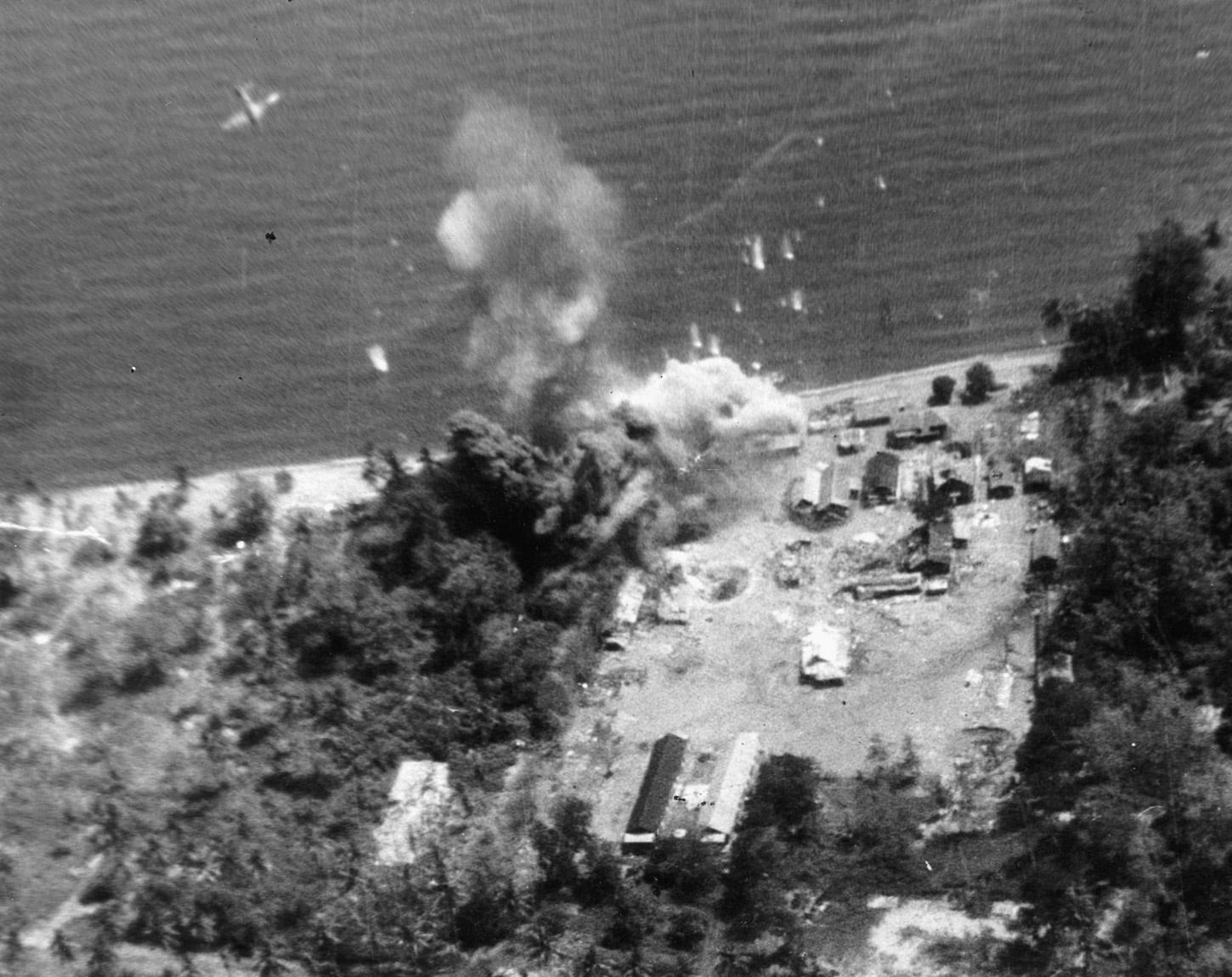
Explosions rock a Japanese airfield near Rabaul. U.S. B-25s and P-38s of the 5th Air Force hammered the site in an effort to put the airfield out of commission.
Some Liberators were operated by Navy and Marine squadrons, but most were assigned to the Army’s 5th and 307th Bombardment Groups. Some of the P-40s were in four New Zealand squadrons. New Zealanders also operated a squadron of Lockheed Ventura bombers. Army, Marine, Navy, and New Zealand aircraft operated together in the same formations.
It was not until December 17 that Mitchell’s command was able to mount a mission against Rabaul. Marine Major Gregory Boyington led a fighter sweep of 76 airplanes over the stronghold, but the Japanese failed to rise to meet them in large numbers. They were more successful a week later on December 23 when AIRSOLS fighters claimed 30 Japanese fighters. Bombing missions were spasmodic, in part due to the weather.
During January, advanced bases were put into operation closer to Rabaul, allowing an increase in the strength of the assaulting forces. During the second week of January, B-25s from the 42nd Bombardment Group flew their first mission over Rabaul from their new base in the Russell Islands. They would fly 11 more missions before the month was out, operating as medium bombers since Thirteenth Air Force had yet to convert large numbers of its B-25s into strafers.
Japanese opposition was intense, much greater than that previously encountered by SOPAC aircrews as they moved northwestward through the Solomons. The AIRSOLS crews were experiencing what Fifth Air Force crews had been enduring for almost two years. Rabaul was the most heavily defended target in the Southwest Pacific; the Japanese had turned it into a practically impregnable fortress with large concentrations of antiaircraft guns. They attempted to maintain a standing fighter force of 100 to 200 planes, flying replacements down from Truk to supplement those lost in the air and to ground attack. The Japanese fighter pilots were not rookies, as the Marines learned on January 3 when their leading ace, Major Gregory “Pappy” Boyington, and his wingman were both lost over Rabaul. Boyington was captured and spent the remainder of the war in a Japanese prison camp.
“Dry on the Vine and Wither Away”
Fortunately, the Allies had something that the Japanese did not—strength in numbers and rising superiority in aircraft, both in quality and production. American fighter pilots had gained considerable experience and were now able to beat the Japanese in the air. By early 1944, American aircraft production had risen to unprecedented levels while thousands of young airmen were coming out of the flight schools and undergoing training conducted by veterans of the Pacific War.
Allied advances in Europe combined with the victory in North Africa to free up some Army air units for duty in the Pacific. Production of B-24 Liberators was unprecedented, and the Army Air Forces began making allowances for Fifth and Thirteenth Air Force squadrons, where they replaced war-weary B-17s and early model B-24s. Although the U.S. Navy’s carrier forces had been rendered impotent after the battles of Midway and Santa Cruz in 1942, new boats had come out of the shipyards and had been equipped with full complements of fighters, dive-bombers and torpedo bombers. U.S. Navy task forces equipped with fast Essex-class carriers were setting sail out of San Diego and Pearl Harbor for fast-moving strikes on Japanese positions all through the Central Pacific.
In mid-February, carrier aircraft struck Truk for the first time. Although Nimitz originally intended to invade and occupy Truk, the decision was made to bypass it. Within a few weeks, Seventh Air Force had established heavy bomber bases on Kwajalein, which had been captured by U.S. forces in February. Kwajalein placed Truk within range of VII Bomber Command Liberators, and attacks began. Thirteenth Air Force Liberators joined with the Seventh bombers and the neutralization of Truk began.
The commencement of air raids on Truk signaled the demise of Rabaul. Without a dependable rear-area base to back it up with supplies and reinforcements for the air squadrons stationed there, Rabaul was practically out of the war. Admiral Halsey’s South Pacific Command declared victory at Rabaul in mid-February. Air strikes would continue against the surviving Japanese forces for some time, but they had been left to “dry on the vine and wither away” as MacArthur’s forces continued their move northward toward the Philippines, and ultimately Japan.
We designed the Community Support Space series to facilitate discussion about the issues and concerns all of you, the OHA community, are currently facing, and any opportunities on the horizon. For the next open forum, we’re giving special attention to people working on regional oral history projects or who are in regional oral history groups. […]
Planning to attend the 2025 OHA Annual Meeting in Atlanta? Whether you’re presenting, not presenting, or joining us from outside the U.S., you can apply to our scholarship funding to help offset the cost of attending. We offer three types of scholarships: OHA encourages applications from students, professionals, and community practitioners from a wide range […]
The Conversation explores how tools like ChatGPT are subtly reshaping the way we write. While these tools can save time and improve clarity, they can also smooth out our quirks and dilute our voice. As the author wisely notes, “writing should be about expressing your ideas in your own way.”
Thanks for reading Capturing Voices! Subscribe for free to receive new posts and support my work.
Have you noticed certain words and phrases popping up everywhere lately?
Phrases such as “delve into” and “navigate the landscape” seem to feature in everything from social media posts to news articles and academic publications. They may sound fancy, but their overuse can make a text feel monotonous and repetitive.
This trend may be linked to the increasing use of generative artificial intelligence (AI) tools such as ChatGPT and other large language models (LLMs). These tools are designed to make writing easier by offering suggestions based on patterns in the text they were trained on.
However, these patterns can lead to the overuse of certain stylistic words and phrases, resulting in works that don’t closely resemble genuine human writing.
The rise of stylistic language
Generative AI tools are trained on vast amounts of text from various sources. As such, they tend to favour the most common words and phrases in their outputs.
And although most of the research has looked specifically at academic writing, the stylistic language trend has appeared in various other forms of writing, including student essays and school applications. As one editor told Forbes, “tapestry” is a particularly common offending term in cases where AI was used to write a draft:
I no longer believe there’s a way to innocently use the word ‘tapestry’ in an essay; if the word ‘tapestry’ appears, it was generated by ChatGPT.
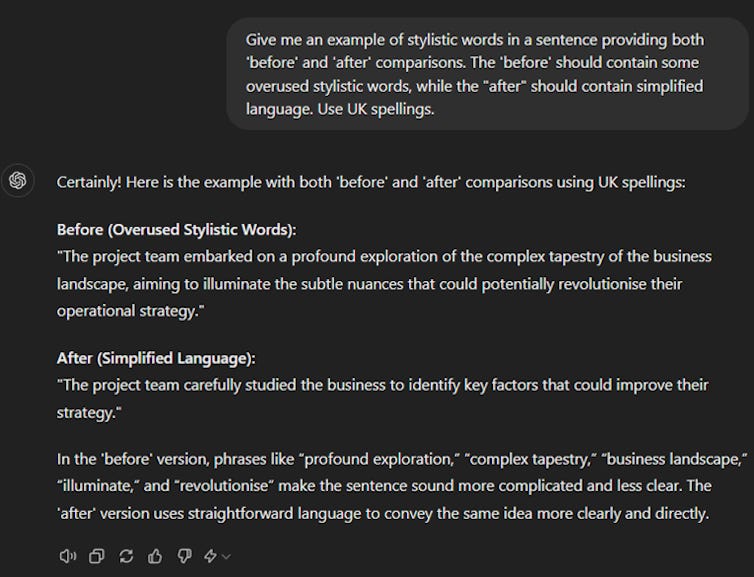
Examples of overused stylistic words and their simplified alternatives, from a ChatGPT query made on September 11. ChatGPT/screenshot
Why it’s a problem
The overuse of certain words and phrases leads to writing losing its personal touch. It becomes harder to distinguish between individual voices and perspectives and everything takes on a robotic undertone.
Also, words such as “revolutionise” or “intriguing” – while they might seem like they’re giving you a more polished product – can actually make writing harder to understand.
Stylish and/or flowery language doesn’t communicate ideas as effectively as clear and straightforward language. Beyond this, one study found simple and precise words not only enhance comprehension, but also make the writer appear more intelligent.
Lastly, the overuse of stylistic words can make writing boring. Writing should be engaging and varied; relying on a few buzzwords will lead to readers tuning out.
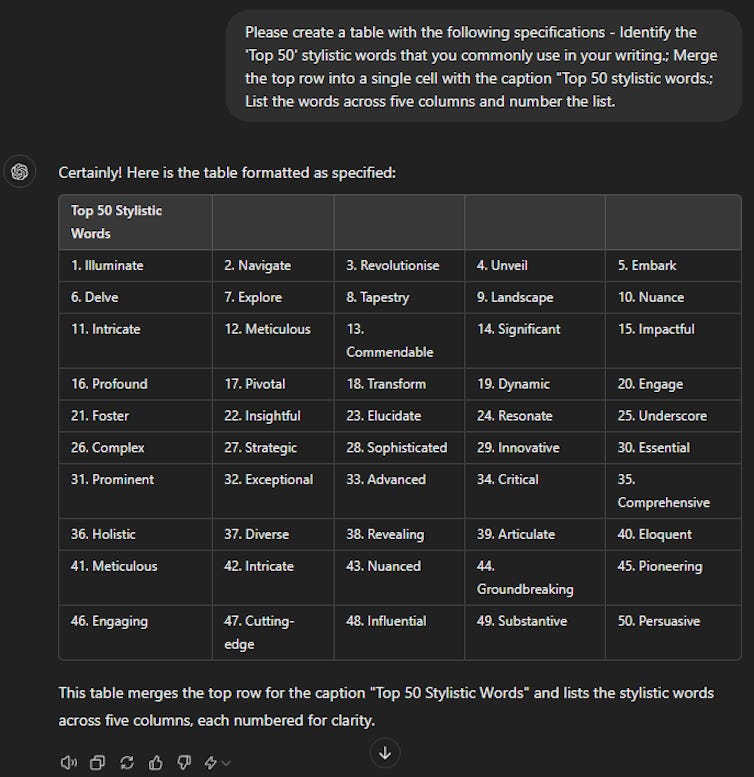
There’s currently no research that can give us an exact list of the most common stylistic words used by ChatGPT; this would require an exhaustive analysis of every output ever generated. That said, here’s what ChatGPT itself presented when asked the question.
The top 50 stylistic words commonly used in AI outputs, according to ChatGPT. ChatGPT/screenshot
Possible solutions
So how can we fix this? Here are some ideas:
1. Be aware of repetition
If you’re using a tool such as ChatGPT, pay attention to how often certain words or phrases come up. If you notice the same terms appearing again and again, try switching them out for simpler and/or more original language. Instead of saying “delve into” you could just say “explore”, or “look at it closely”.
2. Ask for clear language
Much of what you get out of ChatGPT will come down to the specific prompt you give it. If you don’t want complex language, try asking it to “write clearly, without using complex words”.
3. Edit your work
ChatGPT can be a helpful starting point for writing many different types of text, but editing its outputs remains important. By reviewing and changing certain words and phrases, you can still add your own voice to the output.
Being creative with synonyms is one way to do this. You could use a thesaurus, or think more carefully about what you’re trying to communicate in your text – and how you might do this in a new way.
4. Customise AI settings
Many AI tools such as ChatGPT, Microsoft Copilot and Claude allow you to adjust the writing style through settings or tailored prompts. For example, you can prioritise clarity and simplicity, or create an exclusion list to avoid certain words.
The custom instruction settings in ChatGPT can be useful in tailoring outputs to meet your needs. ChatGPT/screenshot
By being more mindful of how we use generative AI and making an effort to write with clarity and originality, we can avoid falling into the AI style trap.
In the end, writing should be about expressing your ideas in your own way. While ChatGPT can help, it’s up to each of us to make sure we’re saying what we really want to – and not what an AI tool tells us to.
Thanks for reading Capturing Voices! Subscribe for free to receive new posts and support my work.
The next offering in the Baylor University Institute for Oral History (BUIOH) series of “Sharpen Your Skills” advanced online workshops is “Applying AI to Oral History” and will take place on July 16, 2025, at 10:00 a.m. CDT. This session serves as both an introduction to artificial intelligence platforms in general and the ways in […]