The Oral History Association is seeking enthusiastic volunteers to help make the 2025 Annual Meeting a success! From welcoming attendees at registration, to supporting sessions as a room runner, to guiding participants on local tours, volunteers play a vital role in creating a smooth and welcoming experience. In return, volunteers receive free meeting registration (with […]
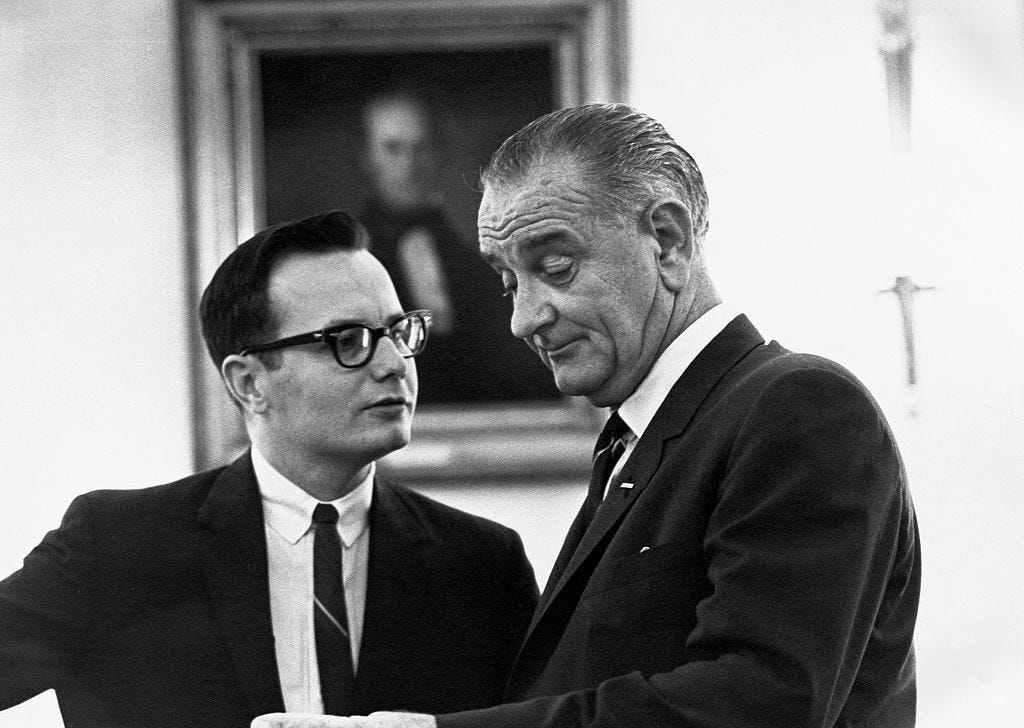
The 31-year-old Bill Moyers, as White House Press Secretary for Lyndon Johnson in 1965. Moyers, who became one of the country’s most influential and respected broadcasters, died last week, at 91. (Corbis via Getty Images.)
As a pre-holiday special, this post is an old-style grab-bag listicle, with items I’ve been “meaning” to write about further. Who knows when that will happen. But for now, some reading and viewing tips:
1) A China book: ‘Breakneck’
I’ve started reading another book about China that seems worth attention. “Another,” because last month I recommended Patrick McGee’s excellent new Apple in China, which is a gripping reportorial narrative and which, I predict, will change the way you look at any piece of Apple equipment from now on. Or the way you read any story about tariffs, “decoupling,” and US-Chinese economic dealings overall.
Thanks for reading Capturing Voices! Subscribe for free to receive new posts and support my work.
These good China-themed books keep coming. The most recent one I’ve seen is by the tech analyst Dan Wang and is called Breakneck. Its subtitle might make you think it’s just another in the tedious “who is number one?” series. That subtitle is China’s Quest to Engineer the Future. I can say that, 150 pages in, it’s far subtler and more interesting than that.
Breakneck got my attention in its very first paragraph, which in fact is all one sentence.1 It reads as follows:
Every time I see a headline announcing that officials from the United States and China are once more butting heads, I feel that the state of affairs is more than just tragic; it is comical too, because I am sure that no two peoples are more alike than Americans and Chinese.
As they would put it in a rom-com: You had me at “no two peoples are more alike.” That’s a main message Deb and I took from our years of living in China, and to me it’s a crucial “tell” about whether someone is worth listening to on the subject.
These are similar people, separated by different systems,2 each dealing with the plusses and minuses of their respective national approach. These plusses and minuses are Wang’s main theme—the differences between the “lawyer” system in the US, and the “engineer” system in China.
Another “tell” for me about books: After reading the first few chapters, do I feel like going on? This far into Breakneck, I want to read the whole thing. Check it out.
2) A film: ‘Facing Tyranny.’
Last week PBS aired an 83-minute film about Hannah Arendt, in its American Masters series. It’s called Hannah Arendt: Facing Tyranny, and it is very much worth seeing in our times.
Hannah Arendt died nearly 50 years ago, when the news about US governance revolved around Vietnam, Watergate, and the Nixon resignation. So she had nothing specific to say about the collapse of governance in the Doge/MAGA age. The last news coverage she might have read about Donald Trump was how Roy Cohn guided Trump and his father through racial-discrimination complaints filed by Richard Nixon’s Department of Justice.
But the film is full of reminders of why Arendt’s first famous book, The Origins of Totalitarianism, which came out in the 1960s, is such a relevant guide to the politics of our immediate moment. And why “totalitarian” is indeed the right term to describe the MAGA era.
Just two samples. First, about the kind of people attracted to serve a totalitarian cult leader:
Totalitarianism in power invariably replaces all first-rate talents, regardless of their sympathies, with those crackpots and fools whose lack of intelligence and creativity is still the best guarantee of their loyalty.
Look at the roster of Trump appointees, and weep.
And, about “truth” and “lies”:
One of the greatest advantages of the totalitarian elites of the twenties and thirties was to turn any statement of fact into a question of motive.
She was talking about the “twenties and thirties” of the 1900s, but we see this every day in our own “twenties.” Trump in his disordered Q-and-As, the histrionic Karoline Leavitt in her “press briefings,” the likes of Kristi Noem and Pete Hegseth—they all meet any question of fact with an attack on motive. “You’re from the fake media, so you would say that…”
It’s worth seeing the film for the many unsettling Arendt resonances.
The Netflix eight-part series The Residence is set in a (fictional) White House, and has a totally different vibe. Funny, smart, wry, suspenseful. Like a highly sophisticated version of Clue. You may feel worse after watching any news. You’ll feel better after watching this.
3) A loss: Bill Moyers.
Bill Moyers died last week, at 91. He was a phenomenally productive and principled journalist and explainer. He was also a very complicated man: A seminarian who became a precocious White House press secretary. A newspaper publisher who became a broadcast icon. He was personally closer to LBJ than most other still-living people whom Robert Caro might have interviewed for his epic book series. But Moyers famously declined ever to discuss LBJ with Caro.
I had close dealings with Moyers in the 1970s, when I was in my 20s and he, at age 40, was undergoing his metamorphosis from political practitioner to revered journalist and public voice. I highly recommend Eric Alterman’s piece about the Moyers of those years, which in turn cites a long Q-and-A he did with Moyers back in 1991. He says this about Moyers’s reluctance to talk with Caro:
He did not feel right about trying to justify himself to Caro. It felt too egotistical to him, he said….
My own theory, however, was that he was deeply, and I mean deeply, pained by some of the things he went along with as a young man in the Johnson administration, though these are not the ones he has sometimes been accused of. He was, he explained when I questioned him in some detail on some of the allegations in the 1991 interview, “I was a very flawed young man, with more energy than wisdom.”
Based on my more limited involvement with Moyers, this rings true. You’ll see more details in Alterman’s pieces. (With a caveat I mention below.3)
Here’s a relevant point about Moyers now. Through his career he appeared frequently on Fresh Air, with Terry Gross. One of his last interviews there was in 2017, near the start of Trump’s first term, when Kellyanne Conway was still his press secretary. By comparison with her successors, Conway seems almost like Diogenes. But Moyers told Terry Gross then that the level of facile lying from Trump and his representatives was new and unknown in American life:
MOYERS: Look, I was not a perfect press secretary. I made a lot of mistakes. But I did feel that the job was to try to help the reporters get what they needed to tell their stories and help the president understand what the reporters were trying to do. I never did think of myself as a propagandist for the administration or the White House.
But these people I’m listening to and have been watching in the Trump administration are really just, you know, they’re lying. They’re deceiving us.
And if you don’t call that out, then the lie becomes a part of the lived experience of the people who are watching or listening.
Part of our lived experience. This takes us right back to Hannah Arendt. The Trump team lies about everything, so as to make people think that nothing can be true. Last year’s movie The Apprentice dramatized Roy Cohn teaching Donald Trump exactly how this process worked. The press has become inured to it. Trump’s delusions and flat-earth lies, and those of people who speak on behalf, are no longer “news,” because they’re no longer new. But they matter. For reasons Arendt and Moyers, in their different ways, explained.
No one (to my knowledge) has done a full biography of Billy Don Moyers and his many lives. I’ll read that one when it comes out.
4) ‘A government as good as its people.’
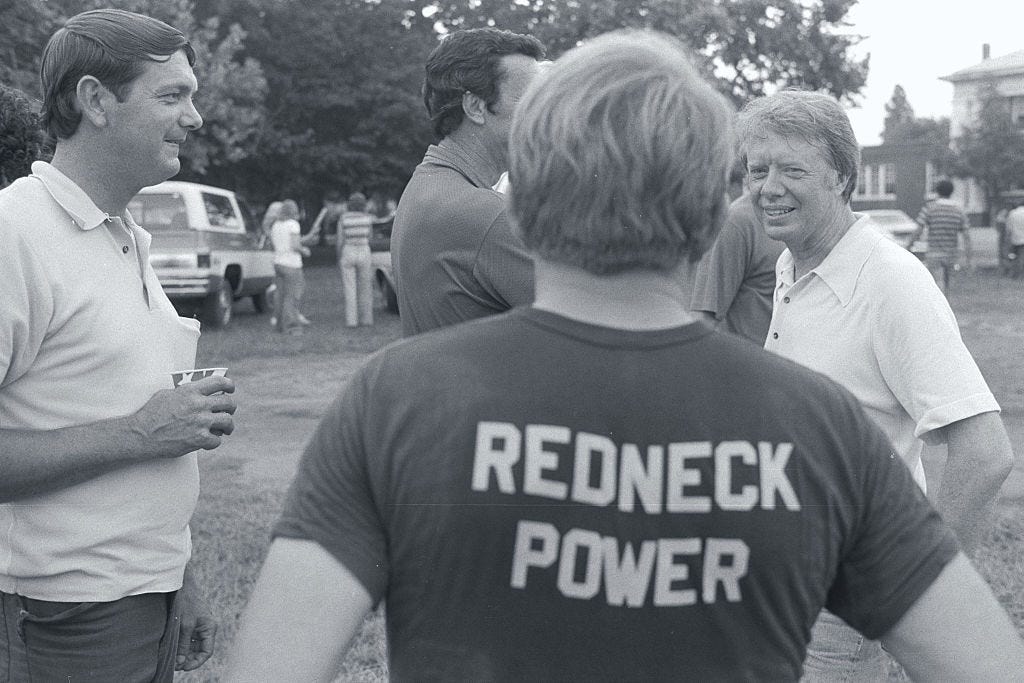
At a summertime gathering in Plains, Georgia, in 1976, Billy Carter with a shirt prefiguring the political culture wars of our times. (Owen Franken/Corbis, via Getty Images.)
Fifty years ago, during his still-unmatched run from obscurity to the White House, Jimmy Carter liked to say that America needed “a government as good as its people.”
Carter had a sardonic edge, and he fully recognized the catty way that line could be read. (“Yeah, our government is as good as our people—that’s the problem!”) But he could project his belief in its earnest, positive side, with its hope for redemption. And I think the way he explained it, just before election day in 1976, is worth attention in our current predicament.
This statement by Carter came at an evening fund raiser in New York, late in October. I was there, as part of Carter’s traveling team. But out of fatigue and distraction I barely registered what he was saying, in the kind of unscripted riff that always showed him at his best. I could, though, tell that the well-heeled crowd was listening closely.
Carter leapt right in: “People like us don’t suffer nearly as much as the ones to whom I talked in Harlem this afternoon,” he said:
And in Winston-Salem this afternoon. And in Miami this morning, on the beach. And last night in Tampa. [This gives you an idea of the campaign-trail travel schedule.] They come [to rallies], having suffered when the unemployment rolls increase, because their families stand in line looking for a job. And they come having suffered when the unemployment rate rises, because they have to cut into their own personal expenses—food, clothing, housing.
Most of us, don’t.
In our times, he could have been talking about the people about to lose their rural hospitals, their coverage for nursing homes, their life saving but expensive medicines, because of the Medicaid cuts the GOP Congress is bloodlessly preparing to inflict.
Carter then said that most of these people—most Americans he’d met during his life in Georgia, and in his campaign travels through the preceding years—were thinking not just about their own troubled circumstances but also about the idea of doing positive things together, with their neighbors and fellow citizens. “I think of the Civilian Conservation Corps that I knew about when I was a child on the farm,” Carter said to the crowd in Manhattan:
I think about the REA when it turned on the electric lights in my house when I was fourteen years old. [This was FDR’s Rural Electrification Administration, which transformed life in rural America. Throughout the South, Carter always got a cheer on this line, from families who could remember life before light bulbs.] I think about the Marshall Plan under Truman, and aid to Turkey and Greece, and the United Nations, and the formation of the nation of Israel. I think about the Peace Corps in which my mother served when she was about 70 years old.
Every politician looks backwards to cite ideals and examples of American greatness. The emphasis in Carter’s presentation was his insistence that the public hungered for something better, again:
We don’t have those concepts any more, of sacrifice and a struggle upward, and inspiration and pride.
We as a nation have been disillusioned, we’ve suffered too much, and in too short a time, the assassination of great political leaders—John Kennedy, Bobby Kennedy, Martin Luther King, Jr. A tragic war, hidden deceitfully from the American people in the case of Cambodia, a national scandal, the resignation and disgrace of a President of the United States, and the Vice President of the United States.
Reminder: This was a time when the Republican party would tell a Republican president that it was time for him to step down. A time in which the term “disgrace” had some meaning.
“All of these things and others made millions of American people lose faith and trust in our own government,” Carter said.
To all these people I say every day, many times: Please. Don’t give up. Don’t be apathetic. Give our system another chance….
If we can only have leaders once again who have vision, and who are as good in office as the people who put them in office. That’s what this campaign is all about….
Government by the people—it’s as simple as that.
What’s the relevance now? Civic life is an endless see-saw between the strengths, weaknesses, character, and desires of the public, and the quirks, rules, and rigidities of the system through which people’s desires are expressed. That’s what every non-totalitarian form of government is set up to handle.
Right now, we’re at a moment where the system is failing, more grievously than the people as a whole are:
Evidence suggests that most people do not want tax cuts mainly for the richest one-tenth of 1%. They do not want a multi-trillion dollar increase in the national debt. They do not want Medicaid and Medicare to be reduced, and rural hospitals closed. They do not want school, libraries, science, and FEMA to be cut, so that those already rich can be richer still. They want “violent criminals” to be deported, but not mass roundups on their streets.
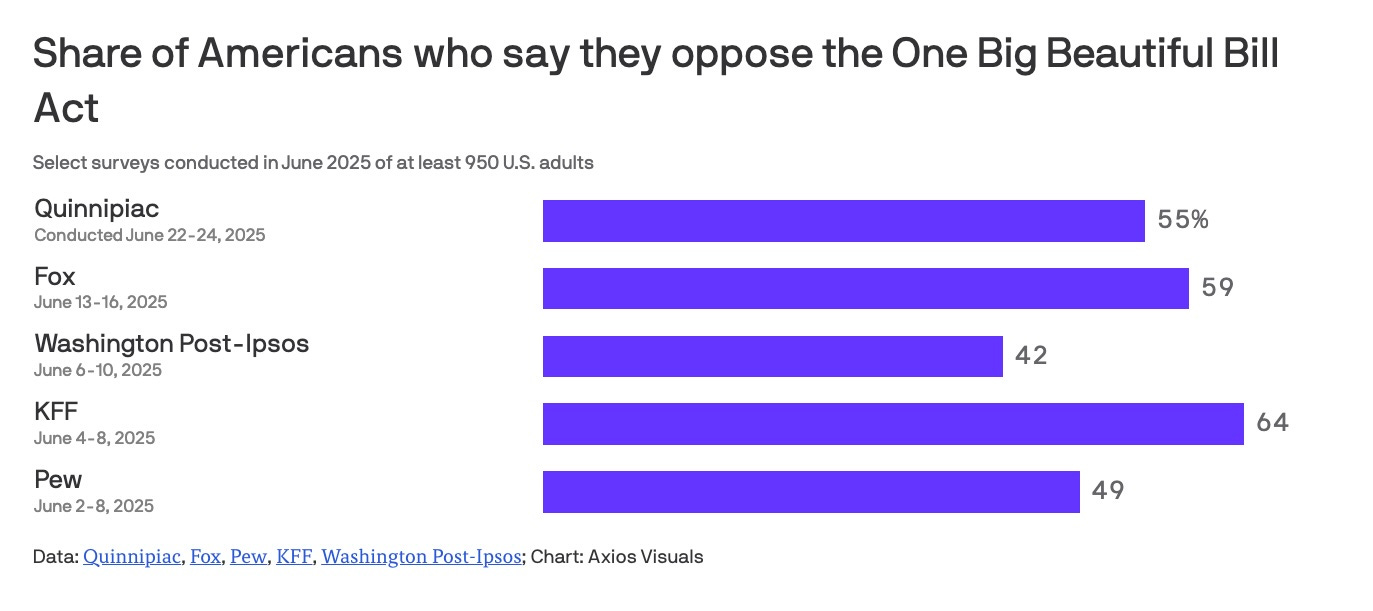
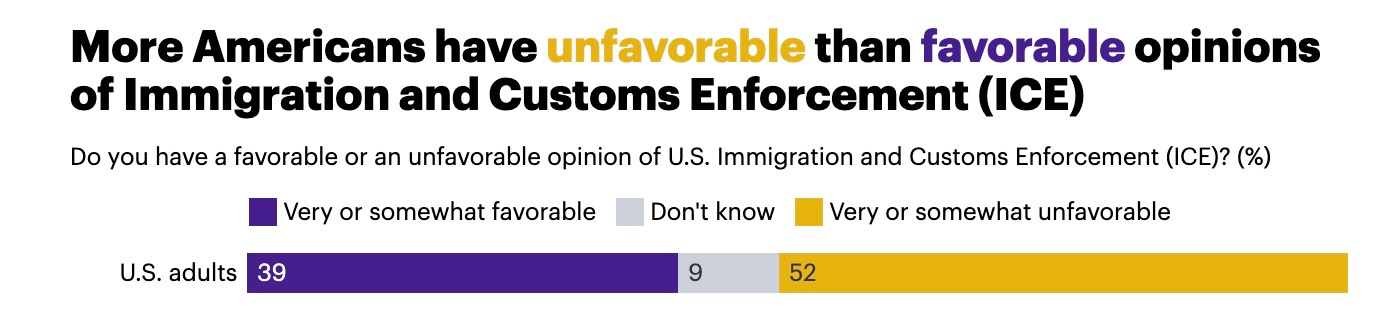
When given the chance this past year, strong majorities have voted against the momentum of MAGA and Doge. We’ve seen this in Wisconsin, in Virginia and New Jersey, most recently in New York City. We’ve seen this in ever-larger demonstrations. We see it in almost every poll:
The machinery of democracy is supposed ultimately to connect what people want, with what the system delivers. Of course the linkage is imprecise, and time-delays are built in, and there are swings from one extreme to another.
But we are at an extreme. Lisa Murkowski told us last month that “we are all afraid,” speaking for her fellow Republicans. This week she showed us how afraid, with her last-minute cave-in to Trump. Last night, breathless live news reports told us about the House Republicans “holding out” against Trump. This morning, they too have caved, as everyone knew they would.4
Look at that Jimmy Carter impromptu speech again. He wound up:
I haven’t given up hope for our country.
I believe in America.
Once the people rule again, we can solve our economic problems. Once the people rule again, we can have a fair tax system.
Once the people rule again, we can reorganize the government and make it work with competence and compassion because the American people are competent, and we’re compassionate.
Once the people rule again, we can have a foreign policy to make us proud and not ashamed.
It all depends on the people and how accurately we represent them, who have been selected by them as leaders.
It’s a long way, from that hope, to majorities in the Senate and House, and lifetime seats on the Supreme Court5. But you have to have a sense of where you want to go. That’s what I sensed in last week’s election in New York, and the preceding weeks’ protests around the country, and most off-year elections we’ve had so far. Our institutions have again failed us: Much of the press, nearly all of the legislative GOP, at least six members of an autocratic Supreme Court. It’s up to the rest of us, again.
Happy Independence Day!
Thanks for reading Capturing Voices! Subscribe for free to receive new posts and support my work.
OHA’s Annual Business Meeting is happening virtually on September 30th from 2:30PM to 4:00 PM CDT. This is a great opportunity to get updated on important developments within our organization, review our financial position, discuss future plans, and vote on bylaw changes. Registration is required. Please register via the link below. Once registered, you should receive […]
Q. I copyedit a technical journal, and I have a question about how CMOS would handle the term “Fortune 500.” Is “Fortune” (as the name of a publication) set in italics while “500” is not, or is “Fortune 500” treated as a standalone brand or fixed term akin to a trademark, where “Fortune” would be set roman? Thanks.
A. That term could go either way, but we’d refer to it as the Fortune 500, without italics for “Fortune,” following CMOS 8.174: “When the title of a newspaper or periodical is part of the name of a building, organization, prize, or the like, it is not italicized.”
The Fortune 500 (an annual ranking of the top 500 companies in the United States published by Fortune magazine) is analogous to a prize, and the fact that the word “Fortune” is part of the name of the list is what determines our choice.
The Billboard Hot 100 presents a similar case. Some editors would style that as the Billboard Hot 100. But we’d use italics only if referring to that list in terms of the magazine that publishes it, as in Billboard magazine’s Hot 100, or Billboard’s Hot 100 for short.
Thanks for reading Capturing Voices! This post is public so feel free to share it.
Q. Which is correct: “one should do one’s duty” or “one should do his or her duty”—or, using singular they, “one should do their duty”?
A. In your example, one is closer to the personal pronoun you than to the indefinite pronoun everyone. Everyone would normally pair with his, her, or singular their, as in everyone should do their duty (see also CMOS 5.51). One, by contrast, can simply switch to the possessive case like other such pronouns:
I should do my duty; you should do your duty; he should do his duty; she should do her duty; they should do their duty; we should do our duty; one should do one’s duty
According to Bryan Garner, however, writers have tended to pair one with he (and, by extension, one with his), despite objections from “strict grammarians” and others (see Garner’s Modern English Usage, 5th ed. [Oxford, 2022], under “One . . . he”).
We can only hope, then, that we’re doing our duty as arbiters of style by recommending a pairing of one with one’s.
One more, I love their comment “ It can be hard to ignore Microsoft Word’s blue underlines, especially when they’re worded in a way that suggests you’d be wrong to keep the text as is: ‘After an introductory word or phrase, a comma is best.’”
“Q. Hello, Chicago. Thanks for your time. I’d like you to confirm the optional comma after a one-word adverb of time (tonight, yesterday, today) starting a sentence. One of my fiction authors is upset because Word is showing blue lines under those words. I told her a comma is optional and Word doesn’t get the nuances. Would you please confirm this so I can calm my jittery author? Thanks again.
A. It can be hard to ignore Microsoft Word’s blue underlines, especially when they’re worded in a way that suggests you’d be wrong to keep the text as is: “After an introductory word or phrase, a comma is best.”
But you can tell your author that we agree with you. In the words of CMOS 6.34, “Although an introductory adverbial phrase can usually be followed by a comma, it need not be unless misreading is likely. Shorter adverbial phrases are less likely to merit a comma than longer ones.”
The adverbs yesterday, tonight, and today aren’t phrases, but each of them derives from one (yesterday comes from Old English giestran dæg), and it’s clear that each is grammatically equivalent to a phrase like next week or in 1965. Plus, any one of these words would qualify as short in the context of introductory adverbial phrases.
To be fair to Word, tonight is the only one among the words and phrases mentioned above (from yesterday through in 1965) that Word’s grammar checker flagged in our tests when it wasn’t followed by a comma (as of July 1, 2025). Conversely, Word didn’t stop on any of them when they were followed by a comma. So it’s not that far out of line with CMOS.
Thanks for reading Capturing Voices! Subscribe for free to receive new posts and support my work.
Tip: To avoid falling under the influence of Word’s blue underlines, some writers prefer to toggle them off as they draft.
A convenient way of doing this is to add a button to the ribbon. In Word for Windows (the desktop version), go to File > Options > Customize Ribbon. Then select All Commands under “Choose commands from” and scroll down until you find Hide Grammar Errors. You can then add that command to a new group under the Home tab (or wherever you want it to appear). Steps for Word for Mac will be similar.
If you use the option under Customize Ribbon to assign a keyboard shortcut to the equivalent command (look for ToolsGrammarHide under the All Commands category in the separate dialog box for keyboard shortcuts), keep the button, which has the important advantage of showing whether it’s on or off (via shading/outline).
Oral Histories with the Dead will be an intimate one-day symposium exploring how oral historians from various backgrounds are working to understand the past and the present through cemeteries and burial spaces. We are seeking paper proposals from community or academic oral historians at all career levels who have engaged with cemeteries and burial sites, […]
I’m so crazy about Stephen Fry, and I have been since the 1990s, watching Stephen Fry and Hugh Laurie in “Jeeves and Wooster.” They were hilarious. And you might not be aware that P.G. Wodehouse was writing to improve British morale between the wars.
The Guardian says: “Countless readers of Wodehouse have testified to the way his novels have their own “stimulating effect” on morale, providing not just comic, but almost medicinal effects: the exiled Kaiser Wilhelm, after his defeat in the first world war, consoled himself by reading Wodehouse to his “mystified” staff; the late Queen Mother allegedly read “The Master” on a nightly basis, to set aside the “strains of the day”; more recently, news reports tell of the imprisoned Burmese comedian Zargana finding comfort in Wodehouse during solitary confinement. “Books are my best friends”, he confided. “I liked the PG Wodehouse best. Joy in the Morning – Jeeves, Wooster and the fearsome Aunt Agatha. It’s difficult to understand, but I’ve read it three times at least. And I used it as a pillow too.” https://www.theguardian.com/books/2011/nov/04/pg-wodehouse-life-in-letters
Sophie Ratcliffe Fri 4 Nov 2011 18.55 EDT
I was fascinated by that and fascinated by the inane comedic stylings of Fry and Lawrie. I’m not the only one; they were enormously popular in England. Imagine my shock when I saw the first episode of House with Bertie Wooster playing a nasty old man!
Stephen Fry, in his post about writing, says “I used to have on my Twitter bio the phrase, “How can I tell you what I think until I’ve heard what I’m going to say?” I could equally as well have had “How can I tell you what I’m going to write until I’ve written it?”
This seems so seminal to the work we do as transcriptionists. We’re capturing those words as they first appear—the speaker’s first—or maybe fiftieth pass at speaking aloud what he’s thinking. That’s our job—to listen carefully, observantly, and capture all the nuances that help the speaker elucidate what he’s thinking!
Thanks for reading Capturing Voices! Subscribe for free to receive new posts and support my work.
In his latest blog post, Words words words Where do they come from?
He muses about writing and putting his thoughts into words.
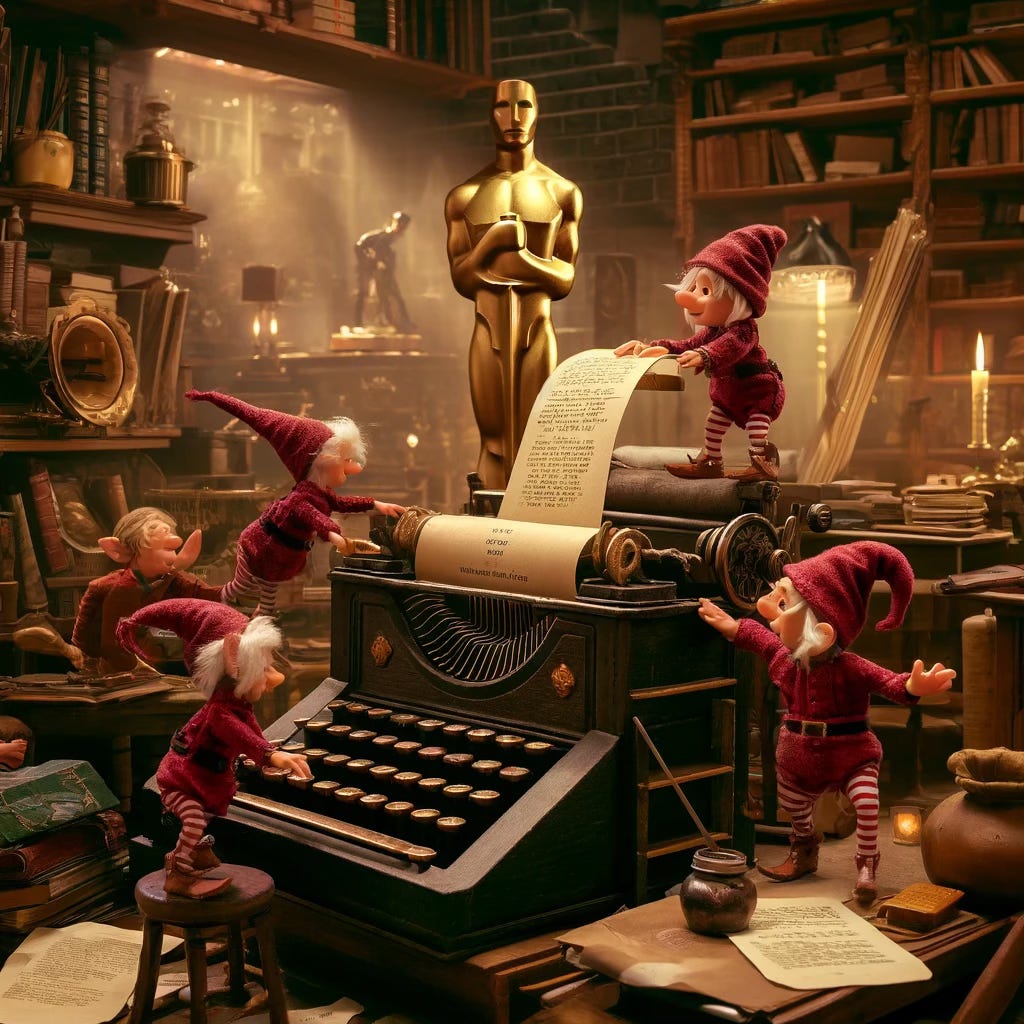
He ends with a joke—one that is as applicable to AI as it is to elves.
Which brings me to a fine Hollywood joke.
Elwood is a screenwriter, and he has been commissioned for a script, his first. The studio has set a deadline of two months. Seven weeks have passed now, and he is getting desperate. Every day, he sits at his computer and tries to type. But he isn’t a third of the way in. Completely stuck.
Elwood stands, sits, kicks the walls. Goes for short walks. Goes for long walks. Nothing comes. He realises that he is either going to have to plead for an extension or pay back the studio’s commission. The night before delivery is due, he sits in his armchair and stares malevolently at the computer. He knows he has to work all night at something, but instead, he falls asleep.
He is awoken at three in the morning by the sound of typing. He opens his eyes and cannot believe what he sees. Two elves are bouncing up and down on the keyboard. Five more elves take pages out of the printer and carefully stack them into a neat sheaf.
‘What are you doing? What’s going on?’ cries Elwood.
‘We’re elves, and we’re writing your screenplay for you.’
‘Wh … ? Huh?’
‘It’s what we do. There aren’t so many shoemakers around these days, so we help out script makers instead.’
‘Yes, but scripts have to have stories…’ Elwood picks up the top page on the sheaf, ‘…and characters and plot twists…’ his voice trails off. The script is good—very good. He takes another piece of paper and another. It’s better than he could possibly have imagined. In fact, it’s brilliant.
He tells them so. ‘Guys, this is amazingly good!’
‘Happy to help, sir.’
‘Can I get you anything? Food, drink?’
‘No, no, we’re ok. Just have three more scenes to finish and then we’re done and we’ll leave you be.’
They are as good as their word. Twenty minutes later Elwood has in his hands a completed screenplay of dazzling quality and originality.
He sends it off to his agent first thing in the morning. A day and a half later, he hears back. The studio is beyond impressed and pleased, and they want a five-picture contract with Elwood. They offer a sum of money that knocks him sideways with joy.
Six months later, he is sitting in his armchair watching script number three chug from the printer. There is now an Oscar on his mantelpiece. Elves are bouncing on the keyboard. All is well.
‘Guys,’ says Elwood for the hundredth time, ‘Are you sure there’s nothing I can get you? Coffee, cookies, marshmallows, anything?’
‘Seriously, we’re good … just happy doing our job.’
‘But money. Surely some money? I’ll give you half, two-thirds of what I’m earning. It’s only fair.’
‘Kind thought, but we don’t use money…’
‘Tell you what though …’ one of the elves on the keyboard stops bouncing up and down, ‘I suppose there is one thing …’
‘Name it!’ says Elwood, thrilled that there might be any means of repayment.
‘You might consider …’ said the elf, ‘that is to say … if we could have, maybe, a screen credit?’
‘Are you out of your fucking minds? Fuck you!’
Muse or Muses, elves, genies, djinns or sprites, no matter how mysterious or even mystical the process of writing may be, no matter how varied the sources of ‘inspiration’, we will take all the credit going, thank you very much.
Thanks for reading Capturing Voices! This post is public so feel free to share it.