UT Health Czik School of Nursing

UT Health Czik School of Nursing

UT Health Czik School of Nursing

Ross inspires nursing students to care for older adults through hands-on experiences

Editor’s note: In celebration of Women’s History Month (March 1 – March 31), UTHealth Houston is featuring outstanding members of our community.

Mary Ellen Trail Ross, DrPH, MSN, RN, said her passion for caring for older adults was likely spurred by the enjoyment she experienced visiting her grandmother, who lived to be 94.

She looked forward to those visits, and conversations with her elder relative. For more than three decades, Ross has been inspiring the same love in her students at Cizik School of Nursing at UTHealth Houston.

“Older adults have a lot to share with the younger generation,” said Ross, associate professor of clinical nursing. “We can learn a lot from their wisdom and experience, and they contribute a lot to society. They care about younger people, are friendly and welcoming to students, and want to give back.”

Ross is passionate about the care of older adults.

“Older adults deserve good care by health care professionals who are knowledgeable and skilled, and who can assist them because they have given so much to society,” Ross said. “We need to do our best to support them as they cope with normal physiological changes of aging as well as chronic health issues.”

Ross equips students with knowledge and creates meaningful interactions between students and older adults. She has created partnerships with Houston-area continuing care retirement homes, assisted living facilities, adult day centers, and nursing homes to allow students to interview and conduct functional assessments on older adults, and to identify needs and concerns of this population. She has also forged a partnership with Fort Bend County Meals on Wheels, allowing students to visit homebound older adults in their homes to assist with assessments, education, and referrals to community resources.

During the COVID-19 pandemic, she has engaged students in virtual innovative learning experiences such as case studies, use of film, simulations, and interprofessional education.

“It’s amazing to watch students interact with older adults in the clinical field,” she said. “Often students find that the personalities of older adults are similar to theirs, and that they are still enjoying life. They get to know the person, and they start to see how rewarding caring for older adults is.”

The demand for nurses specializing in geriatric care is growing as the Baby Boomer generation ages. Ross said being a caring gerontological nurse extends past medical diagnoses. It is also about learning a person’s challenges and trying your best to assist them.

“Older adults are not concerned about getting older, necessarily. They are concerned with their functional ability, what their health is like, and their overall quality of life,” Ross said. “As people are living longer, they have to manage chronic illness, and learn new skills to manage. That could be a new medication, new medical equipment, or learning about community resources that can help them.”

Compassionate caregivers also take a holistic care approach, where they evaluate the patient as a whole rather than solely managing medical conditions.

“In a hospital setting, clinicians have a lot of control, but some older adults face significant challenges once they get home,” she said. “They may be on a fixed income and making tough financial decisions, or they may not have enough groceries for the month or sufficient heat. It’s so important that students learn what their lives may be like outside of the hospital.”

Ross said she knew from a young age that she wanted to be a nurse, but she did not envision how much joy she’d get from teaching nursing students.

“I was in fifth grade when I decided I wanted to be a nurse,” Ross said. “My mom was hospitalized for a surgical procedure. When I visited her in the hospital, I got to see nurses in action. I liked how caring and helpful her nurses were. Sure enough, I attended McNeese State University in Lake Charles, Louisiana, and graduated from the BSN program.”

While in college, Ross worked as a certified nursing assistant at St. Patrick Hospital. After graduation and becoming a registered nurse, she continued to work at the hospital on medical-surgical units and in the ICU.  

Ross said she loved being at the bedside, but she realized it was interacting with patients and helping them learn about their medical conditions and care that she loved most.

“At the bedside, I had so many patients and stayed so busy, that I didn’t feel like I had enough time to teach like I wanted to,” she said. “I was impressed by watching the diabetic educators work with patients. They had time to really teach, and I was inspired to pursue a master’s degree in nursing education and administration with a clinical focus in gerontology.”

Ross first came to Cizik School of Nursing as a student. The campus wasn’t too far from her family in Lake Charles, and she was attracted to being in the Texas Medical Center.

“I entered the gerontology nursing program,” she said. “At the time, I thought we would be moving back to my hometown after graduation to work in the hospital setting, but that didn’t happen. I worked as a graduate teaching assistant in the skills lab and as a tutor, and before graduating Dean Starck offered me a teaching position. I truly found my niche. I love academia. I love teaching students.”

In 2001, Ross earned her doctorate degree from UTHealth School of Public Health with a focus in community health practice. She said it felt serendipitous. Over the 23 different courses she’s taught at Cizik School of Nursing, her favorite courses to teach are gerontology and community health. She is also a certified Gerontological Clinical Nurse Specialist. 

“This year marks 34 years that I’ve been teaching at UTHealth Houston,” she said. “Sometimes I look back and I can’t believe the time has flown by, but it’s something I really love and I’m passionate about. I’m proud of what I’ve done in my career — educating nursing students and future nurses. To me, it’s significant, and I’m part of the difference they make in the world and the difference they make in the lives of their patients and families.”

Ross is a member of a number of organizations including the American Nurses Association, Texas Nurses Association, Sigma Theta Tau International Honor Society for Nursing/Zeta Pi Chapter, National Black Nurses Association, Fort Bend County Black Nurses Association, Gerontological Society of America, and the Southern Nurses Research Society.

Her research interest and is on custodial grandparenting. She has published and presented on this topic, as well as on senior health, elder abuse, and on teaching strategies she has used in her courses.

Ross also credited her family, including her parents who valued education and set a strong example of love, determination, and hard work, and her husband and two children for their love and support, as well as her faith for carrying her through the journey.

Faith Harper

In this story

Mary E Ross, DrPH, MSN, RN, GCNS-BC

Latin American participants needed for genetics of OCD study

Latin American participants needed for genetics of OCD study

Baylor College of Medicine

Latin American participants needed for genetics of OCD study

Homa Shalchi

713-798-4710

Houston, TX – Mar 24, 2022

Share this article

Obsessive-compulsive disorder (OCD) is a psychiatric condition that affects nearly 1 to 2% of the world’s population. Evidence shows genetics can contribute to OCD diagnosis, but researchers still need a better understanding of the role genetics play into the condition. Most OCD research represents almost exclusively those of European descent, creating bias in OCD genetic findings. Researchers at Baylor College of Medicine and University of North Carolina at Chapel Hill received funding from the National Institute of Mental Health to address the lack of diversity in genetics of OCD research.
 
The consortium of more than 50 sites in 11 countries aims to collect saliva samples for DNA from 5,000 Latino, Hispanic or Brazilian individuals (defined as having at least one Latino, Hispanic or Brazilian grandparent) with OCD between the age of 7 to 89 years old. The five-year study is beginning to recruit participants. Sites are located across different countries:

Peru

Mexico

Ecuador

Brazil

Argentina

Chile

El Salvador

Colombia

Paraguay

Canada

USA

“Including a more diverse sample will further advance our ability to detect, diagnose and treat individuals of Latino ancestry,” said Dr. Eric Storch, professor and vice chair of psychology in the Menninger Department of Psychiatry and Behavioral Sciences at Baylor and principal investigator of the study.
 
“Mapping the OCD-specific genes for Latinos and comparing the results to those of European ancestry contributes to a more comprehensive and generalizable understanding of the common human genetic code, which will help us understand and treat those of any ancestry,” said Dr. James Crowley, co-investigator and associate professor of genetics and psychiatry at the University of North Carolina at Chapel Hill.
 
To get involved with this research, contact latinostudy@bcm.edu.

SE NECESITAN PARTICIPANTES LATINOAMERICANOS PARA APORTE GENÉTICO EN ESTUDIO SOBRE TOC

SE NECESITAN PARTICIPANTES LATINOAMERICANOS PARA APORTE GENÉTICO EN ESTUDIO SOBRE TOC

SE NECESITAN PARTICIPANTES LATINOAMERICANOS PARA APORTE GENÉTICO EN ESTUDIO SOBRE TOC

La mayoría de las investigaciones sobre el TOC representan casi exclusivamente a personas de ascendencia europea, lo que crea un sesgo en los hallazgos genéticos sobre el TOC.

La mayoría de las investigaciones sobre el TOC representan casi exclusivamente a personas de ascendencia europea, lo que crea un sesgo en los hallazgos genéticos sobre el TOC.

Baylor College of Medicine

Se necesitan participantes latinoamericanos para aporte genético en estudio sobre TOC

Comparte este artículo

El trastorno obsesivo-compulsivo (TOC) es una condición psiquiátrica que afecta a entre el 1 y 2% de la población mundial. La evidencia muestra que la genética puede contribuir al diagnóstico de TOC, pero los investigadores todavía necesitan comprender mejor cuál es el rol de la genética en esta condición. La mayor parte de las investigaciones sobre el TOC representan casi exclusivamente a personas de ascendencia europea, lo cual crea un sesgo en los hallazgos genéticos sobre el TOC. Investigadores del Baylor College of Medicine y la University of North Carolina at Chapel Hill recibieron financiamiento de parte del Instituto Nacional de Salud Mental para abordar la falta de diversidad genética en los estudios sobre el TOC.
 
Un grupo de más de 50 sitios en 11 países pretende recolectar muestras de saliva para obtener datos de ADN de 5.000 personas de origen latino, hispano o brasileño (lo cual implica tener al menos un abuelo/a latino/a, hispano/a o brasileño/a) con TOC de entre 7 y 89 años. El proceso de reclutamiento de participantes para este estudio de cinco años está comenzando. Los sitios se encuentran ubicados en diferentes países:

·  Perú

·  México

·  Ecuador

·  Brasil

·  Argentina

·  Chile

·  El Salvador

·  Colombia

·  Paraguay

·  Canadá

·  EE.UU.

“Incluir una muestra más diversa potenciará aún más nuestra capacidad para detectar, diagnosticar y tratar a personas con antepasados latinos”, dijo el Dr. Eric Storch, profesor y vice-presidente del departamento de psicología en el Menninger Department of Psychiatry and Behavioral Sciences en Baylor e investigador principal del estudio.
 
“Mapear los genes específicos del TOC en latinos y comparar los resultados con aquellos correspondientes a personas de ascendencia europea contribuye a tener un entendimiento más amplio y generalizado sobre el código genético del ser humano, lo cual nos ayudará a comprender y tratar a personas de cualquier ascendencia”, dijo el Dr. James Crowley, co-investigador y profesor adjunto de genética y psiquiatría de la University of North Carolina at Chapel Hill.
 
Para participar en esta investigación, escribe a latinostudy@bcm.edu.

From the WaPo: The real reason Will Smith’s Oscars outburst was censored on U.S. broadcasts

From the WaPo: The real reason Will Smith’s Oscars outburst was censored on U.S. broadcasts

View in browser

 By Cristiano Lima

Happy Tuesday! Today’s top was reported with an assist from our ace business of entertainment reporter Steven Zeitchik.

The real reason Will Smith’s Oscars outburst was censored on U.S. broadcasts

Will Smith approaches and slaps Chris Rock onstage during the 94th Oscars at the Dolby Theatre in Hollywood on March 27. (Robyn Beck/AFP)

After movie star Will Smith slapped comedian Chris Rock onstage during the Oscars late Sunday, people rushed to social media to see their confrontation in full.

That’s because immediately after the slap aired on U.S. broadcasts, sound was briefly cut off as Smith and Rock continued to trade words — marking one of the most high-profile instances of a broadcast being censored in recent U.S. history. 

The decision to censor the altercation highlights the fiercely contested U.S. standards around indecent and profane material, which constantly loom over broadcasters when they decide whether to carry controversial segments, like this. 

Social media users on Sunday quickly surfaced uncensored footage of the broadcast that appeared to run in full in other countries, including Australia and Japan, but not in the United States.

The clips show that after Smith slapped Rock for making a joke about Smith’s wife Jada Pinkett Smith, Rock quipped, “Wow. Will Smith just smacked the s— out of me.” After Smith sat back down in the audience, he shouted repeatedly at Rock, “Keep my wife’s name out your f—ing mouth.”

If U.S. broadcasters had carried the profanity-laced exchange, they could have run afoul of federal rules prohibiting “obscene, indecent and profane content from being broadcast on the radio or TV,” media law experts told The Technology 202. 

Regulators ban the broadcasting of “obscene” material, which is treated more severely, 24 hours a day. But they only restrict broadcasters from airing “indecent” or “profane” material between 6 a.m. and 10 p.m., “when there is a reasonable risk that children may be in the audience,” according to the Federal Communications Commission

While the exchange ran after 10 p.m. on the East Coast, it ran before the cutoff on the West Coast, which could have opened broadcasters up to liability.

The definitions of those terms have been subject to intense debate for decades and has spawned legal battles that have risen all the way up to the Supreme Court. 

While the FCC has rarely punished broadcasters for violating the rules in recent years, American University law professor Victoria Phillips said the mere threat of a fine in the hundreds of thousands has led companies to police themselves, with the guidelines serving as “a constant bee in their bonnet.”

The FCC did not return a request for comment on whether it has received consumer complaints about the segment, or whether it is reviewing the matter.

An email request to the Academy of Motion Picture Arts and Sciences, which produces the Oscars, was not returned. ABC, the Academy’s long-term U.S. broadcasting partner, which has a strong say in production, declined to comment. 

ABC creates a raw feed of the event which it sends globally for rights-holders around the world to air in accordance with their own precepts. The network then employs its own standards and practices department to bleep or cut away from moments it finds problematic in the United States, relying on a brief delay to do so, my colleague Steven Zeitchik reports for The Technology 202.  

If run in full, the altercation may have tested a controversial FCC policy against what are known as “fleeting expletives” — vulgar words flung in an unscripted manner, including at live events like the Oscars. 

In 2012, the Supreme Court ruled against the FCC’s “fleeting expletives” policy because it said the agency did not give broadcasters adequate notice of its rule change. But the court notably did not rule on the constitutionality of the policy itself, creating a legal gray area for regulators and broadcasters.

“Broadcasters deal with some ambiguity about whether fleeting expletives, like what Will Smith said, would result in a fine or not,” Duke University professor Philip Napoli said.

But Napoli argued that other factors play a strong role in these decisions, including concerns that airing such material could upset advertisers and consumers.

Phillips said the decision by U.S. broadcasters to censor expletives that ran in some other countries — right after airing the physical altercation between Smith and Rock in full — also speaks to Americans’ sensibilities about profanity and violence. 

“Indecency guidelines have all been about sort of sexual, titillating provocative stuff, yet we see so much violence” on broadcast TV and radio, said Phillips, who previously served as an adviser at the FCC.

According to the FCC, profane content is considered “ ‘grossly offensive’ language that is considered a public nuisance,” while indecent content “portrays sexual or excretory organs or activities in a way that is patently offensive” but stops short of legal standards on obscenity. 

Tim Winter, president of the Parents Television Media Council, applauded ABC for “doing a superb job at ensuring audiences did not hear profanity in the U.S. broadcast,” but called it “disappointing” that viewers, including younger ones, saw the physical altercation.

U.S. rules on indecent material only apply to things broadcast on TV or radio airwaves — not cable, streaming or social media. That means that while ABC could theoretically face fines for carrying such material, HBO, Netflix or YouTube could not. 

“This notion of indecency is literally a category of speech, that from a legal standpoint, only really exists within the realm of broadcasting,” Napoli said.

From “Generation A” To “Zeitgeisty”: Over 200 New Words And Definitions Added To Dictionary.com

From “Generation A” To “Zeitgeisty”: Over 200 New Words And Definitions Added To Dictionary.com

Published March 29, 2022

Homelessness

Accessibility

Disability

COVID

Climate And Environment

Social Sciences

Other Assorted Terms

by Nick Norlen, Research Editor, and Heather Bonikowski, Lexicographer

The latest update to Dictionary.com reflects our mission to help make sense of the world through words.

Of the hundreds of newly added terms, some define our times, notably those related to the ongoing COVID pandemic and climate emergency. Other updates cover important changes in how we talk about a vast range of topics, including disability, accessibility, homelessness, and countless aspects of culture.

The variety ranges from Generation A to zeitgeisty, from the timely (metaverse) to the old-timey (cheeseparing) to the timeline-bending (bootstrap paradox).

Our tireless team of lexicographers touched over 2,400 entries across our dictionary. Highlights include:

235 new entries
72 new definitions in existing entries
1,024 revised definitions

As you can see, this update consists of more than just newly added terms. We also added new definitions to existing entries, revised outdated definitions, and updated other content, such as pronunciations and etymologies. And remember: just because we just added a word to our dictionary doesn’t mean it’s brand new to the English language (in fact, many have been around for quite a while).

How do dictionaries work?

If you’re wondering why some words that get added to the dictionary aren’t necessarily new, read more about how dictionaries work and get answers to these questions and more:

How does a word get into the dictionary?

That word isn’t new. Why are you adding it now?

That’s not a word. Why is it in the dictionary?

I just created an awesome new word. How can I get it into the dictionary?

All that said, we’re well aware that it’s the newly added words that draw most of the attention and questions. Here are some of the terms that are likely to grab headlines and that you’ll probably start to encounter more and more.

Find out if you’ve been paying attention to the latest updates in the English language by taking the quiz on these new words.

Homelessness

If you haven’t yet, you’re likely to start encountering some of the newly added terms that are increasingly used in reference to people who lack stable housing. Each of these is often intended to convey a specific nuance of meaning:

unsheltered (Sometimes used in reference to people who sleep in cars or under overpasses, for example, but not people in temporary housing like shelters.)

unhoused, houseless (Both mean that a person lacks permanent housing, but may still be a member of a community that they call home—in which case the designation homeless is imprecise.)

Do these terms replace homeless?

The word homeless, as explained in the new usage note on that page, can be offensive or disparaging, especially when used collectively (the homeless), which can stigmatize or reinforce negative associations or assumptions, such as the pervasive notion that homelessness results from a stubborn refusal to work, or a substance or alcohol use disorder, for example. Such stereotypes ignore the many circumstances and factors that contribute to homelessness, including the high cost of housing, poverty, mental illness, domestic violence, and other forms of abuse.

It’s important to emphasize, though, that the term homeless is still widely used and even preferred as a term of self-identification among some people without stable housing.

Still, use of alternative terms is increasing among members of that community and by advocates who view those expressions as better able to convey the range of experiences that can be lumped together (and obscured) under the single term homeless. Some prefer unsheltered and unhoused because they frame homelessness not as a personal failing or defining characteristic, but rather as a condition, one that must be addressed through societal responsibility and policies.

Accessibility

As Dictionary.com Lexicographer Heather Bonikowski told Forbes recently, the increase in the availability of assistive technologies has brought with it an influx of terminology.

Here are some of the newly added terms related to accessibility tech:

alt text

auto caption

live caption

open caption

SDH

screen reader

closed caption

That last term, closed caption, may sound familiar, but it’s a more recent noun form of closed-captioned. Closed-captioned is one of the existing entries whose definition was revised to reflect what it means today. Other updated entries include caption, CC, and subtitle.

You’re probably familiar with some of these terms, or at least the technologies they refer to. But the specific features of each type can differ and overlap—and capturing these distinctions and similarities is one of the challenges of defining these words.

Here’s a chart that breaks down the typical characteristics of each technology. It shows some of the nitty-gritty lexicographical research that goes into crafting definitions for such terms (which are certain to continue to evolve in meaning and use).

Disability

Among the many changes made to terms used in the context of disability was the addition of an important usage note for disability itself:

Disabled is a comprehensive umbrella term to describe people or communities of people who live with functional limitations in carrying out major life activities, such as walking, lifting, seeing, or learning. When should disabled be used to describe someone? First, in many cases, there is no need to mention disability; it is often not relevant to the information being conveyed. In most cases, when disabilities are mentioned, it is preferable to name the person’s specific physical or mental condition, like diabetes or traumatic brain injury. However, when addressing an issue that affects the larger community of people living with such functional limitations in daily activities, for example, when discussing accessibility in the workplace, disabled and disability are the appropriate terms.

Some people prefer person-first constructions like “a person with a disability” to emphasize the whole person, not defined exclusively by living with a disability. Others use identity-first language like “a disabled person” to center the disability as an important aspect of identity and push back on the presupposition that disability is inherently negative, unmentionable, or something to be politely ignored.

Following similar logic, the euphemisms “special,” “challenged,” “differently abled,” and “handicapable” are not recommended. The straightforward, simple, and descriptive term disabled is preferred.

The ongoing pandemic

After more than two years, COVID continues to change our lives and language in ways that will likely be long-lasting. Some new terms emerged during the pandemic. In other cases, existing terms became more established in mainstream use due to the influence of COVID on so many aspects of our lives. Many of the terms are examples of the evolving language of vaccination and masking, including:

vax

vaxxer

antivax

antivaxxer

anti-mask

anti-masker

In addition to these newly added terms, we’ve added new senses of existing terms, including:

breakthrough

frontline

boost

jab

In some cases, the addition of terms as a result of COVID was somewhat indirect. For example, we added nontaster and hypogeusia, which are both used in the context of COVID’s effects on smell and taste. These additions precipitated the addition of their opposites, supertaster and hypergeusia, which are not associated with COVID but nevertheless made sense to add in tandem.

Climate and environment

Climate change continues to change our planet and our lives in countless ways, including in the often overlapping contexts of science, personal behavior, politics, policy, activism, and tech innovations, all of which are sources of emerging terminology.

Chief among the terms we’ve added in this area is one that is now commonly used to capture the urgency of the issue:

climate emergency (the entry also notes the synonymous term climate crisis).

Our additions also reflect a focus on the extreme weather events driven by climate change—and the greater awareness and mainstream use of some of the technical terms used in studying and discussing them. Some of these include:

megadrought

mesovortex

We’ve also captured terms for other environmental issues becoming more prominent in mainstream consciousness, as well as some words related to energy technologies often cited in the discussion of climate change mitigation, including:

microplastics

overtourism

electrolyzer

The push to reduce the use of fossil fuels is often discussed in relation to the transportation industry, where many terms have emerged in relation to evolving technologies:

EV (electric vehicle)

HEV (hybrid electric vehicle)

PHEV (plug-in hybrid electric vehicle)

BEV (battery electric vehicle)

charging station

e-bike

micromobility

Here’s a chart to help visualize the overlap and differences between these terms for electric vehicles. We’ve included traditional gas-powered vehicles and bicycles as points of reference on the spectrum.

Social sciences

More than ever before, our everyday discussion of a wide range of issues features vocabulary initially used and developed by professionals and academics in fields like sociology, psychology, and race and gender studies. Of course, many of these terms are not at all new, but have been more recently adopted into (or are trending toward) mainstream use. Here are some of the terms we’re adding to the dictionary for the first time or whose definitions we’ve updated to reflect modern senses:

trigger

problematic

code-switching

translanguaging

decolonize

silo / siloed

compartmentalize / compartmentalization

hegemonic masculinity

heteropatriarchy

grievance

repress

radioactive

Assorted Terms: Culture, Life, Everything Else

Here’s the thing about words: they’re used in literally every context. Our lexicographers take note of a vast span of topics, tracking terms that have become an established part of a subculture or that go on to make headlines or even enter mainstream awareness as “household words.” In this section, you’ll find entries as diverse as Generation A (the one after Gen Z), UAP (different than UFO), throuple (three + couple), chair yoga (yoga with a chair), and verklempt (yet another useful Yiddish word), as well as many, many others.

Of the hundreds of new terms and definitions we’ve added, here’s a group that stands out, among many other reasons, for its sheer variety. We’ve broken them down into categories, including:

Sports

greasy goal

Olimpico

Gaming

gameplay

skin

Pop culture

Nordic noir

replicant

Leisure pursuits and wellness

forest bathing

chair yoga

Relationships

throuple

Beer

saison

sour (as a noun)

Internet and online life

metaverse

memeify

in-app

hamburger menu

kebab menu

manosphere

Words and names

aptonym

inaptonym

And whatever category NFT (non-fungible token) falls under.

Along with NFT, new additions include several significant acronyms and abbreviations, including:

AAPI (Asian American and Pacific Islander)

BASL (Black American Sign Language)

UAP (unidentified aerial phenomenon; we also updated the entry for the distinct term UFO).

STEAM (Science, Technology, Engineering, Arts, and Mathematics—STEM that incorporates art)

We’ve even tackled a timeline-bending set of terms that see frequent use in sci-fi and pop culture discussion:

bootstrap paradox

causality paradox

grandfather paradox

predestination paradox

time paradox

Here are just a few miscellaneous examples that show how much variety our lexicographers have to tackle in terms of diversity of topics:

Generation A (the latest generation name)

verklempt, wabi-sabi (both borrowed from other languages and added due to their widespread currency in English)

cheeseparing (actually quite an old word, and not what it sounds like)

peak (the sense used in peak TV)

zeitgeisty (a slangy adjective variation of the noun zeitgeist)

Review our new additions and updates from recent years:

Summer 2021 Update

Spring 2021 Update

2020 Update

2020 Coronavirus Words Update

2020 Slang Update

2019 Update

How New Words Get Added To Dictionary.com—And How The Dictionary Works

RELATED POSTS

What Is The Longest Palindrome In English?

WORD FACTS

Why MLK’s “I Have A Dream” Speech Is A Perfect Example Of Anaphora

HOLIDAYS

Where Do Christmas Words Like “Wassail” And “Sugarplum” Come From?

WORD FACTS

YOU MIGHT ALSO LIKE

From “Generation A” To “Zeitgeisty”: Over 200 New Words And Definitions Added To Dictionary.com

NEW WORDS

How New Words Get Added To Dictionary.com—And How The Dictionary Works

TRENDING WORDS

100+ Basketball Terms: Slang, Moves, and Rules of the Modern Game

CURRENT EVENTS

What’s In A Name: The Laws That Apply When Naming Your Baby

EDUCATION

Should You Say “Octopuses” Or “Octopi”?

MIXED-UP MEANINGS

“Squid” vs. “Octopus”: Get A Firm Grasp Of Their Differences

MIXED-UP MEANINGS

Prepare For The Lavish World Of Bridgerton With 16 Regency Period Words

POP CULTURE

20 Fancy Spring Words To Breathe Life Into Your Budding Vocabulary

NATURE

“Karat” vs. “Carat”: The Difference Between How These Measure All That Glitters

MIXED-UP MEANINGS

“Duke” vs. “Prince”: Learn Who Is Closer To The Throne

MIXED-UP MEANINGS

WORD OF THE DAY

jornada

[ hawr-nah-duh ]

SEE DEFINITION & EXAMPLES

MAR 29, 2022

REDEFINE YOUR INBOX WITH DICTIONARY.COM UPDATES!

POPULAR NOW

WAYS TO SAY

Show Your Appreciation With 25 Other Ways To Say “Thank You”

By Ashley Austrew Is a “thank you” in order? On a daily…

GRAMMAR

What Is A Pronoun? Types And Examples

Nouns do a lot of work in our sentences. They fulfill the…

GRAMMAR

11 Common Types Of Verbs Used In The English Language

On an average day, a lot of things can happen: people go…

GRAMMAR

What Are The 3 Types Of Dashes?

In writing, we use three different types of dashes: the hyphen, the…

GRAMMAR

10 Types Of Nouns Used In The English Language

Nouns are an all-star team of words and always have a player…

GRAMMAR

13 Types Of Adjectives And How To Use Them

Adjectives are one of the most exciting parts of speech that we…

MIXED-UP MEANINGS

“Subjective” vs. “Objective”: What’s The Difference?

Has someone ever asked for your objective opinion? Or said that something…

TRENDING WORDS

Do You Know What These Gen Z Slang Terms Mean—And Where They Really Come From?

Language is constantly evolving, but there’s one type of language that so…

Refine Your Final Word With 10 Alternatives To “In Conclusion”

Home / Trending Words / New Words / From “Generation A” To “Zeitgeisty”: Over 200 New Words And Definitions Added To Dictionary.com

Expand your vocabulary daily

About

Careers

Contact Us

Apps

Press

Terms of Service & Privacy Policy

© 2022 Dictionary.com, LLC

LofC Veteran’s History Project New Online Exhibit: Transcribed Correspondence Collections

LofC Veteran’s History Project New Online Exhibit: Transcribed Correspondence Collections

March 29, 2022 by Megan Harris

Part of the suite of interpretive resources released earlier this month focusing on letters in the VHP archive, this online exhibit came to life a bit differently than others on our list.

LC staff member Candace Milburn at her bedroom work station during the Covid-19 pandemic, June 2020. Photo courtesy of Candace Milburn.

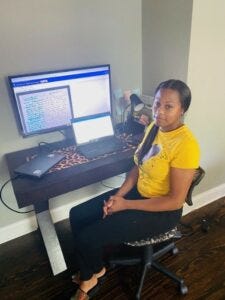
In the spring of 2020, Library of Congress staff members left our Capitol Hill campus to isolate at home due to COVID-19 safety protocols. For many of us, this transition to telework was a fairly easy process. Once we worked out the kinks of remote connections and video conference etiquette, we could resume our normal day-to-day operations with just a few hiccups here and there. But for many others—those staffers whose work requires in-person access to collection materials—telework presented a huge challenge. How could these colleagues contribute to our mission-critical activities with little or no access to physical collections?

One of the many creative solutions to this problem was the establishment of VHP’s ongoing program of transcribing correspondence collections. Transcription is such a laborious process that up until recently, VHP has not had the time or resources to transcribe collection materials (whether they are manuscripts or oral histories). While VHP has a vast array of digitized letter collections in our archive, prior to the pandemic, very few of them featured transcripts.

Rare though they are, transcripts can be a lifesaver for researchers and those interested in reading correspondence collections, exponentially increasing the accessibility of the contents. Anyone who has squinted their eyes trying to decipher a vintage letter knows how hard it can be to interpret handwritten material. Our modern eyes are accustomed to reading typewritten or printed words, and not those written in cursive script. In the case of VHP materials, many of the letters in our archive were written under less-than-ideal conditions, often making them even harder to read. Servicemen and women would frequently compose their correspondence in foxholes and leaky tents, aboard trains and tempest-tossed ships—and their handwritten letters sometimes reflect these rough conditions. Add to it the inherent degradation of decades of wear and tear, and it’s a wonder that these letters are legible at all!

Screenshot of a transcribed letter from the Ewing Miller II collection, showing the original letter beside the transcript. Ewing Miller II Collection, Veterans History Project, AFC2001/001/102421.

That’s why VHP’s pandemic transcription efforts have been so valuable. Over the last two years, staff members working from home have transcribed over 5,000 letters in over 50 different VHP collections. Many of these collections included hundreds of letters—the Andrew Del Regno Collection almost 600! We chose nine of these collections to include in Line by Line, to offer readers a taste of what transcribed collections have to offer.

On each veteran’s digitized collection page, the transcripts are situated alongside the original letters; readers can view the original letter while simultaneously reading through the transcript. This mode of presentation maintains the integrity and distinctiveness of the original letter without demanding that the viewer stumble through deciphering each and every word. Having access to these side-by-side transcripts means that readers can focus on the contents of the letter rather than on interpreting the quirks of a veteran’s handwriting.

And the content of these letter collections is riveting: by turns poignant and heart-wrenching, humorous and eye-opening. You might chuckle over Edward Zahler’s jocular exchanges with his sister, and glimpse his anxiety over the fate of his kid brother, Donald, who was also serving. Perhaps you’ll be drawn to John Carson’s dry wit, evident throughout his missives to his parents. Or you can take a look at Henry Walker McIver’s letters, which all begin with a detailed, evocative pen-and-ink sketch illustrating his text.

“Letter to Folks [March 10, 1944].” Henry Walker McIver Collection, Veterans History Project, Library of Congress, AFC2001/001/67942.

All of these letter collections illustrate the power of personal correspondence as a primary historical resource. Though they originally functioned as a means of reassuring loved ones and providing the writer with a momentary escape from the desolation of wartime conditions, these letters now personalize and contextualize larger historical events. You may think of D-Day a bit differently after reading Ellsworth Hill’s account of it in a letter to his family.

We hope you enjoy browsing through the featured collections, line by line. Many thanks to Tamika Brown, Yvonne Brown, Glenn Ferrara, Rachel Frederick, Jordan Kearschner, Laura Kells, Helen McNamara, Candace Milburn, Sarah Mitrani and Justina Moloney for all of their hard work in making these letter collections more accessible.

For more blog posts detailing VHP staff activities during the pandemic, see our blog series Working Together Apart, with posts authored by Tamika Brown, Yvonne Brown, Tracey Dodson, Andrew Huber, Candace Milburn, and Justina Moloney.