
May News Blast2022

May News Blast2022

May News Blast2022

OHA Member Site | OHA Website

In this issue…

2022 Call for Posters

Scholarships to the Annual Meeting

OHA Awards

Assessing the Role of race and Power in Oral History Theory and Practice, a (virtual) Symposium

Town Hall on OHA Culture of Service

RFP/SOW for an Accessibility Guide and Goals Consultant

Call for Posters

The OHA invites you to apply to exhibit a research poster related to your oral history project at our 2022 annual meeting in Los Angeles. As part of the program, we will host a Poster Session on Saturday, October 22, 10:00 a.m. We invite your proposal to display a research poster as part of that session. Posters can be related to any oral history projects. We welcome posters related to human stories in all their diversity, but especially those exploring this year’s theme, “Walking Through the Fire: Human Perseverance in Times of Turmoil.”

The application deadline is July 15.

Start your application here: https://www.oralhistory.org/call-for-posters/

Scholarships to the Annual Meeting

The Oral History Association’s annual scholarship program assists students, professionals, and community practitioners, etc. with travel funds so they may attend the annual meeting. Each year, OHA offers more than $10,000 in scholarship funds.

The application deadline is June 20.

To apply see our website: https://www.oralhistory.org/annual-meeting-scholarships/

OHA Awards:

OHA’s award season is here! The deadline for all nominations is July 1.

Annual Awards:

Article Award

Mason Muli-Media Awards

Book Award

Stetson Kennedy Vox Populi (“Voice of the People”) Annual Award

Biennial Awards:

Postsecondary Teaching Award (in even numbered years, 2018, 2020, etc.)

Find out more information here:https://www.oralhistory.org/award/

Assessing the Role of race and Power in Oral History Theory and Practice, a (virtual) Symposium

June 27-28, 2022

Oral historians from around the world will gather virtually for three days of discussion about the role of race and power in oral history theory and practice. Organized as a symposium, discussions will be based on pre-circulated papers posted on the conference website and made available to all registrants. Presentations based on these papers, as well as discussants’ comments, will be brief, allowing ample time for discussion and small, break-out group conversations. Each of the three days will include only two, well-spaced two-and-one-half-hour sessions, giving attendees the opportunity for focused attention in the context of their everyday lives.

Don’t forget to register soon! Find the program and registration information here: https://www.oralhistory.org/race-and-power-symposium/.

Town Hall on OHA Culture of Service

As our the OHA continues to work to be more inclusive and equitable, one important conversation we have been having is about our culture of service – like all professional associations, OHA relies almost entirely on volunteer labor.

We thought it might be helpful to provide a space for those who give their time to OHA to reflect on questions like these:

How did you get involved in OHA service?

What makes service possible?

What makes service meaningful?

What makes service rewarding?

What are the barriers to serving?

We will convene on May 24 to discuss these questions from 12-1:30 ET.

Register here: https://zoom.us/meeting/register/tJ0oduivqj8sH9Bf0Ij7Wv3yynCKWFNnIQLa

RFP/SOW for an Accessibility Guide and Goals Consultant

The Oral History Association’s (OHA) Diversity Committee seeks a consultant to help the Committee create an initial “Accessibility Guide and Goals” of accessibility considerations for in-person and virtual events affiliated with the OHA. These events may range from routine meetings to public webinars and conferences. The “Guide and Goals” will be a resource for event organizers—some with little or no experience with accessibility supports—looking for guidance about or a way to ensure that they have considered and addressed a range of accessibility needs. It will include nuts-and-bolts items (such as ramps and not just stairs into the physical space) as well as those that provoke deep consideration but may not have definite answers (such as the time at which the event will take place).

Individuals and organizations/companies are invited to submit proposals for the work, due by 5:00pm EST on Friday, June 3, 2022.

Find the full RFP here: https://docs.google.com/document/d/1xxJ2sGdyka7Spv8yvExUlD7xUXgHMDJ7-OkNXS3xroc/edit?usp=sharing
HAPPY 4TH OF JULY

HAPPY 4TH OF JULY

Do you read Heather Cox Richardson’s blog, Letters from an American? It’s brilliant, but her piece on the 4th of July is one of her most stirring.

Open in browser

July 3, 2022

Heather Cox RichardsonJul 4

And on July 4, 1776, the Second Continental Congress adopted the Declaration of Independence, declaring: “We hold these truths to be self-evident, that all men are created equal, that they are endowed by their Creator with certain unalienable rights, that among these are Life, Liberty and the Pursuit of Happiness.”

For all the fact that the congressmen got around the sticky little problem of Black and Indigenous slavery by defining “men” as “white men,” and for all that it never crossed their minds that women might also have rights, the Declaration of Independence was an astonishingly radical document. In a world that had been dominated by a small class of rich men for so long that most people simply accepted that they should be forever tied to their status at birth, a group of upstart legislators on the edges of a continent declared that no man was born better than any other.

America was founded on the radical idea that all men are created equal.

What the founders declared self-evident was not so clear eighty-seven years later, when southern white men went to war to reshape America into a nation in which African Americans, Indigenous Americans, Chinese, and Irish were locked into a lower status than whites. In that era, equality had become a “proposition,” rather than “self-evident.”

“Four score and seven years ago,” Abraham Lincoln reminded Americans, “our fathers brought forth on this continent, a new nation, conceived in Liberty, and dedicated to the proposition that all men are created equal.” In 1863, Lincoln explained, the Civil War was “testing whether that nation, or any nation so conceived and so dedicated, can long endure.”

It did, of course. The Confederate rebellion failed. The United States endured, and Americans began to expand the idea that all men are created equal to include Black men, men of color, and eventually to include women.

But just as in the 1850s, we are now, once again, facing a rebellion against our founding principle, as a few people seek to reshape America into a nation in which certain people are better than others.

The men who signed the Declaration of Independence on July 4, 1776, pledged their “Lives, [their] Fortunes and [their] sacred Honor” to defend the idea of human equality. Ever since then, Americans have sacrificed their own fortunes, honor, and even their lives, for that principle. Lincoln reminded Civil War Americans of those sacrifices when he urged the people of his era to “take increased devotion to that cause for which they gave the last full measure of devotion—that we here highly resolve that these dead shall not have died in vain—that this nation, under God, shall have a new birth of freedom—and that government of the people, by the people, for the people, shall not perish from the earth.”

Words to live by in 2022.

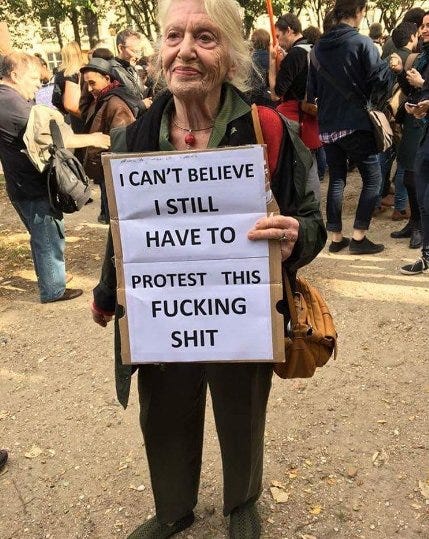
I was born in the 1950s and I’m one of these white-haired ladies. It’s important to remember, too, that those early founders largely represented slave-holding interests. We are being misled again by some with power and wealth.

I was ten years into starting my own business when The Apprentice first launched, and I was thrilled at the opportunity to learn from a successful businessman. I read the book, and my office staff and I even bet on who would be fired this week! It can be hard to see a huckster for what he is. But that seems to be a big part of our job as citizens in a country created by this radical declaration.

It can be discouraging to keep fighting for what seems so simple and clear. I think we need to get back to basics. You know another document stated it even more simply, “Love they neighbor as theyself.”

A respondent to Heather Cox Richardson’s post cited this note from Dan Rather.

“What we should celebrate on the Fourth is less what happened on that day in 1776 and more what followed. Our Founding Fathers, deeply flawed though many of them were, set in motion a revolution in thought that far exceeded their imaginations. The principles they defined, once documented in writing, ceased to be theirs to own and shape. That people like Frederick Douglass, and Dr. Martin Luther King Jr. a century later, should seek to narrow the chasm between our aspiration and our reality is as much a part of July 4 as faded words on parchment.

And that could be a guide for us today. We, as individuals and as a people, can choose not to let those who will divide us define this day. We can choose not to let those who seek to disassemble our progress determine our path forward; not to allow the forces of intolerance, autocracy, and lawlessness to claim our star-spangled banner.”

Dan Rather

SOME Q&A TIPS FROM THE CHICAGO MANUAL OF STYLE

SOME Q&A TIPS FROM THE CHICAGO MANUAL OF STYLE

Q. Should there be a comma after “also” when it begins a sentence?

CMOS Answers: Yes, an introductory “also” would normally be followed by a comma. The relevant rule is the one that applies to an introductory adverb like the word yes in the previous sentence (see CMOS 6.34). Note, however, that after an introductory adverbial phrase rather than a single word, the comma can often be omitted, particularly if the phrase is short (see CMOS 6.31). So,

Thanks for reading Capturing Voices! Subscribe for free to receive new posts and support my work.

As of late 1999 our Y2K fears still seemed warranted.

but

Also, many of us were new to computers back then.

Q. Hi. I’m working on a label for an image in a printed brochure. The entire label is “bison shoulder blade hoe.” How would you punctuate that—with an en dash (“bison–shoulder blade hoe”)? Or hyphens (“bison-shoulder-blade hoe” or “bison shoulder-blade hoe”)? I was thinking that technically an en dash would be correct according to CMOS 6.80, but that seems too formal and, as CMOS states, unlikely to be noticed by most. There is no room to reword it. Thank you!

Q. Regarding open compounds, would an en dash be correct in “Mr. Potato Head–like head” and “rubbing alcohol–soaked cotton”? Thank you!

CMOS Answers: See CMOS 7.85: “With the exception of proper nouns (such as United States) and compounds formed by an adverb ending in ly plus an adjective (see 7.86), it is never incorrect to hyphenate adjectival compounds before a noun.” The goal of adding such hyphens is to clarify the meaning of the text.

To start with the bison, that example refers to a hoe fashioned from a bison’s shoulder blade. The three relevant terms are bison, shoulder blade, and hoe, so the clearest version is the last: “bison shoulder-blade hoe.”

We agree that an en dash wouldn’t work all that well; in “bison–shoulder blade hoe,” readers would need to recognize “shoulder blade” as a distinct compound before “hoe.” You’d be better off leaving the words open (“bison shoulder blade hoe”), trusting readers to sort out the modifiers without the help of hyphens or dashes. Or you could use two hyphens (“bison-shoulder-blade hoe”), but that doesn’t single out “shoulder blade” either, so the uncluttered open version is better.

As for the second question, it would be hard to improve on “Mr. Potato Head–like head,” where the en dash provides a perfect illustration of the principles covered in CMOS 6.80. And though the en dash is technically correct also in “rubbing alcohol–soaked cotton,” we’d advise rephrasing: “cotton soaked in rubbing alcohol.” Readers then won’t have to mentally sort out the string of modifiers to identify “rubbing alcohol,” a compound that, like “shoulder blade” in the bison example, lacks Mr. Potato Head’s prominent initial caps. Nor would “rubbing-alcohol soaked cotton” work; participles like “soaked” always require a hyphen in that position (see the hyphenation guide at CMOS 7.89, sec. 2, under “noun + participle”).

Q. With a compound subject, does the verb number change when the conjunction “and” is replaced by “and then”? For example: “Swimming in the ocean and then running a marathon require/requires great endurance.” I’m told CMOS 5.138 applies and the verb should be plural (“require”). But it seems to me “and then” has combined the two actions into a sequence (as one) which would take the singular “requires.”

CMOS Answers: Two subjects joined by and can sometimes be considered singular. The test is whether the subjects express a single idea or more than one. In your example, what requires endurance is the combined action of swimming in the ocean and running a marathon—a continuous feat of athletic activity. The adverb “then” makes this clear.

But adding “then” won’t always make a plural compound subject singular. Consider the following sentence, in which the subjects clearly take a plural verb: “A bandage and then an ice pack were placed on the wound.” On the other hand, you can write a sentence with a compound-but-singular subject without the help of “then.” For example, “Peanut butter and jelly is the best thing to happen to sandwiches since sliced bread.”

So it’s best to consider such sentences on a case-by-case basis.

The Chicago Manual of Style 17th edition text © 2017 by The University of Chicago. The Chicago Manual of Style 16th edition text © 2010 by The University of Chicago. The Chicago Manual of Style Online © 2006, 2007, 2010, 2017 by The University of Chicago. The Chicago Manual of Style is a registered trademark of The University of Chicago.

Thanks for reading Capturing Voices! Subscribe for free to receive new posts and support my work.

Write How You Write, Not How You Speak

Write How You Write, Not How You Speak

Daily Writing Tips, one of my favorite blogs, has some thoughtful observations about the difference between written language and spoken language. (You can find the blog at dailywritingtips.com.)

He’s talking here about phrases like “so to speak” and “In my opinion,” but the difference between the written and spoken words goes much deeper. A transcript is a “written record of someone’s comments, rather than the prepared script for a speech.”

Thanks for reading Capturing Voices! Subscribe for free to receive new posts and support my work.

“Readers expect your prose to be direct and dynamic,” and the spoken word is not. It’s riddled with “um”s and “uh”s, self interruptions, reactions to distractions, and lazy speech. You know can be a bid to buy more time or a request for reassurance that the listener is actively listening and understands your point.

There are a wealth of differences between the spoken word and the written word, and most people don’t give them a second thought. But that is precisely the focus of transcription. A transcript of the spoken word edited to the expectations of the written word would be unrecognizable.

Recently, I wrote about word patronage, the often-unnecessary inclusion of self-referential expressions as “as you will” and “so to speak” in one’s writing. This post expands on that one to recommend that you inspect your writing for anything that smacks of spoken English.

If you’ve ever seen a transcript of an extended discourse — a written record of someone’s comments, rather than the prepared script for a speech — you’ll understand how widely spoken and written English can diverge.

Spontaneous speech, at least, is riddled with qualifications and equivocations. It’s easy enough to dispose of “um”s and “uh”s, “well”s and “you know”s when converting a transcript to an essay, but writers should purge their prose of other utterances, words, and phrases as well that add a lot to a word count but little to a description or an argument. (See this post, for instance, for a list of adjectival intensifiers and their adverbial forms to avoid.)

In addition, omit hedging phrases such as “as I see it,” “from my point of view,” “in my opinion,” and “it seems to me.” Search and destroy such pompous filler as “be that as it may” or “other things being equal.” These are all understandable (though not necessarily forgivable) indulgences in spoken English, whether impromptu or rehearsed — at best, they’re nearly meaningless phrases one tosses off while thinking of what to say next, and at worst, they clutter a speech, distracting and discouraging listeners. But readers expect your prose to be direct and dynamic, and there’s no place for such self-gratification in written form.

Thanks for reading Capturing Voices! Subscribe for free to receive new posts and support my work.

Dummy Subjects

Dummy Subjects

Maeve Maddox at Daily Writing Tips talks about “Dummy Subjects” in her blog today. Her discussion is intriguing. I wasn’t very familiar with the expletive used in this way or with the idea of Dummy Subjects.

This bit from her blog enticed me to do some more research. So I’m going to investigate dummy subjects for my next several posts. As always, I’ll be exploring how the idea of Dummy Subjects can aid us in Capturing Voices.

Thanks for reading Capturing Voices! We investigate capturing the spoken word to preserve primary sources and improve understanding of personal histories. Subscribe for free to receive new posts and support my work.

Common terms used in teaching the expletive use of it and there are “dummy it, ” “dummy there,” and “dummy subject.”

expletive: Of a word or phrase: serving merely to fill out a sentence or a metrical line without adding anything to the sense.

Dummy
A derivative of dumb (“unable to speak), dummy boasts twenty-one shades of meaning in its OED entry. There’s even a verb, to dummy up: “to render silent.”

Merriam-Webster arranges its definitions of dummy under five headings, one of which is “an imitation, copy, or likeness of something used as a substitute.” This is the word’s meaning in the general terms “newspaper dummy,” “ventriloquist’s dummy,” crash-test dummy,” and “dummy corporation.” All stand in for or act as a substitute for something else. The usage is clear.

When it comes to the grammatical terms—“dummy it,” “dummy there,” and “dummy subject”—connotation enters the picture.

Words exert power.

Some words exert so much power that they must not be spoken or written.

For the orthodox Jew, the word God is so fraught with divine power that it is written as G-d. In speech, a different word altogether—Hashem (“Name”)—is used.

An English word that centuries of contemptuous use have imbued with toxic power is now referred to as “the n-word.”

A word that seems innocuous or even pleasant to one speaker may stir feelings of discomfort in another. For example, an insect name that had always sounded romantic to me—the “gypsy moth”—has been officially changed by the Entomological Society of America. The change was prompted by the fact that—for Romani people—the word gypsy has distressing connotations.

In Anglo-Saxon times, our linguistic ancestors used the adjective dumb only to mean “speechless” or “unable to speak.” The word dummy was coined to refer to people so afflicted. It didn’t take long for the noun to acquire the meaning, “stupid person.”

It can be argued that the dummy in “dummy subject” is so totally removed from use of dummy as an accusation of stupidity as to be irrelevant. But, although words can be conveniently categorized in a dictionary, connotations often overlap in use.

Take the British word for a baby’s pacifier, for example. In the UK, crying babies are given a “dummy.” In this context, the word dummy is a substitute nipple, but it is also a means of obtaining silence from the baby.

The word dummy used to label a grammatical construction implies that there is something wrong, if not stupid, about the usage. Here are some sentences that might be said to contain a “dummy subject.”

There’s a unicorn in the garden.
There will be a time to sleep, but not now.
It’s raining, it’s pouring, the old man is snoring.
It’s too late to apologize.

So what exactly is a dummy subject? And how does it figure in writing and speech? The Editor’s Manual explains:

What is a dummy subject?

A dummy subject conveys no meaning of its own but simply fills the position of subject in a sentence. The subject is whom or what a sentence is about. It usually precedes the verb.

EXAMPLES

Maya wants to travel the world.

We don’t know where Poco is.

The book you were looking for is on the bookshelf.

A sentence must have a subject. When one isn’t available, the pronouns it and there fill this position.

EXAMPLES

It is raining today. Not “is raining today.”

There is no way Farley can win this match. Not “Is no way Farley can win this match.”

Note how dummy subjects don’t refer to anything specific. Compare this with it being used as a pronoun in place of a specific noun.

EXAMPLE

Look at this wooden table. It is three hundred years old. In this sentence, it refers to something specific: a wooden table. Therefore, the word isn’t being used as a dummy subject.

TIP

The dummy subject is variously called a fake, artificial, or empty subject.

‘Got a screwdriver?’ … ‘I do.’

‘Got a screwdriver?’ … ‘I do.’

Florencia, our QA expert, shared this note with our staff. The idea that when you shorten a phrase, it’s called an “elliptical” reply caught my eye.

Grammarphobia says: “Both of those are elliptical [emphais mine] replies, in which the verb is stranded at the end. They might be expanded as “Yes, I have [or have got] a screwdriver” and “Yes, I do have a screwdriver.”

Thanks for reading Capturing Voices! Subscribe for free to receive new posts and support my work.

Transcriptionists and clients often ask about the use of the ellipsis (. . . ) instead of an em dash (—).

An ellipsis indicates that words have been purposely left out of a quote. So, you might say the Constitution of the US says that “We hold these truths to be self-evident, that all men are created equal . . . ” The rest of the sentence is not included intentionally. 

These two replies leave out some words intentionally, for brevity, or idiomatically. 

An em-dash indicates an abrupt break in a sentence: “You know, the Constitution says . . . all men are created equal—I’m sorry, what did you just say?”

An em-dash indicates an interruption. In this case, the speaker is interrupting themselves.

This explanation of the idiomatic use of the helper verb have at the end of the sentence is enlightening!

Q: If I ask a question like “Have you got a screwdriver?” and someone answers, “I do,” it sets my teeth on edge. I extrapolate that to mean “I do got.” Is that answer incorrect, or is it just me?

A: The use of “I do” in reply to “have you got” is a normal and correct construction in English. There is no “rule” against this common usage.

What’s thrown you off is the idiomatic verb construction “have got.” Both the Oxford English Dictionary and The Cambridge Grammar of the English Language say “have got” here means “have” (in the sense of own or possess). Oxford calls it a “specialized” usage while the Cambridge Grammar calls it an informal idiom.

So in the type of question you mention, “have got” and “have” are interchangeable. And whether it’s worded “Have you got a screwdriver?” or “Do you have a screwdriver?” the question has several grammatically correct replies, including (1) “Yes I have” and (2) “Yes I do.”

Both of those are elliptical replies, in which the verb is stranded at the end. They might be expanded as “Yes I have [or have got] a screwdriver” and “Yes I do have a screwdriver.”

So as you can see, the “do” in reply #2 is elliptical for “do have,” not “do got.” As the Cambridge Grammar explains, the “got” in the idiomatic “have got” cannot be stranded at the end of a sentence. This means that in an elliptical construction with a verb at the end, an auxiliary like “have” or “do” is used.

Keep in mind that “have you got” is an idiom to begin with, so it’s not unexpected that the common reply—“Yes I do,” or “No I don’t”—should be idiomatic too.

Fowler’s Modern English Usage (4th ed.) says that in answer to a “have you got” question, the “do” reply is a familiar feature of both British and American English. Fowler’s, edited by Jeremy Butterfield, offers this analysis:

“Question: Have you got a spare room? Answer: Yes, we do. This apparently illogical use of do, replacing have as the auxiliary verb, arises because the question implicitly being answered is ‘Do you have a spare room?’ It is a common pattern in AmE and causes less surprise to British visitors than formerly, since it has also become a feature of BrE.”

In ordinary usage, rather than in the idiom, “have got” is the present perfect tense of the verb “get,” with “have” as the auxiliary (as in “I have got infected”). But in the idiom we’re discussing, the OED says, “have got” functions as the present-tense equivalent of “have.”

And “have” in the idiomatic “have got” is the main verb (not an auxiliary). So both grammatically and semantically, “I have got” = “I have.” In fact, the question  “Have you got a screwdriver?” could be rephrased more formally as “Have you a screwdriver?”

(We might add that many speakers find a sentence like “Have you a screwdriver?” to be excessively formal. Americans in particular seem to prefer questions phrased with “do” when there’s a direct object: “Do you have a screwdriver?”)

You might wonder why English speakers started using the idiomatic “have got” in the first place. After all, the simple “have” performed that function for hundreds of years, and still does.

As we said in a 2014 post, there are two theories about the likely origins of this usage, which date back to Elizabethan times.

One is that the verb “have” began losing its sense of possession because of its increasing use as an auxiliary. Thus “got” was added as an informal prop.

The other theory is that “got” was originally inserted because of the tendency to use contracted forms of the verb “have.” So if a sentence like “I’ve a cat” felt unnatural or abrupt, one could use “I’ve got a cat” instead.

We should mention another familiar idiomatic use of “have got”—the one that means “must.” Here too, the “got” is not essential to the meaning. “I have got to leave” = “I have to leave” = “I must leave.”

And again, a “do” reply to this variety of “have got” question is perfectly acceptable: “Have you got to leave?” … “I do.”

The “have got” that indicates obligation or necessity is followed by a “to” infinitive, like “to leave.” (The other “have got” idiom, the one indicating possession, is followed by a direct object, like “a screwdriver.”) We wrote about this usage in 2010.

Thanks for reading Capturing Voices! Subscribe for free to receive new posts and support my work.